


“Society will develop a new kind of servitude which covers the surface of society with a network of complicated rules, through which the most original minds and the most energetic characters cannot penetrate.” – Alexis de Tocqueville
Hello everyone! I hope you’re all doing well. Halfway through October already… 🍂
IN THIS NEWSLETTER
GRAB BAG ISSUE: Agentic payments, stablecoins and the price of intermediation
commentary on pieces by Jordi Visser, Citrini Research and David Marcus
Markets: about turn?
Crypto is Macro Now offers ~daily commentary and updates on crypto’s evolving role in the changing geopolitical and financial landscapes. Plus links and more.
If you’re a premium subscriber, thank you so much!! ❤
PUBLISHED IN PARTNERSHIP WITH: ✨ ALLIUM ✨
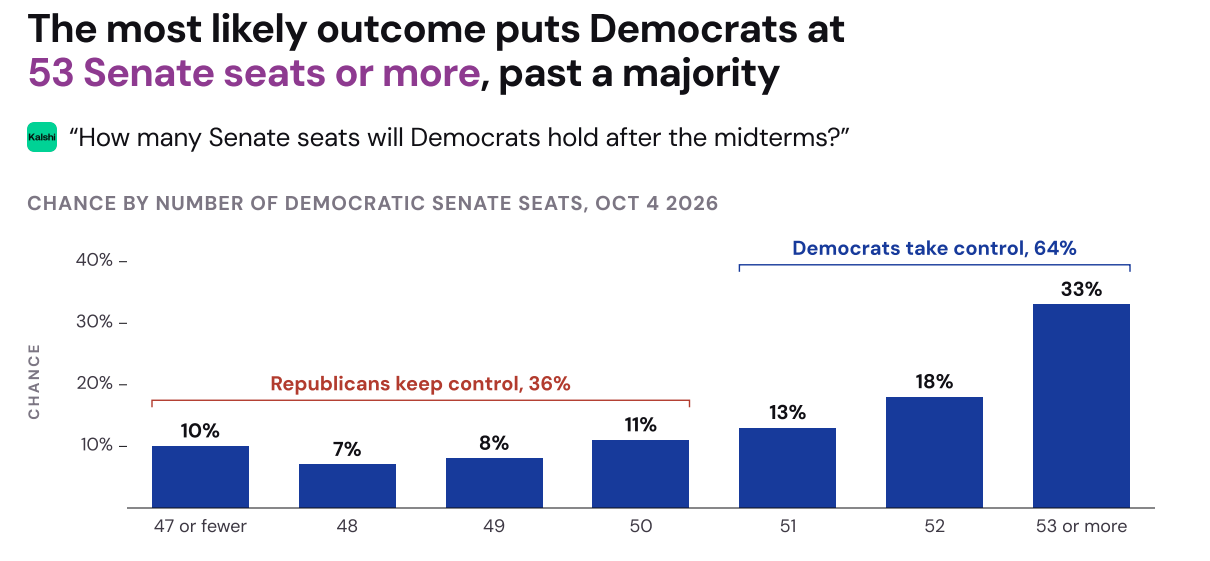
Most of the move in prediction market odds for a Democrat win in the Senate midterms came in two weeks: the week after US crude topped $90/bbl following strikes on Iran, and the week to Sept 17, when Democrats took the lead.
Full report: Prediction markets and a live read on the US midterms
Get weekly onchain data and analysis from the Allium Research team on Substack.

WHAT I’M WATCHING

GRAB BAG ISSUE
For new readers (hello!), every now and then I offer a brief summary of and commentary on some recent articles that caught my attention. I call this my “grab bag” section as sometimes there’s a common theme but usually not – they do, however, all touch on the macro/crypto intersection I focus on.
I also have a stack of interesting papers I want to synthesize for you, but that will have to wait until next week.
AI Slop, Bitcoin, and the Price of Intelligence – by Jordi Visser
In this loosely structured but insightful piece, Jordi Visser highlights the impact of AI on the price of work and knowledge and contrasts it with that of Bitcoin.
He wonders why we’re upset about AI slop, as humans have been generating mediocre work and other time-wasters online for decades – only, more slowly and sometimes with credentials attached.
One reason is perhaps that now there is so much of it. AI changed slop economics, and in so doing, enabled price discovery on cognitive work. Now, something that looks like it took four hours, took four minutes. This impacts not only the economics of knowledge work; it also alters the psychology.
In the pre-AI era, a polished report signalled work, and work implied at least some value and expertise. Now, AI strips away that signal; when work is cheap, the value comes down to the idea behind it.
Value also accrues to expertise, the ability to distinguish between ideas, to curate or intermediate those that are worthwhile.
In sum, value is inferred and subjective, derived from intangible contributions rather than tangible output.
Bitcoin inverts this: work is verifiable, determined by compute. No subjectivity. Bitcoin enforces scarcity, while AI eliminates it.
But both change the economics behind intermediation.
Bitcoin allows users to transfer value directly and to self-manage related services such as custody. Intermediation is optional, which means the intermediary has to compete. The user pays an explicit price for the service. If the user chooses to use one, it’s because the price paid is compensated with convenience, security, whatever. It’s explicit, unlike in the traditional system where the bulk of intermediation prices are implicit, bundled, hidden.
The same with AI content. Output is abundant, minimal implicit cost. The value is in the intermediation of the ideas – users can consume vats of slop if they wish, or they can pay an explicit price for expertise.
This ends up translating into a price on trust. Reliable services, accumulated knowledge, an earned reputation – these are now for sale in a cleaner marketplace than under the old “bundled” system.
Breaking The Wall: Has Blockchain Finally Reached Its Moment? - by Citrini Research
I don’t have a paid subscription to Citrini Research (beyond my budget, sadly), but they are quite generous with what they offer above the paywall.
This post focuses on the utility of onchain securities. Regular readers will know that I’m sceptical of the hype around tokenized stocks as old formats on new rails doesn’t feel particularly innovative.
Here, the Citrini team pulls on the same thread but wraps it around the spread of AI agents.
The promise of blockchain was never decentralization, they argue – it was always onchain programmability, and the blockchain industry has been preparing for agentic finance from day 1: 24/7, easy connectivity, control embedded in code. Now, assets investors actually want to own are moving onto these new rails, ready to interact with AI agents.
Traditional finance is not suitable for AI agents. Crypto finance is.
It’s a compelling point – at its root, not a new one as if feels like we have been talking about crypto as a solution for agentic payments for ages. But the Citrini team pull the argument into traditional finance, and imbue tokenized assets with a new type of utility.
I have some quibbles, though. The post characterizes crypto as an “industry that has enabled so much capital destruction, that most “serious” investors have written off” – which says more about misplaced expectations on new technology than on the industry itself. The railroad bubble. The internet bubble. Those who swore these technologies would transform, well, everything felt embarrassed… until they were proved right, in time. There is no evidence at all that most “serious” investors have written off digital assets – underperformance is a sign that other assets are more appealing at this point in time, not the same thing.
I was also struck by the tone of triumph in pointing out that the crypto ecosystem today resembles tradfi, as if that was a vindication of some sort. It’s positive that more people realize the industry is not just about get-rich-quick schemes – but that was always a lazy conclusion anyway, fed by media headlines and easily dispelled by maybe 5 minutes of investigation.
The overall implication is that crypto and tradfi have “discovered” each other, giving us the desired happy ending to this coming-of-age movie. Satisfying, but limiting – only, here comes the sequel in which agentic finance sweeps in to disrupt the happy relationship and take crypto rails for itself.
This part of the story, I can get more excited about as we’re looking at new plot lines and unconventional protagonists. Here’s where we could start to see real transformation, not so much old stuff in new wrappers, but entirely new functionality.
The Death of the Interface – by David Marcus
LINK (X post)
At first glance, this may look like a post about UX, but really it’s about money. To be more specific, it’s about how money moves – or rather, who gives the order for it to do so.
And it contains the following subtitle, provocative and buried about halfway down: Stablecoins aren’t a thing anymore.
Taking a step back, our interaction with digital payments has been mainly via screen interfaces – we activate an app, we click on a button, and a lot of thought has gone into designing that app and refining that button so we click more often.
But in a world of agentic payments, we won’t need interfaces. No apps to open, no buttons to click. We tell agents what we want, in our language rather than that of UX, and it gets handled in the background.
Granted, the background is complicated, the “eat glass” layer of licenses, APIs, identification, liquidity and such. Fortunes will be made by the businesses that come to dominate that sub-world that we never see – the new “operating system”. But because we never see it, no interface is needed.
Stablecoins are likely to form part of that agentic sub-world (“underworld” has sinister connotations, perhaps appropriate but too soon to tell) – but as a facilitator, not as a thing unto themselves. The term is a convenient wrapper for a specific form of token. But the wrapper matters much less than the actions to which it is subjected. Put differently, we won’t care what powers the agentic transaction, as long as stuff gets done.
David has a good term for this: “headless money”. No front-end, just a simple API that agents can use when they need to move value.
And while this may seem like a long way off, David suggests that agentic finance has been slow to spread because it has been trying to accommodate the traditional money stack which introduces a lot of friction.
I’ve often made the argument that we’ll know blockchain has gone mainstream when we stop talking about it, when we get enhanced efficiency without needing to know what powers it. David’s argument adds a twist – when we stop talking about stablecoins, it won’t necessarily be because everyone is using them. It will be because our understanding of “money” won’t depend on form, but rather on function.
