


“The leader of the past was a person who knew how to tell. The leader of the future will be a person who knows how to ask.” – Peter Drucker
Hello, everyone, and welcome to November! I’m relieved Halloween is over and so I truly don’t mean to scare anyone 😰, but there are only seven more weeks until Christmas… 🌲
IN THIS NEWSLETTER
Coming up this week: elections, US jobs, big conferences
Binance: the resilience and the aftermath
Crypto is Macro Now offers ~daily commentary and updates on crypto’s evolving role in the changing geopolitical and financial landscapes. Plus links and more.
If you’re a premium subscriber, thank you!! ❤
PUBLISHED IN PARTNERSHIP WITH: ✨ ALLIUM ✨
While the circulating supply of stablecoins from Tether and Circle dropped by $4 billion in the first 9m of 2026, overall supply increased by $1.2 billion (0.4%) and the number of issuers with more than $1 billion outstanding climbed to 15, up from 11 in 2025.
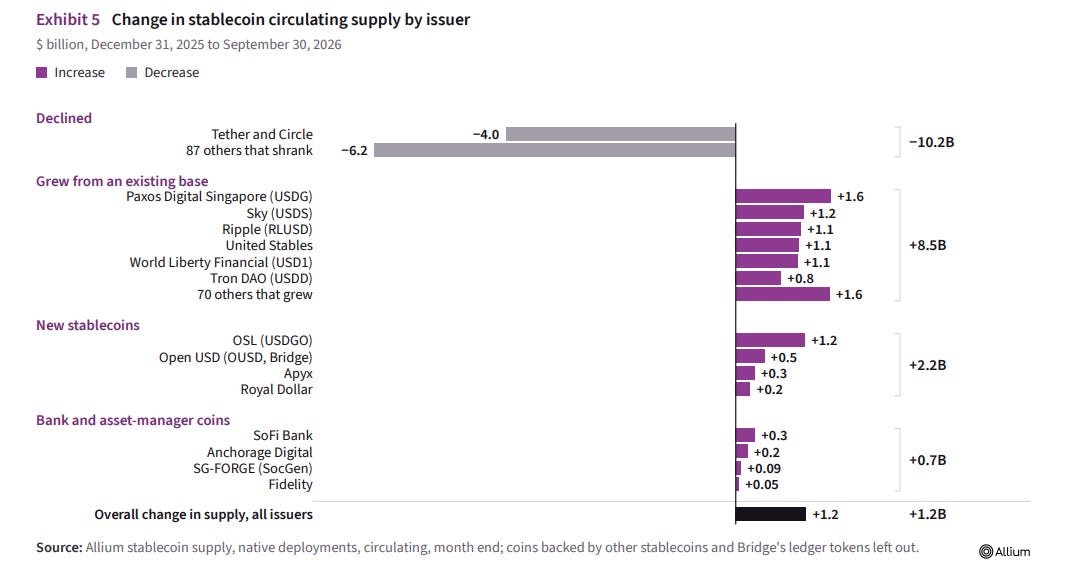
Download Allium’s State of Stablecoins and Payments Q3 2026.
And get weekly onchain data and more analysis like this from the Allium Research team on Substack.

WHAT I’M WATCHING

Coming up this week:
A packed week ahead, what with the US midterm elections, and lots of data on the US jobs market.
Today, we get US Purchasing Managers Index (PMI) October data for the manufacturing industry, expected to show consistent expansion.
And the Global Financial Leaders’ Investment Summit kicks off, hosted by the Hong Kong Monetary Authority (HKMA) and due to run until Wednesday. A who’s-who of financial heavy hitters from around the world will be speaking: China’s Vice Premier He Lifeng; HKMA CEO Eddie Yue; the Deputy Governor of the PBOC Zou Lan; Founder/CEO of Kimi Zhilin Yang; CEOs and chairs from Goldman Sachs, Morgan Stanley, UBS, State Street, BNP Paribas, Barclays, Citadel, HSBC, Societe Generale and others… and all that is just before the first morning’s break.
It’s also the start of Hong Kong Fintech Week, with a ton of high-level panels on stablecoins, tokenization, crypto market infrastructure, digital asset regulation and more.
On Tuesday, the US goes to the polls in its much-hyped and long-awaited midterms, which elects the House of Representatives, roughly a third of the Senate and 36 state governors. Turnout is expected to be high given the stakes and level of emotion. So far, early voting has set a record and is more than 10% higher than that seen before the 2022 midterms. I’ll write more about what to keep an eye on in tomorrow’s newsletter.
Also, the Bureau of Labor Statistics (BLS) delivers the US Job Openings and Labor Turnover Survey (JOLTS) for September, expected to show a slight uptick.
And Mumbai plays host to the Ethereum Foundation’s flagship developer conference Devcon 8, due to run until Friday. The buzz seems more muted around the event this year, which itself is interesting.
On Wednesday, the US Treasury announces its quarterly refunding plans – traders are eager to find out if there will be any change to the usual weightings or if we’ll see a notable shift towards more short-term issuance.
Also, we get the private sector ADP payrolls report, expected to show a slowdown in growth.
We get PMI reports on the US services sector, with forecasts pointing to a slight slowdown.
And the Eurozone reports on October CPI, with the headline rate forecast to accelerate to 4.0% and core expected to hold steady at 2.5%.
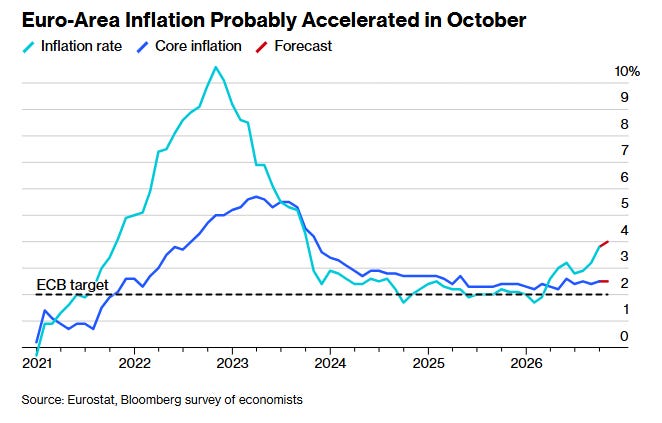
(chart via Bloomberg)
On Thursday, the Bank of England is expected to raise its key interest rate for the first time in more than three years.
Plus, we get US non-farm productivity data for Q3, forecast to show a notable acceleration.
On Friday, the Bureau of Labor Statistics publishes the US payrolls data for October, expected to increase by 65,000, more than double September’s increase of 29,000. The unemployment rate is forecast to hold steady at 4.2%.
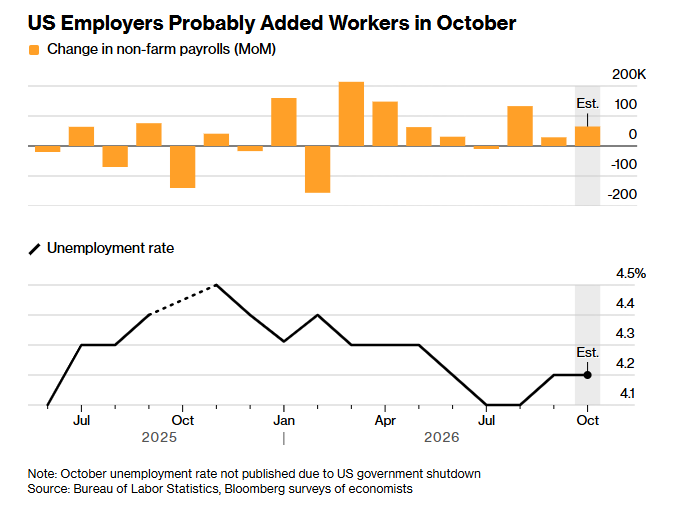
(chart via Bloomberg)
We also get the preliminary November report from the University of Michigan’s consumer survey.
Binance: the resilience and the aftermath
As the shock wears off, the impact of the largest crypto hack to date – a whopping $6.3 billion stolen from Binance last Thursday, more than 4x the previous record – is starting to come into focus.
I’m not just referring to the market impact, although that has been fascinating. There’s more at stake here than prices.
Let’s look at the market impact first: as I wrote on Friday, the resilience has been encouraging and, I have to say, a bit surprising. After all, even if you are not worried about the crypto market’s structural soundness, there’s all those stolen unfreezable tokens waiting to be sold for cash, right?
And yet, a few days later, the price of BTC continues to shrug off the media attention. As I wrote last week, when the news of the hack came out, BTC fell just over 3%, not a move that signals panic. Since then, it has gently drifted upwards.
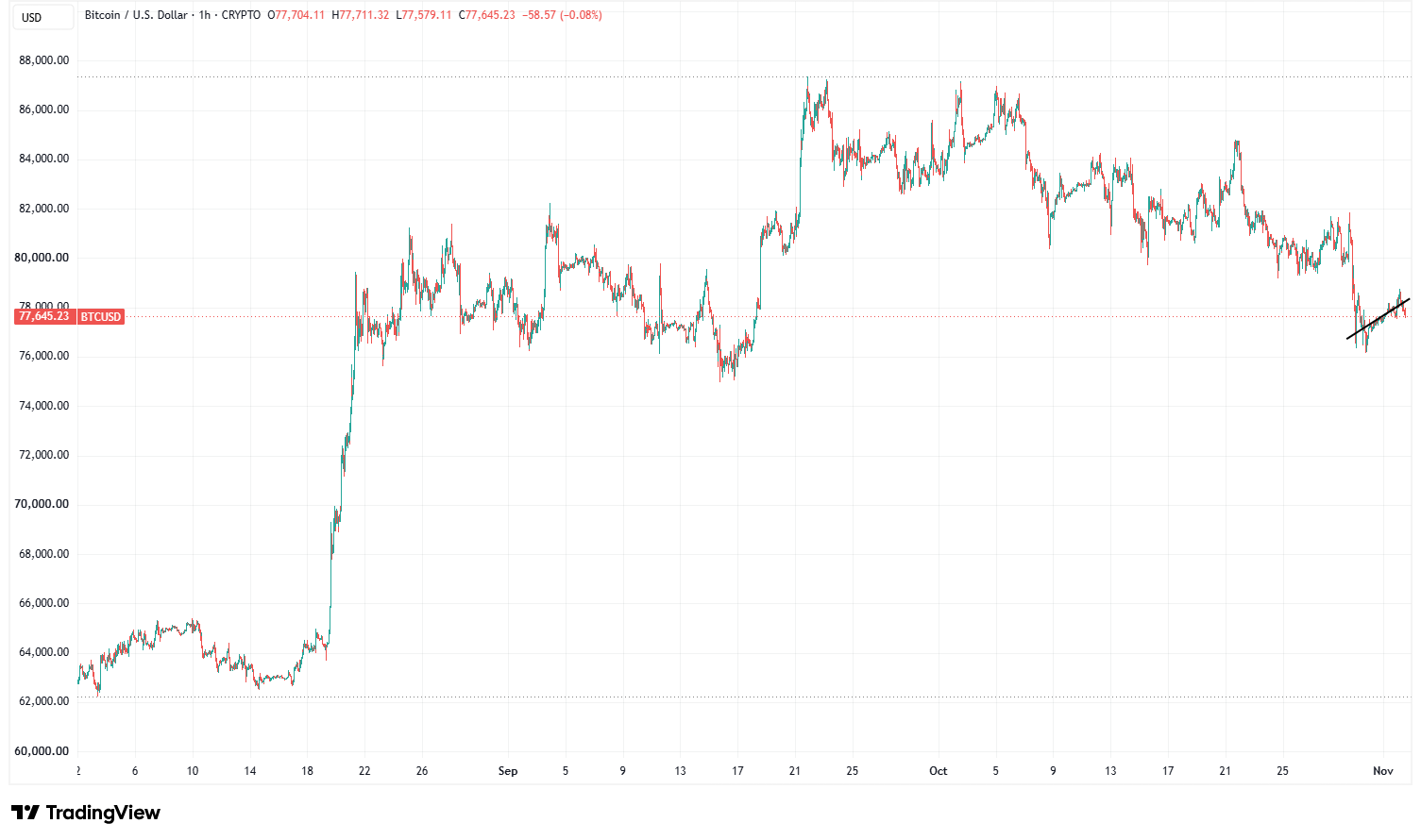
(chart via TradingView)
To those who would like to point out that a drop of 2.6% over the past week is not nothing, you’re right – but it’s also not unusual for a volatile asset such as BTC. I mean, gold dropped 2.3% over the same period.
