


“Progress is a comparative of which we have not settled the superlative.” – G. K. Chesterton ||
Hey everyone! I hope you’re all hanging in there… There is SO much going on in tokenization and stablecoins at the moment – big steps forward from both traditional institutions and crypto-native firms – but they regrettably are being pushed onto my backlog list as the world realignment accelerates. On the one hand, this is frustrating as these moves are signs of momentum and it’s important to understand what they say (and what they don’t) about market transformation.
On the other hand, the spreading global recognition of the rupture sets the stage for new types of connections, systems and even thinking.
If you thought last year was interesting, strap in.
PUBLISHED IN PARTNERSHIP WITH: ✨ ALLIUM ✨
As traditional finance and crypto converge, trusted data is the missing infrastructure layer. Allium provides this data foundation for teams like Visa, Stripe and Grayscale.
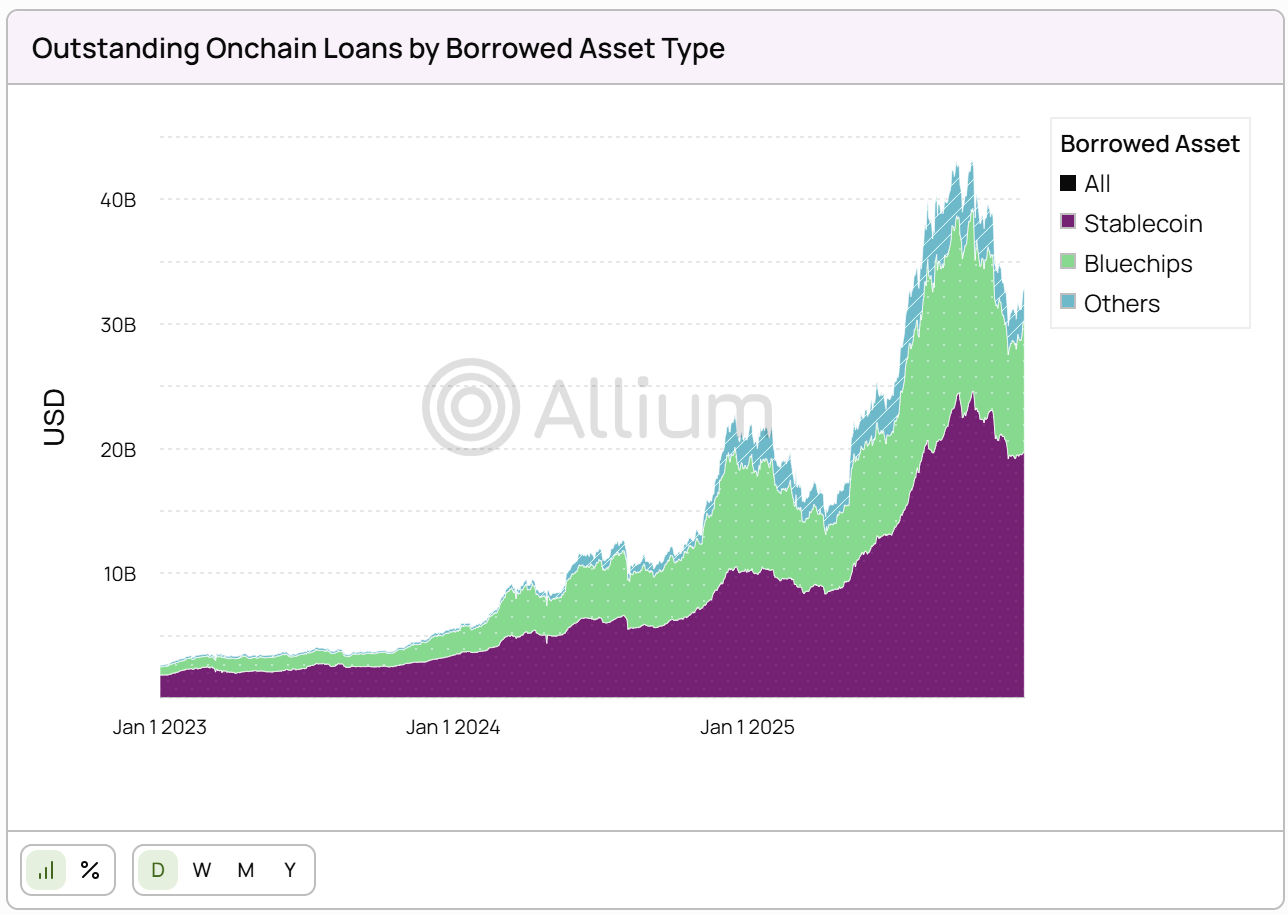
Our latest whitepaper published with Visa, Stablecoins Beyond Payments: The Onchain Lending Opportunity, examines how banks can access emerging credit markets. Looking at the data, outstanding onchain loans reached over $40Bn this year, with stablecoins making up more than half of borrowed assets.
If you’re producing institutional crypto research or analytics, start with trusted data. Explore a live demo.
IN THIS NEWSLETTER:
Davos: The circularity of recognition
What the Davos set is afraid of
Markets: be careful out there
Crypto is Macro Now offers ~daily commentary and updates on the overlap between the crypto and macro landscapes. Plus links, a music recommendation (‘cos why not?), and more.
If you’re a premium subscriber, thank you!! ❤
WHAT I’M WATCHING:

Davos: The circularity of recognition
I confess to not expecting Davos to be consequential this year other than to highlight the scramble for new power narratives now that climate change is no longer the most pressing elite concern. I expected to hear admonishments about the need to put surveillance into AI, pearl-clutching about the importance of trusted partnerships, and much hot air about the theme of this year’s event, “A Spirit of Dialogue”.
It turns out I underestimated the courage of Canadian Prime Minister Mark Carney.
In his speech yesterday, he was both blunt and bracing in his acknowledgement that the world has changed – but he went further. He acknowledged the role his country and many others have played in digging trenches of fragility, adeptly wrapping the West’s panic in reasonable words and sketching a practical plan for a way out.
This speech is up there with US Vice President JD Vance’s harangue in Munich last year, when he figuratively threw a jug of cold water in the faces of the complacent European elite, calling them out on their “values” hypocrisy and warning that the US no longer is wholeheartedly on their side.
Carney, with a touch more subtlety but with force nonetheless, has done the same by moving the recognition window.
Vance’s Munich speech last year can be seen as the starting gun of the geopolitical shift. Carney’s is more a turning of a very large page, but will end up being more consequential for historians documenting the beginning of this new era.
In every paradigm shift, there comes a moment when the obvious becomes unignorable, despite the best efforts of the entrenched elite. Carney’s speech yesterday both spoke about this and embodied it, marking the moment when the unthinkable was said out loud, and now everyone knows. Not only that, but now everyone knows that everyone knows.
He opened with a sharp observation from Czech dissident (and eventual president) Vaclav Havel, that unsustainable systems are sustained by those that “go along to get along”. Havel had made his point with an anecdote about a greengrocer that every day put a sign in his window: “Workers of the world, unite!”. All the shops in his town did it, and even though no-one believed the slogan, the signal meant cooperation and hopefully an absence of trouble. But when consensus is based on an illusion, it can shatter fast. Communist systems around Europe learnt this the hard way. We’re learning it, too.
Trust is broken. Faith in “rules-based orders” perpetuates weakness. And faith in the triumph of values over might is naïve.
“When even one person stops performing, when the greengrocer removes his sign, the illusion begins to crack. Friends, it is time for companies and countries to take their signs down.”
Carney not only spoke about it; he did it – he took the sign down. And after the above exhortation, the room burst into spontaneous applause, extremely unusual in the Davos snooze-fest – you could almost feel the palpable relief that now we can stop pretending.
“You cannot live within the lie of mutual benefit through integration, when integration becomes the source of your subordination.”
He is the kid that stands up to the playground bully, knowing that he will probably have to take a few punches but that others will bravely join him.
“If great powers abandon even the pretense of rules and values for the unhindered pursuit of their power and interests, the gains from transactionalism will become harder to replicate. Hegemons cannot continually monetize their relationships. Allies will diversify to hedge against uncertainty.”
Reading between the lines, Carney is reminding Trump that actions have consequences, runway runs out, and partners can’t unsee the seen. With this forceful a sledgehammer wielded by the White House, the hope for “transitory” goes out the window and survival becomes about adaptation and resilience, which redistribute power.
“We are in the midst of a rupture, not a transition.”
The biggest surprise was the explicit recognition that the “rules-based order” is over – and also the vision for how a new order can emerge, one grounded in self-sufficiency but also collaboration.
What’s more, it’s a huge deal that the message came from the prime minister of Canada, someone that Europeans see as one of their own. The call came from inside the house.
But this is so much more than a call for “middle nations” to band together.
We have to remember that Carney is a central banker, formerly head of the Bank of Canada and of the Bank of England, the first non-Brit to hold the role. He knows, better than most leaders today, the value of faith in the “system” as well as the price of losing that faith. He is also the leader of a country rich in natural resources, and rattled off a long list of moves to leverage that strength. He has been criticized for his visit and concessions to China, for his participation in EU security pacts, for his “impractical” approach to dealing with his belligerent neighbour to the south. You can imagine many in the room nodding and thinking “ohhh now I get it”.
This brings me back to why crypto matters in this changing world – it’s about resilience. As Carney said:
“[Allies] will buy insurance, increase options in order to rebuild sovereignty – sovereignty that was once grounded in rules, but will increasingly be anchored in the ability to withstand pressure.”
Supply chains, resource allocation, wealth distribution… and independent financial networks as well as vibrant local markets. Less dependence on the dollar system, greater interest in the decentralizing strength of local investment.
After initial dislocation, there is upside here, in individual sectors as well as in a less fragile and hopefully more diverse global economy. Inflation will be a problem amid the scramble for local resources and as the cost savings of globalization are unwound (personally I am sceptical of the technology-triggered disinflation assumption). The dollar will continue to be the world’s reserve currency, but its systems will wield less power. And the prevailing air of floundering will hopefully calm down as structures adjust.
The alternative is more floundering, more futile protests, more damaging tariff retaliations and a continued disconnect between leaders and the people they were elected or appointed to lead – a continued hollowing out of the middle ground.
Carney’s flourish for rhetoric was in full force yesterday as he urged those in the room to stand up and take the short-term hits, arguing that there is no palatable choice:
“The middle powers must act together, because if we’re not at the table, we’re on the menu.”
An additional takeaway is a reminder of the power of a good speech, one with rhythm and punch that speaks to the moment and touches a nerve – and just how rare they are. It was just words, sure, but it changed the mood.
What the Davos set is afraid of
The World Economic Forum Global Risks Report 2026 was published earlier this week, to coincide with the kickoff of the annual chinwag. Even more so than in other years, given what’s going on, it shares a truly absurd list of potential risks with truly absurd threat weightings, a crinkly reminder of just how irrelevant Davos has become (except, see above).
