


“There is nothing noble in being superior to your fellow man; true nobility is being superior to your former self.” – Ernest Hemingway ||
Hello everyone! I hope you’re all taking care of yourselves.
If you missed my Monetary Forces chat yesterday with Izabella Kaminska, you can catch the replay here.
✨ And come and join me tomorrow for another session of “Press Publish” with the one and only Marvin Barth – we’ll talk about his publications Thematic Markets and Seriously, Marvin?!, his podcast, why he does what he does, how he gets so much done, what has worked for him and what hasn’t, how he handles the information firehose, where he thinks media is heading, and more.
Thursday, July 9th @ 10am EST/ 3pm BST/ 4pm CEST – see you there, I hope!
Link: https://open.substack.com/live-stream/261155 👈
PUBLISHED IN PARTNERSHIP WITH: ✨ ALLIUM ✨
Are agentic stablecoin payments becoming a thing?
Software agents now pay each other, for data, API calls or compute – but the volume is tiny. The two main agentic rails are x402 (concentrated on the Base blockchain) and MPP (a protocol on Tempo), and about $4.5 million has moved across them over the last 90 days, in 24 million tiny payments.
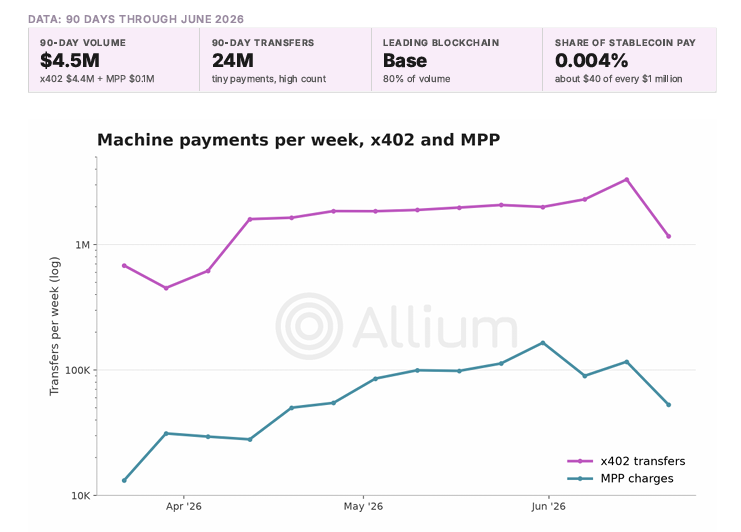
→ For more, download Allium’s State of Onchain Finance report: https://allium.so/reports/state-of-onchain-finance-q2-26
IN THIS NEWSLETTER
Do stablecoins deserve privacy?
Markets: off the rails
Term of the day: crack spreads
Crypto is Macro Now offers ~daily commentary and updates on the overlap between the crypto and macro landscapes. Plus links and more.
If you’re a premium subscriber, thank you so much!! ❤
WHAT I’M WATCHING:

Do stablecoins deserve privacy?
I finally had time over the weekend to watch Gita Gopinath’s presentation at the recent BIS Annual General Meeting (thanks Marieke for flagging!). And wow, is financial privacy misunderstood in the halls of power.
The gist of the presentation is that stablecoins allow anonymity, and that’s not good. Of course that is the sort of conclusion we expect from someone steeped in global governance (until she left last year, Gopinath was the First Deputy Managing Director for the IMF) – but there is nuance here worth unpacking.
What most stands out in her speech is the conditioning lens through which she looks at anonymity – surveillance is good because it prevents crime which is bad.
I’m going to resist the temptation to call out the narrowness of this lens (at least for now), and instead focus on her arguments.
Perhaps the most egregious has to do with the nature of authority.
Policy makers deserve congratulations, she suggests, for how successful they have been over the past few decades in eroding the use of anonymity-protecting cash. It hasn’t been easy, she stresses, and the cost has been considerable: the annual expenditure on financial crime compliance in the US and Canada is around $60 billion – but, we’re reminded, “that’s a choice that we’ve made as a society”.
Is it, though? The bodies that set the compliance standards – mainly the Financial Action Task Force (FATF), with input from the Basel Committee on Banking Supervision (BCBS), the United Nations Office on Drugs and Crime (UNODC), the Financial Stability Board (FSB) and others – are not elected by “society”. None of them. They are appointed by elites, so it’s a stretch to say that “we” made that choice. Rather, it was made for us, and we bear the cost.
It’s jarring to see former unelected officials assume they have a popular mandate to impose unpopular measures and then tell us that we wanted them all along.
Moving on…
Gopinath points out that more insight into who is moving money, and where, is not just about stopping money laundering (just as well) – it’s also about more tax collection, stronger sanctions efficacy, useful insight into cross-border flows, all essential for authorities to feel they’re doing their jobs well.
And here come stablecoins to unwind their good work.
To be fair, she does acknowledge that self-custody does not mean criminal intent – again, just as well. But, as the volume of stablecoins in circulation grows, so will the volume held in self-custody. And, she implies, more self-custody will lead to more crime.
So, of course we should want less undocumented self-custody, because combating crime is good.
We’re shown some charts of the proportion of stablecoin balances held in self-custody, relative to how much is held on centralized platforms that conduct robust KYC/AML checks.
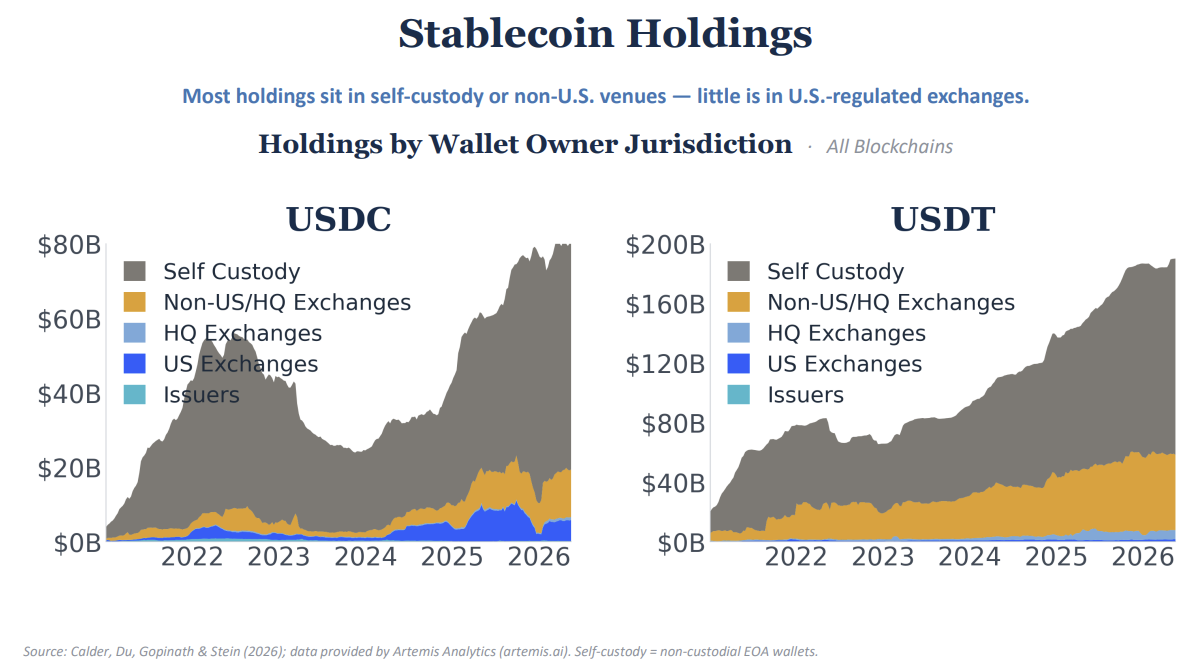
(chart via Gopinath, BIS)
Holy cow, look at all that potential crime.
It gets worse. At one point, Gopinath said:
