


“We demand rigidly defined areas of doubt and uncertainty!” – Douglas Adams ||
Hello everyone, and happy Friday! I hope you all had a meaningful week?
It’s a long newsletter today, but a good story that I’ve been wanting to dive into for ages – a small island nation between Hawaii and Australia has issued the first tokenized sovereign debt that I’m aware of, and the first token for UBI that is also institutional-grade collateral. Read on.
PUBLISHED IN PARTNERSHIP WITH: ✨ ALLIUM ✨
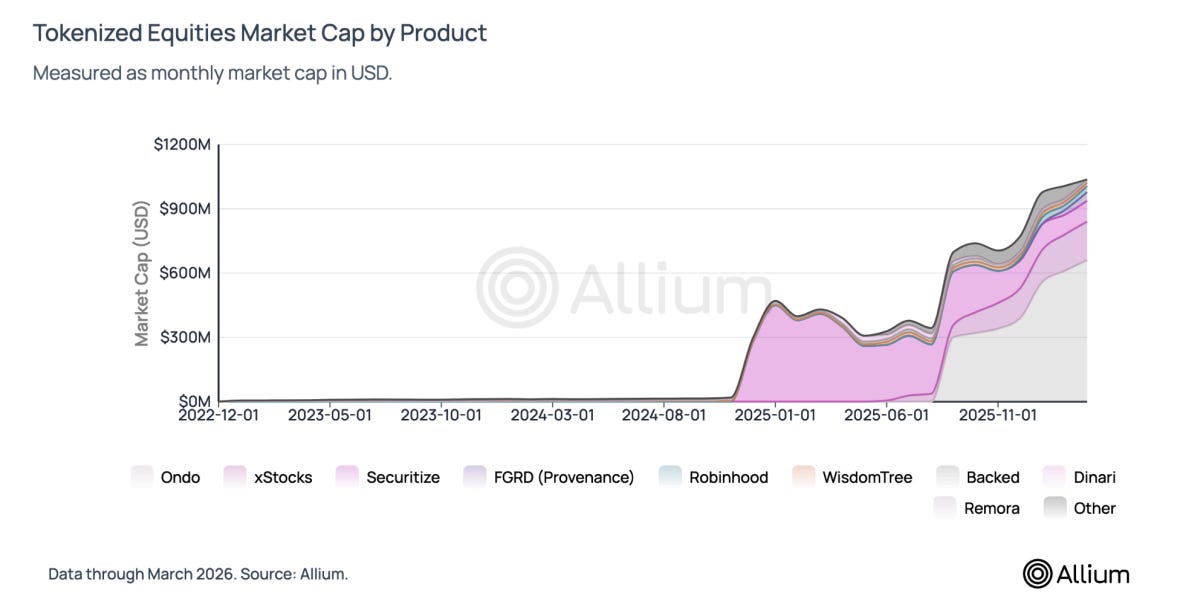
Tokenized equities hit ~$1B in supply since launching in mid 2025. The market structure is more interesting than the milestone.
Allium’s latest research covers where liquidity actually lives, how tokenized prices compare to traditional equities, overnight price discovery, and why ~90% of volume is outside the US.
For fintech platforms, exchanges, institutional investors, and builders evaluating the tokenized equities opportunity.
→ Read the report: https://www.allium.so/reports/allium-tokenized-equities-report-q1-2026
IN THIS NEWSLETTER
From the Pacific to Wall Street: tokenized sovereign debt
Term of the day: Brady bonds
Macro: US wholesale inflation
Crypto is Macro Now offers ~daily commentary and updates on the overlap between the crypto and macro landscapes. Plus links and more.
If you’re a premium subscriber, thank you so much!! ❤
WHAT I’M WATCHING:

From the Pacific to Wall Street: tokenized sovereign debt
Students of innovation know that it tends to happen fastest at the margins, whether in finance, technology or geography. Sometimes, the combination of the three can produce some surprising moves. One example of this is a Universal Basic Income distribution that has ended up connected to new types of collateral efficiency on Wall Street.
For more detail, we have to travel to a sparsely populated region of the Pacific Ocean.
The Marshall Islands
The Republic of the Marshall Islands consists of over 1,200 islands and rings of coral known as atolls (including the world’s largest, Kwajalein) spread across nearly 2 million square kilometres – roughly the size of Saudi Arabia or Mexico – between Hawaii and Australia. Only 24 of the islands and atolls are inhabited; Majuro is the largest, and hosts the capital of the same name. Almost 99% of Marshall Islands territory is water, the largest proportion of water to land of any sovereign state. Its total land mass is just over 180km2, about the size of Washington DC, and a third of the size of my home city of Madrid. To get an idea of just how remote the Marshall Islands are, in “Everybody Loves our Dollars”, Oliver Bullough describes them as being “as far from anywhere as you can get while still being somewhere”.
Towards the end of World War II, US forces captured the Marshall Islands from the Japanese, after which they became key US military bases. In 1947, the United Nations established a trusteeship covering the Marshall Islands and other Micronesian territories, to be administered by the US.
Starting in 1946 (even before it had a legal right on the territory) and stretching out to 1958, the US conducted 67 nuclear weapons tests across the Bikini and Enewetak atolls, effectively unleashing forces equivalent to 1.6 Hiroshima-sized bombs being detonated every day for 12 years.
Unsurprisingly, many residents suffered long-term health effects, and to this day some atolls are uninhabitable due to radiation.
(Want a not-so-fun fact? The bikini swimsuit apparently got its name from the Bikini atoll, both because of the inference of small-ness – splitting the atom – and because the marketing stressed the “explosive” association. And SpongeBob SquarePants’ home, Bikini Bottom, is based on, well, you can guess where. Ever wonder why the character’s friends look so, um, different?)
In 1979, the Marshall Islands became a self-governing sovereign entity, adopting its own constitution. In 1982, it was officially renamed the Republic of the Marshall Islands (RMI), and the following year it signed a Compact of Free Association (COFA) with the US. This gave it independence while also promising a bilateral relationship that delegates defence to American forces while granting exclusive military base rights, offers substantial US grants and sector funding, brings US postal and weather service coverage, allows residents to live and work indefinitely in the US as well as join the US military, and commits the Marshall Islands to using the US dollar as its only currency. The COFA entered into force in 1986 and was recently renewed up until 2043. In 1991, the island state became a voting member of the United Nations.
The thing is, the fledgling nation was sparse, thinly populated and struggled to find a source of reliable income. It sensibly chose to capitalize on its location by establishing an international ship registry and implementing Delaware law but with stronger privacy protection. A low-cost high-privacy offshore jurisdiction with good shipping services? You can imagine what happened next. It ended up with one of the world’s largest ship registries and thousands of non-resident shell companies.
In 2000, the Financial Action Task Force (FATF), responsible for cleaning up global money laundering and terrorism financing, labelled the Marshall Islands as “non-cooperative” and blacklisted it from financial networks, dealing a major blow to its ability to participate in international flows.
The RMI got to work upgrading its regulatory framework and was removed from the blacklist in 2002. Yet it still struggled to get global banks to open correspondent branches on the islands. The 2008 financial crisis and the subsequent hike in fines for “financial safety” infractions triggered a global pullback from small yet active economies, even those not seen as a nexus for financial crime, as increasing compliance costs make them unprofitable.
This makes life more expensive for residents who often have to take a plane in order to cash a check. Remittance fees average 10%, triple the UN target. International USD wires can cost 4-5x the global average, with settlement taking up to a week. The domestic card system is expensive and does not accept international cards from Visa or Mastercard. Even inter-atoll payments can face high costs and due diligence requirements. And because cash is scarce, local banks apply withdrawal limits and ATMs frequently run dry, sometimes for weeks at a time.
UBI
Against this backdrop of limited banking infrastructure, the Marshall Islands has developed an intriguing Universal Basic Income (UBI) program.
My baseline opinion on UBI programs is that they herald the end of democracy as we know it, with most voters choosing the political party that pays them more, in a terrifying race to the fiscal bottom.
The Marshall Islands program is an intriguing exception, however, as it doesn’t “print money” to buy votes – it distributes income that technically belongs to the islanders anyway.
A bit of background:
The COFA renegotiation in 2003-4 gave birth to the Compact Trust Fund for the People of the Republic of the Marshall Islands, funded mainly by the US but also to a much lesser extent by the Marshall Islands itself and Taiwan (which the RMI officially recognizes). The fund, professionally managed and incorporated as a non-profit in Washington DC, invests in US securities with a view to earning around a net 7%. In August of last year (the latest report I could find), the fund held around $1.3 billion, with up to $500 million in additional contributions committed through the end of next year.
From this fund stems ENRA, the Marshall Islands’ Universal Basic Income program – in Marshallese, the term “enra” means “sharing plates”, and the aim is to spread the income from the fund around the islands.
The program kicked off in late November 2025 with the distribution of roughly $200 to every Marshallese citizen on the islands. The plan is to continue with quarterly distributions going forward.
Here’s a key twist:
The bulk of the distribution was via physical checks and direct deposits into bank accounts. But, given that 1) not all islanders have bank accounts, 2) digital banking is fragmented and expensive, and 3) the physical disbursement of funds is challenging in such a spread-out and thinly populated geography, the Marshallese government recognized early on that an alternative was needed.
Together with blockchain consultancy M1X, it developed an app called Lomalo (“shared waters” in Marshallese) with a Crossmint wallet built on Stellar, via which eligible ENRA recipients can verify their identity and receive benefits cheaply and instantly.
USDM1
The Lomalo app is set up to receive benefits in the form of USDM1 tokens, which are technically Marshall Islands Digital Sovereign Bonds in electronic form worth $1, offering stronger legal rights for holders than other tokenized assets such as deposit tokens (bank risk) and stablecoins (corporate risk).
Structured along the lines of Brady bonds, these sovereign assets are collateralized 1:1 by US Treasuries and regulated by New York law. USDM1 is Marshall Islands government debt in token form; but its value is backed by US government debt. And it will be distributed to Marshall Islands citizens who opt to receive their UBI directly in their Lomalo wallet rather than via bank deposit or paper cheque.
Here’s another intriguing twist: UBI distribution is just one use case for the token.
Another is as high-grade collateral, for which tokenized sovereign debt carries some key advantages.
The assets underlying the Marshall Islands issuance are US treasuries, which means that the issuance benefits from the “lookthrough” to the US credit rating and qualifies as HQLA (High Quality Liquid Assets, a central component of compliance with Basel III/IV bank capital requirements). Essentially, USDM1 is a pass-through tokenized treasury – I’m not aware of any other examples.
This makes it an attractive asset for bank balance sheets, and a welcome collateral for financial operations. OCC-chartered entity Anchorage has integrated USDM1 for custody, settlement and collateral management, as well as a convenient 24/7 conduit to institutions. Last week, the custodian arm of tokenization services provider tZERO announced regulated USDM1 custody services. And late last year, USDM1 was part of a tokenized repo trial on the Canton blockchain that also involved institutions such as Bank of America, Citadel, Société Générale, DTCC and others.
Another intriguing twist? USDM1 acts like a stablecoin, in that it has a stable dollar value and settles onchain 24/7. But technically it’s high-rated, liquid sovereign debt that “looks through” to US treasuries – the highest quality collateral there is. Stablecoins, on the other hand, are not considered HQLA, and are therefore not eligible for bank reserves without additional capital cost. Nor are they eligible without limitations as collateral on traditional derivatives platforms, whereas tokenized representations of already eligible assets (such as US Treasuries) are.
But wait, what about the revenue from the underlying Treasuries, wouldn’t that make USDM1 a security? Well, yes - but sovereign securities aren’t subject to the same burdensome requirements imposed on securities issued by private entities.
Yet another intriguing twist: the interest only partly accrues to the tokenholder, and partly to the issuer, the Marshall Islands. According to the USDM1 white paper, the income will be used to:
“support long-term development priorities within the RMI’s fiscal framework, reflecting the nation’s realities as one of the world’s most climate-vulnerable countries with significant climate-adaptation needs, as one of the most geographically dispersed countries where service delivery and economic inclusion entail exceptionally high structural costs, and as a nation still addressing the meaningful long-term impacts of its nuclear-exposure legacy.” (my emphasis)
It’s important to clarify that this institutional use case relies on the same token as the Marshall Islands UBI digital distribution – but the sources of funding of the underlying treasuries are totally different. The former is institutional money that is used to buy the treasuries and mint the digital Marshall Islands sovereign bond. The latter comes from citizens who have opted in to receive their ENRA disbursements in USDM1. ENRA comes from the COFA, with a portion of the fund’s generated income used to buy the underlying treasuries.
So, a stablecoin-like token with sovereign backing is powering an innovative and uplifting example of how UBI can benefit citizens while solving significant distribution pain points. What’s more, it does this without imperilling the fiscal outlook of the issuer, as disbursements are budget-neutral. And it creates a capital-efficient HQLA onchain asset with the maximum credit rating for use as institutional collateral, while generating income for a small economy.
Innovation at the margins, indeed.
(Special thanks to my friend Jordan Goldman for suggestions, additional information and some needed corrections!).
Term of the day: Brady bonds
Here’s something that Scott Bessent would probably not mind: having a security named after him.
For now, there’s only one security that has been named after a US Treasury Secretary. In 1989, as several Latin American countries were either defaulting on their debt or struggling to cover interest, then-Treasury Secretary Nicholas F. Brady proposed a plan to help out the lenders: they were offered the chance to swap their loans to emerging economies for more marketable sovereign bonds denominated in US dollars and partially collateralized with US Treasuries. This was usually accompanied by some debt relief from the lenders and economic reforms from the borrowers.
These became known as Brady bonds: sovereign bonds issued by third countries, denominated in USD, and collateralized with US government debt (often paid for with loans from the IMF and the World Bank). They commanded lower rates given the removal of currency risk and the reassurance of the collateral – a win for the borrowers. And they got bad loans off banks’ balance sheets, replacing them with tradeable securities – a win for the lenders.
