


“Better to remain silent and be thought a fool than to speak out and remove all doubt.” – Abraham Lincoln
Hi everyone! I hope you’re all doing well. I’m grateful for the day off yesterday as Madrid celebrated the Fiesta de la Almudena – the procession was called off due to rain, but there was still church, cake and dancing. Good to be back, though, a lot to talk about this week… 😎
IN THIS NEWSLETTER
Coming up this week: US inflation, geopolitics
Gold tokens: the emergence of a new monetary standard?
Crypto is Macro Now offers ~daily commentary and updates on crypto’s evolving role in the changing geopolitical and financial landscapes. Plus links and more.
If you’re a premium subscriber, thank you!! ❤
PUBLISHED IN PARTNERSHIP WITH: ✨ ALLIUM ✨
The amount of stablecoins held on exchanges at the end of September 2026 dropped by 7% year-on-year, while that held in wallets jumped by more than 20%, to 45% of the total circulating supply.
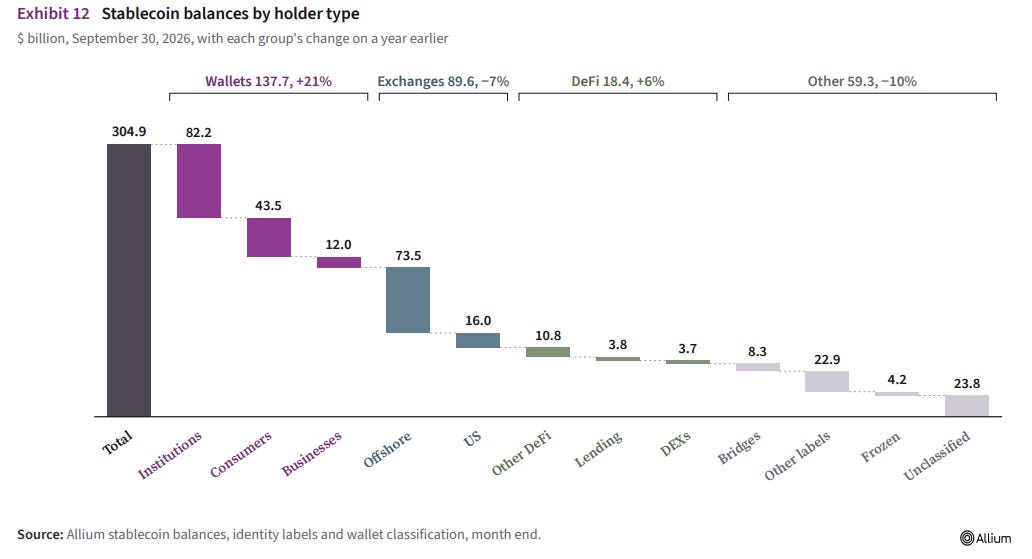
Download Allium’s State of Stablecoins and Payments Q3 2026.
And get weekly onchain data and more analysis like this from the Allium Research team on Substack.

WHAT I’M WATCHING

Coming up this week
Yesterday saw the kickoff of the 31st COP summit, this year in Turkiye – it runs until November 20th. It’s striking how low-key these events have become on the collective hysteria scale… I presume because there’s so much else for media and activists to obsess over?
Today, we get the official US CPI report for October, but not the year-on-year figure as last October’s report was skipped due to the government shut-down. Forecasts point to an increase of 0.3% month-on-month, down from 0.6% in September. This is the last CPI report before the December FOMC meeting.
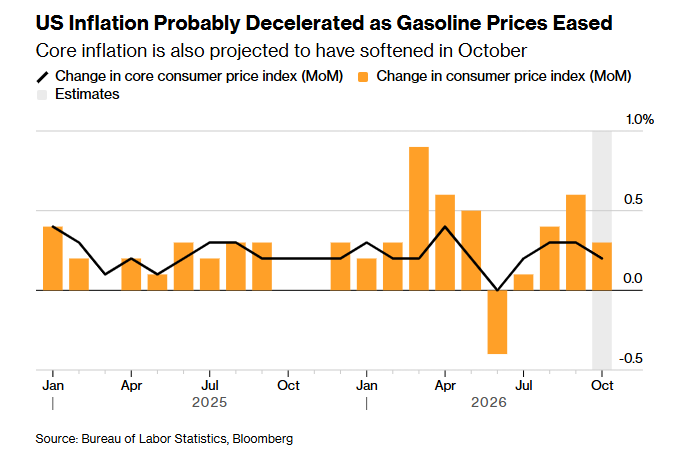
(chart via Bloomberg)
The US, Ukraine and Russia will meet in Abu Dhabi today and tomorrow for peace talks. Let’s send all sorts of good vibes – this war needs to end.
Meanwhile, G7 foreign ministers meet in Paris today for the second day of meetings – this year, US Secretary of State Marco Rubio is attending the full two-day session, unlike the March meeting in which he attended only half. Last week, attendees were informed that the venue was being moved from Marseille to Paris, which must have triggered some logistical scrambling, especially since the World Peace Forum kicks off in the city today. What’s more, multiple protests in the city are scheduled for today, and are expected to turn violent. We can only presume they had good reasons for the location change.
The European Parliament holds a hearing on the digital euro, at which ECB Executive Board member Piero Cipollone will deliver his usual upbeat spin.
On Wednesday, US bond markets are closed for Veterans Day.
On Friday, we get the US Producer Price Index (PPI) report for October, with the year-on-year increase expected to accelerate to 6.6% – this would be the steepest annual increase in almost four years.
And the New York Fed and the European Central Bank hold a joint workshop in New York on non-bank financial institutions.
On Sunday, Southeast Asian leaders gather in Manila for the annual ASEAN Summit, which will run until next Tuesday.
Gold tokens: the emergence of a new monetary standard?
Tokenized gold is one of the more geopolitically significant and yet, surprisingly, one of the more overlooked examples of blockchain representation of real-world assets. It looks like that’s about to change.
Below I’ll get into why, but first I’ll explain my interest. Regular readers will know that I haven’t been impressed with the recent fuss over tokenized equities – they’re not that interesting, other than as a test of new market technology. In other words, I don’t see them having much of an impact in their current form; wake me up when they trigger new use cases, new types of activity. Tokenized bonds make more sense given the potential savings in issuance and servicing costs, as well as greater sophistication in collateral management. And tokenized commodities? Now we’re talking.
For a while now, I’ve had tokenized gold near the top of my way-too-long list of topics to dig into – not so much for the broader access, nor the enhanced collateral options, both of which are meaningful. My interest is more in the asset’s potential role as a monetary asset, made more feasible by blockchain technology.
My reasoning has been this: many central banks want to boost adoption of their currencies, but there is little incentive for trading partners to either use or hold onto currencies that are relatively illiquid and volatile.
Many central banks hope that a wholesale CBDC will help with this by offering enhanced settlement efficiency and lower cross-border cost. The thing is, that doesn’t solve for the lack of demand.
What if there was a less volatile and more liquid asset into which entities could easily convert a received wholesale CBDC? Tokenized gold could act as a stable placeholder, converting back into onchain fiat as needed, 24/7, or offchain fiat during banking hours.
This would not only remove some layers of risk for smaller currencies. It could also help central banks put their gold holdings, many of which continue to increase, to a productive use.
Now, there are no doubt many financial plumbing obstacles that my back-of-envelope scenario does not take into account. But obstacles can, with time and diligence, be worked around.
