


“You wouldn’t worry so much about what others think of you if you realized how seldom they do.” – Eleanor Roosevelt ||
Hello everyone! Spain is through to the next round!! ⚽😃
If you watched the game last night, you might have noticed that Mikel Merino shouted “Viva San Fermín!” after he scored. He’s from Pamplona, where the annual festival honouring its patron saint San Fermín kicked off yesterday with the traditional launch of rockets (the “chupinazo”) from the balcony of City Hall – this marks the beginning of eight days of partying, wine-drinking, bull-running and lots of red scarves. Today is the traditional procession, dating back to the 13th century, in which a statue of San Fermín is paraded through the streets of Pamplona accompanied by hilarious papier-mâché figures, musicians, dancers, guilds and other noise makers. And this morning, the bulls made their first appearance of the season. For a modern country, tradition runs deep here in Spain.
Today’s newsletter is short (finally!) as I have a schedule squeeze.
I hope you’ll come join me and Izabella Kaminska later TODAY for Episode 3 of our 📽 pilot Monetary Forces livestream series. Izabella will be talking about unified ledgers, I’ll discuss tokenized deposit networks, and we’ll both dive into OUSD. More details below.
PUBLISHED IN PARTNERSHIP WITH: ✨ ALLIUM ✨
Are agentic stablecoin payments becoming a thing?
Software agents now pay each other, for data, API calls or compute – but the volume is tiny. The two main agentic rails are x402 (concentrated on the Base blockchain) and MPP (a protocol on Tempo), and about $4.5 million has moved across them over the last 90 days, in 24 million tiny payments.
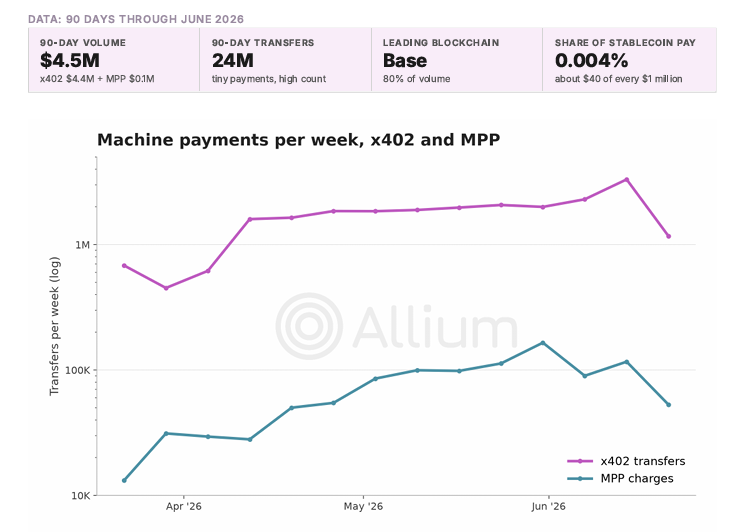
→ For more, download Allium’s State of Onchain Finance report: https://allium.so/reports/state-of-onchain-finance-q2-26
IN THIS NEWSLETTER
How can deposit tokens be made more liquid?
Podcast episode recommends
Crypto is Macro Now offers ~daily commentary and updates on the overlap between the crypto and macro landscapes. Plus links and more.
If you’re a premium subscriber, thank you so much!! ❤
WHAT I’M WATCHING:

Podcasts: upcoming streams
✨Monetary Forces: later TODAY, Izabella Kaminska and I pick at the key headlines that paint the picture of how technology is changing finance, and Izabella will dive into the entrails of a paper illustrating an overlooked aspect of the transformation.
Tuesday, July 7 @ 4pm CEST / 3pm BST / 10am EST – livestream link: https://open.substack.com/live-stream/262758
✨Press Publish: on Thursday, I’ll be talking to Marvin Barth about his Seriously, Marvin?! and Thematics Markets newsletters as well as his excellent podcast – we’ll get some insight into how he produces so much quality content, how he navigates the information firehose, how he deals with obstacles, what he thinks of different formats, and more.
Thursday, July 9 @ 4pm CEST / 3pm BST / 10am EST – livestream link: https://open.substack.com/live-stream/261155
How can deposit tokens be made more liquid?
There as been an unexpected flood of thought-provoking blockchain-related papers from supra-national institutions lately – mercifully, they seem to have all abandoned the “we should try and stop this risky nonsense” of previous years, and are focusing on “what will the new infrastructure look like”.
Last week, the IMF published one titled “The Rise of Tokenization: Deciphering New Trends in Payments and Asset Tokenization”.
Unfortunately, the paper doesn’t do what the title promises. Then again, nor could it in 15 pages. Rather, it speeds past key questions such as the tradeoffs between permissionless and permissioned networks, scalability vs specialization, etc. But it will hopefully kickstart deeper consideration of the impact of tokenization on traditional market structure – how will that need to adapt in the face of the new emerging financial models?
The section on stablecoins was interesting as it raised a couple of issues I’ve written about before: 1) why can’t tokenized Treasuries be transferred like stablecoins?, and 2) should stablecoin yield accrue to the token or the account? Like other questions introduced throughout the paper, these could use a lot more investigation.
