


“Freedom would be not to choose between black and white but to abjure such prescribed choices.” – Theodor Adorno
Hi everyone! I hope you all had a good weekend.
A big day where I am: el Día de la Hispanidad, a celebration of Hispanic culture and a flex of Spanish military – tanks have been rolling by, soldiers have been marching, and fighter jets have been screeching overhead. Moving stuff.
Production note: I have to skip publication tomorrow (Tuesday).
IN THIS NEWSLETTER
Coming up this week: lots of high-level global meetings, US inflation
How relevant are consumer surveys?
Crypto is Macro Now offers ~daily commentary and updates on crypto’s evolving role in the changing geopolitical and financial landscapes. Plus links and more.
If you’re a premium subscriber, thank you so much!! ❤
PUBLISHED IN PARTNERSHIP WITH: ✨ ALLIUM ✨
Most of the move in prediction market odds for a Democrat win in the Senate midterms came in two weeks: the week after US crude topped $90/bbl following strikes on Iran, and the week to Sept 17, when Democrats took the lead.
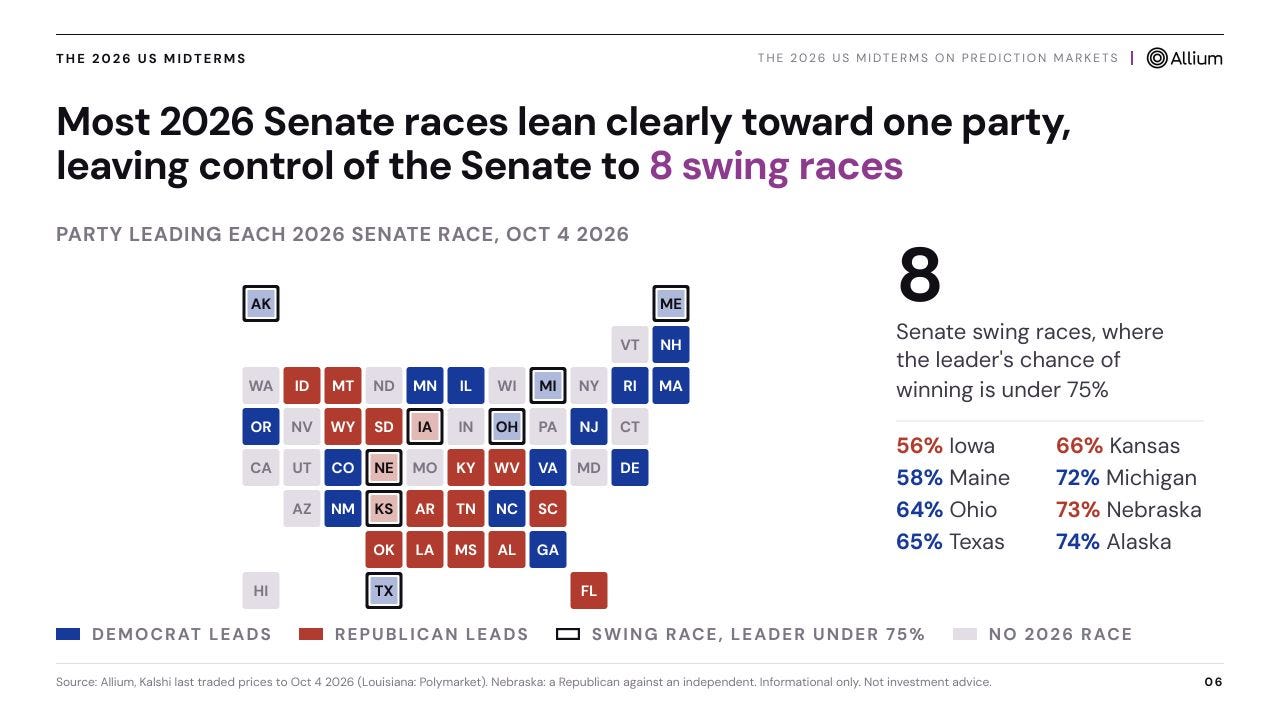
Full report: Prediction markets and a live read on the US midterms
Get weekly onchain data and analysis from the Allium Research team on Substack.

WHAT I’M WATCHING

Coming up this week:
US inflation week! Plus so many top-level macro and geopolitical meetings.
Today (Monday), markets in Japan are closed for Sports Day, a celebration of an active lifestyle with parades and local sports tournaments around the country – I only mention it because I think it’s an enchanting idea to have a public holiday commemorating exercise and competition.
The Annual Meetings of the International Monetary Fund and the World Bank kick off in Bangkok, Thailand – this is the first time they are being held outside of Washington DC in three years. (That plus expected heavy rain should do wonders for the notoriously bad traffic in the city.) Federal Reserve Chair Kevin Warsh will attend, but US Treasury Secretary Scott Bessent won’t – his absence, plus the change in venue, sends a not-so-subliminal signal about shifting global influence on the macroeconomic stage.
There is also a full agenda of economic gatherings, festivals, talks and symposiums on the margins of the official event – we can expect many high-profile panels on stablecoins, digital assets and the like.
The two-day Warsaw Security Forum kicks off in Poland.
Also, the US bond market is closed for Columbus Day (but not the stock market).
On Tuesday, we get the latest IMF World Economic Outlook and Global Financial Stability Report.
We also get the official data on the US federal budget deficit for FY 2026 (the 12 months up to the end of September), expected to reach 6.2% of GDP, up from 5.8% in FY 2025.
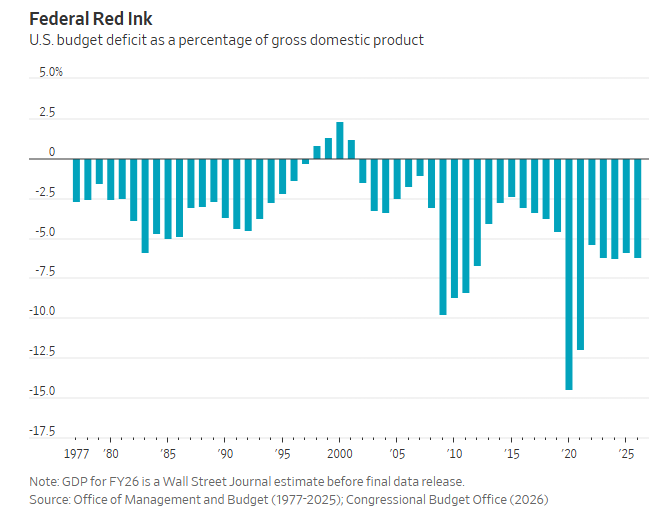
(chart via the Wall Street Journalv)
The National Federation of Independent Businesses delivers its latest optimism report.
And Goldman Sachs, JPMorgan, Citi and Wells Fargo kick off the Q3 reporting season.
On Wednesday, we get the US CPI report for September. Consensus forecasts have the headline index coming in at 0.6% month-on-month, which would be higher than August’s 0.4% and the steepest increase in five months. The year-on-year rate is expected to pick up to 3.7% from 3.4%. The core index, ex-food and energy, is forecast to climb 0.2%. This would be slightly lower than August’s 0.3%, but would push the year-on-year rate up to 2.5% from 2.4%.
China’s inflation rate is expected to pick up to 1.0% from 0.8%.
We also get the Federal Reserve’s Beige Book, with anecdotal commentary on the economic environment from businesses around the country.
On Thursday, the G20 Finance Ministers and Central Bank Governors Meeting kicks off in Bangkok, this time without the presence of US Treasury Secretary Scott Bessent (even though the US holds the G20 presidency this year). Federal Reserve Chair Kevin Warsh is expected to attend.
There will also be a G7 Finance Ministers and Central Bank Governors meeting.
We get the US retail sales report for September, expected to show slowing growth.
We also get the US Producer Price Index (PPI) report for September, forecast to show headline wholesale inflation holding steady at 5.4%, with the core measure expected to decelerate to 4.4% from 4.6%.
Also, the two-day European Council summit kicks off in Brussels, gathering leaders of the 27 member states and the presidents of the European Council and the European Commission. On the agenda: the affordability crisis, migration, security and Ukraine.
On Friday, Fed Chair Kevin Warsh takes the stage at the IMF Annual Meeting in Thailand, to be interviewed by IMF Managing Director Kristalina Georgieva.
And we get the US September import and export price indices as well as September industrial production.
How relevant are consumer surveys?
Even among seasoned economists, opinions are divided not only as to the importance of consumer surveys, but also as to which ones are more relevant.
On the one hand, surveys aren’t exactly reliable measures of anything, as opinions change, samples can distort results and people don’t always say what they mean. Let’s face it, we’re complicated, and our thoughts even more so. Plus, who enjoys responding to surveys?
On the other hand, they’re all we have, for now, to gauge sentiment changes. Consumer surveys are imperfect, but they have been relatively consistent over decades, and statistics can be smoothed and weighted and averaged to even out human-shaped anomalies. Consumer surveys may be unreliable, but even a vague message is better than nothing.
Ok, once we accept that they can be big-picture useful, which ones matter and why?
