


“We become what we behold. We shape our tools and then our tools shape us.” – Marshall McLuhan ||
👀 You’re reading Crypto is Macro Now, which covers the role of crypto in the changing landscapes of finance, economics, politics, culture and markets. 👀
Hey, everyone! I hope you’re all doing well.
Another last-week-of-summer format change today: yesterday I shared some good reads on Bitcoin, today the same but for stablecoins/CBDCs. I’m taking a short summer break from tomorrow until Saturday, back next week with deeper dives on Brazil, multicurrency platforms and more.
PUBLISHED IN PARTNERSHIP WITH: ✨ ALLIUM ✨
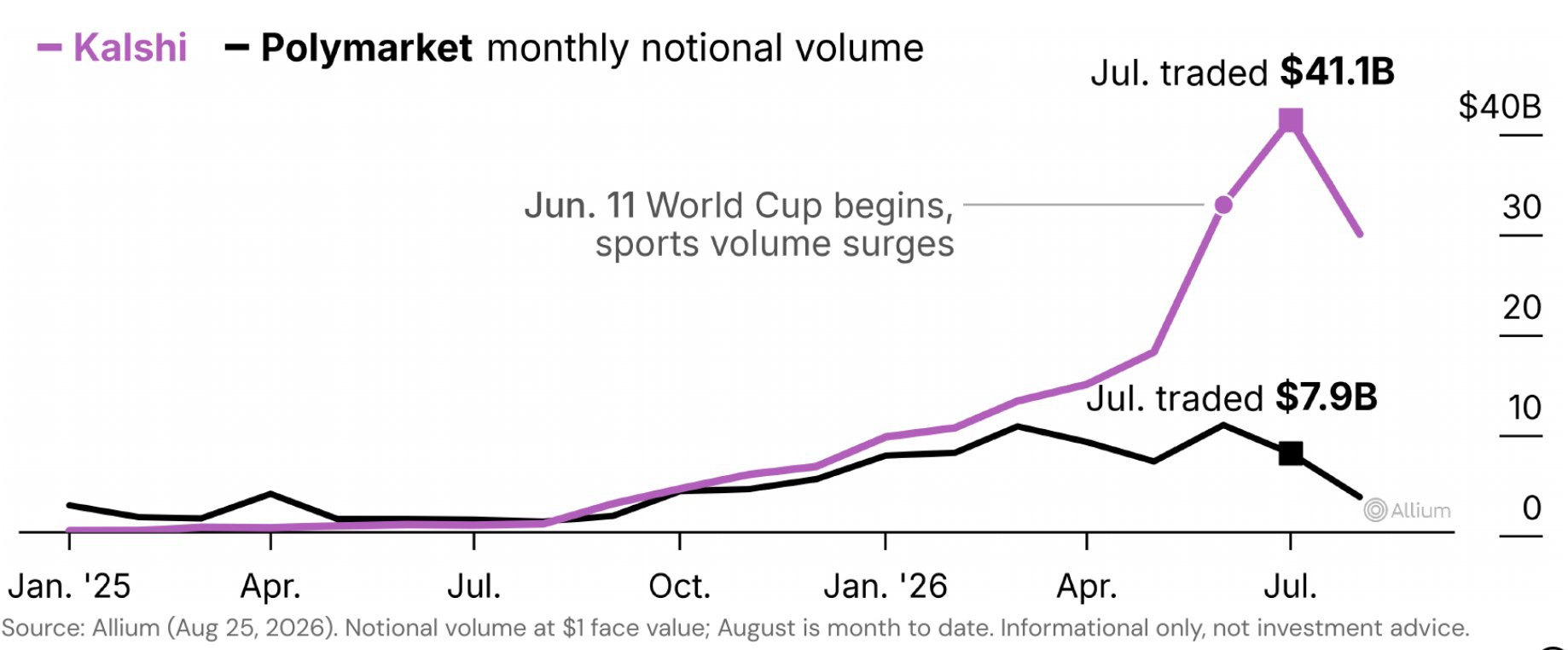
Prediction markets are no longer a niche election product. Sports are turning them into a mass-market trading venue. Kalshi traded $41.1 billion in July, its biggest month ever. That’s more than 5x Polymarket International’s $7.9 billion.
→ Book a demo: https://www.allium.so/
And get weekly onchain data and more analysis like this from the Allium Research team on Substack.
IN THIS NEWSLETTER
Network incentives, digital euro design and bank mendacity
What is co-badging?
Podcast episode recommendations (they’re back!)
Crypto is Macro Now offers ~daily commentary and updates on the overlap between the crypto and macro landscapes. Plus links and more.
If you’re a premium subscriber, thank you so much!! ❤
WHAT I’M WATCHING:

Network incentives, digital euro design and bank mendacity
(Yesterday, I shared some good free access pieces I’ve read recently on Bitcoin; today’s the turn of stablecoins and CBDCs. This is a departure from my usual format – below, I ask you whether you’d like links to others’ work to be a regular feature, feedback please!)
Borja Neira – Food for Thought
In this thought-provoking X post, Borja outlines how the main barrier to greater global connectivity in payment networks is not technology, it’s incentives. Central banks don’t want to give up control of their settlement assets, commercial banks want to keep making money off deposits and credit, liquidity providers want to be paid for the risk they assume, corporates want privacy… all would benefit from greater efficiency, but at the cost of independence and self-determination? Unlikely.
Distributed ledger technology (DLT) can offer an “unbundling” of the connectivity trade-off: a shared network state, with participants retaining control over their contribution. Jurisdictions decide on settlement assets, banks could sell access, FX providers would earn from conversion, liquidity providers could decide how much to offer, and all could choose the risk they’re comfortable with.
Contributions to the network savings could be attributed transparently and remunerated accordingly.
Barriers still remain (such as cross-border bankruptcy risk) and new ones emerge (such as governance of a shared substrate), but DLTs can change how we think about incentives and interoperability by allowing for the separation of coordination from sovereignty.
Bottom line, Borja suggests that by focusing on how the technology could work, we’re overlooking the most important issue: efficiency is not necessarily the priority. His argument is especially relevant given widening cracks in existing currency blocs, friction in traditional cross-border payment alliances, and the geopolitical trend away from cooperation and towards stronger borders, economic security and defense.
Omid Malekan – The banking lobby’s bad faith campaign to kill the Clarity Act will backfire
In an op-ed published in Fortune, Omid brings his typical scathing wit to the lies told by the banking lobby in their fight to kill stablecoin rewards of any kind.
He points out that the banking industry’s pleas for government protection give the impression that it is struggling, in danger of collapse if it loses any deposits at all. But US bank profitability is strong, with $740 billion in net-interest income last year – this is more than the GDP of Australia. It’s also more than the combined net income of the Magnificent Seven tech companies, and you don’t see them clamouring for help. Yet we’re expected to believe stablecoins are a threat?
And there is no credible evidence at all that even direct remuneration to stablecoin holders would have a noticeable impact on bank deposits, any more than money market funds did.
Also, suppose the banks did have to start paying interest on deposit accounts in order to compete – that might dent their considerable profits, not their ability to lend.
Anyway, banks only account for around 20% of credit creation in the US economy, and the largest banks only lend out around half what they get from deposits – these are more likely to be parked at the Fed (earning interest) or used to buy Treasuries than go towards financing businesses.
Basically, the banks want to limit options available to savers, because they make more money from borrowers and there are not as many of them.
Omid asks the unspoken question: why does a highly profitable and highly protected industry need more protection, at the expense of savers and financial innovation?
“The industry that gave us Lehman and SVB would have you believe it’s really PayPal you should be worried about. It also wants you to believe that crypto is an unusual enabler of illicit activity, as if no bank ever moved money to facilitate any kind of illicit activity.”
I chuckled out loud at Omid’s comparison of the collective reverence for banks to a type of Stockholm syndrome. And I totally agree with him that this is likely to backfire as more of us start questioning the industry’s special status. I’ve written about this before, most recently a couple of weeks ago, but Omid brings up many points I hadn’t thought of, and does so with punchier prose.
See also:
OMFIF – What makes or breaks the digital euro
The central bank think tank OMFIF teamed up with a researcher at Imperial College London to develop a model to simulate the impact of design choices on digital payment method adoption, and what they could mean for the digital euro.
Key factors:
Sign-up process. We have no insight yet into the European Central Bank’s thinking on this, but the study shows that users drop off if it takes more than 20 minutes. That sounds like a long time to me, I’d drop off after 10 minutes.
Time to execute a transfer. The ECB has indicated it will develop its own app – does this mean users will have to input the recipient’s banking details in order to send funds? Any additional data collected adds time and after 30 seconds, users drop off, especially if other payment methods are easier.
(It’s worth noting that the latest documentation from the ECB on the app stresses its accessibility for those with disabilities, which is good, but perhaps not enough to ensure users will choose it over other options. However, we’re told the digital euro will also be available via existing payment platforms.)
The authors acknowledge that the ECB’s decision to include a waterfall will reduce operational overhead – if a user receives funds that push the balance over the set limits, the excess will be siphoned off into a designated bank account. Useful, but it overlooks the friction of having balance limits in the first place.
Also, if the digital euro account does not have enough funds to fulfil a transaction, these can be automatically taken from a bank account. Again, useful, but I’m not convinced this does much to reduce the cognitive friction – wouldn’t it just be easier to make the transfer from your bank account?
Given the ECB’s promise of zero-fee transfers of the digital euro, plans to enable co-badging could be a successful hook (see below if you’re not familiar with the payments jargon) – credit/debit card payments could offer users a choice of which network they want their payments to route through, that of the card provider or that of the digital euro. But it would require a meaningful change to typical co-badging set-up (from one card => one bank account, to one card => both a bank and a digital euro account?). I’m struggling to see why card providers would welcome this.
The authors close by pointing out that the ECB has so far positioned the digital euro as a geopolitical imperative, but has failed to adequately explain to the public why they should use it when Europe already has plenty of excellent payment options. This makes design choices the secret to success – and it’s not clear (to me, anyway) that a central bank is best positioned to get that part right.
