


“The inevitable is always certain but not always punctual.” – Jim Grant ||
Hello everyone! I hope you’re all taking care of yourselves.
✨ Come and join me later today for another session of “Press Publish” with the one and only Marvin Barth, author of the publications Thematic Markets and Seriously, Marvin?!, and host of the Thematic Edge podcast. We’ll talk about newslettering, production, information overload, media and more – given his experience and impact, he’ll have plenty to say on these topics that you won’t hear elsewhere.
Thursday, July 9th @ 10am EST/ 3pm BST/ 4pm CEST – see you there, I hope!
👉 Link: https://open.substack.com/live-stream/261155
PUBLISHED IN PARTNERSHIP WITH: ✨ ALLIUM ✨
We know stablecoin volumes are climbing, but what about the rate of increase?
Allium research shows that, over the past two years, supply has doubled but the rate of growth is slowing, the signature of a market moving from a land grab into steady infrastructure development.
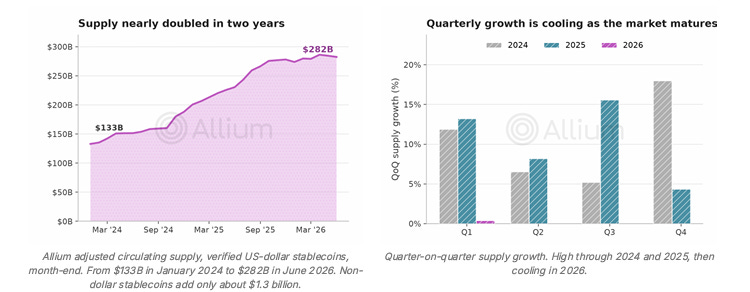
→ For more, download Allium’s State of Onchain Finance report: https://allium.so/reports/state-of-onchain-finance-q2-26
IN THIS NEWSLETTER
Poland, China and the new monetary order
Term of the day: phosphate
Crypto is Macro Now offers ~daily commentary and updates on the overlap between the crypto and macro landscapes. Plus links and more.
If you’re a premium subscriber, thank you so much!! ❤
WHAT I’M WATCHING:

Poland, China and the new monetary order
Today, I’m going to go out on a limb and write about gold, even though I am not a commodities expert nor a gold bug. I’m doing so because you all help me synthesize my curiosity, and there are things going on with central banks that have grabbed my attention.
Bear with me, this ties into the fragmentation of the monetary order that is one of the backbones of my Crypto is Macro Now thesis.
A couple of days ago, we learnt that the People’s Bank of China added to its gold reserves in June, for the 20th consecutive month, at the highest rate since October 2023.
But last week, the World Gold Council published data on central bank gold buying for May that shows there’s a bigger story: despite its massive gold accumulation, China is not the main central bank buyer, not in May and not year-to-date. It ranks third.
Second is Uzbekistan, which has been buying gold hand over fist, to the extend that the metal now accounts for almost 90% of central bank reserves (for context, China is at around 9%).
The surprise leader is Poland. It also easily led the league of central bank gold buying in 2025.
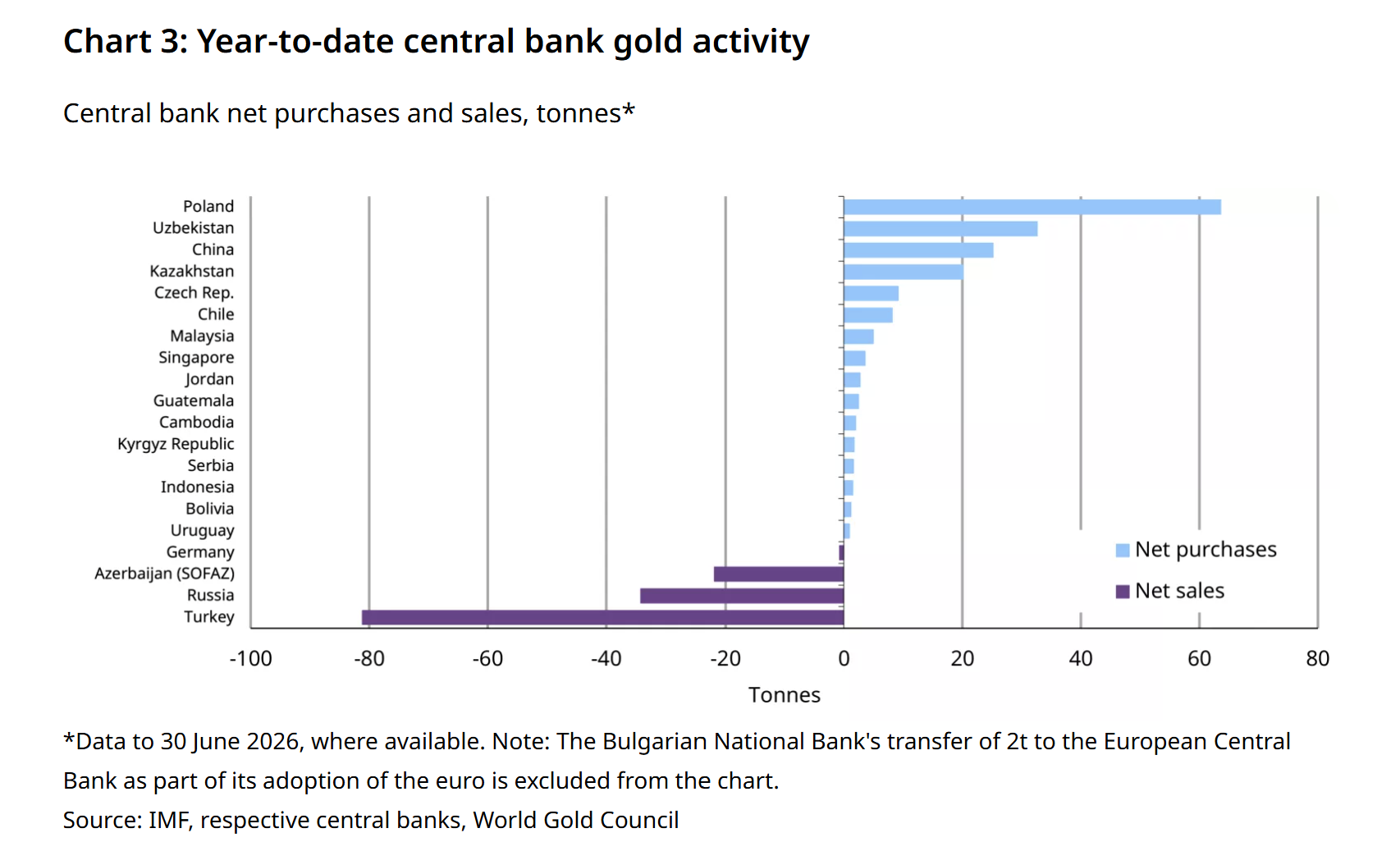
(chart via gold.org)
This is especially interesting because China wanting to diversify reserves away from dollar assets, we can understand. Officials are no doubt worried about the threat of seizure, as happened with Russia, and have for some time been working on reducing overall reliance on the dollar system, given the US Administration’s weaponization of trade. As of April (latest data available), its disclosed holdings of US Treasuries have dropped to the lowest level since 2008.
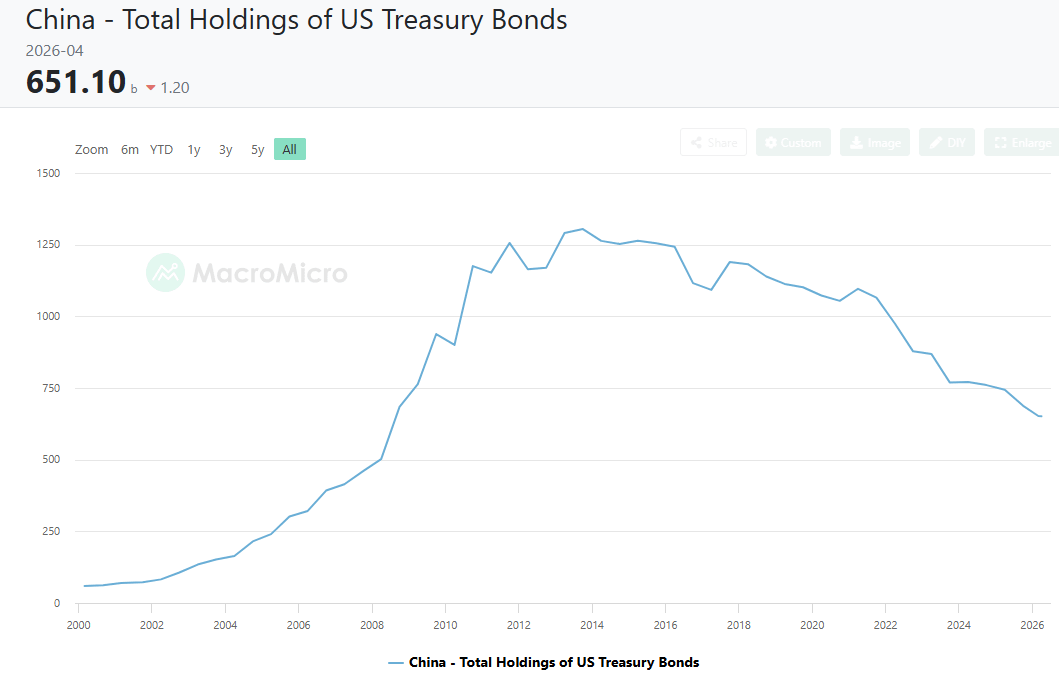
(chart via macromicro.me)
We can also understand Uzbekistan’s motives. Russia is its second largest trading partner after China, Russian firms are dominant in its domestic economy, and the two countries have close diplomatic ties.
But Poland, an EU country, a member of NATO, a close ally of the US? Why is the National Bank of Poland the world’s leading central bank gold purchaser year-to-date?
Like China, Uzbekistan and others, geopolitics is a key factor, but from a different angle.
Back in January, when the central bank voted to boost its gold holdings, an official told Bloomberg that the goal was “to build an appropriate portfolio for these unstable geopolitical times”.
Poland shares a border with Ukraine and Belarus.
While invasion from Russia is unlikely since Poland is a member of NATO, the threat of financial destabilization is no doubt a deep concern. Plus, the future of NATO is up in the air, and Poland probably realizes that the value of US Treasuries could be compromised were global conflict to escalate.
What’s more, those in power in Poland today no doubt still remember the currency turmoil and hyperinflation of a few decades ago. It’s understandable they’d be predisposed to making sure that never happened again – and gold is a safer “neutral” reserve than government debt or currencies.
I expect the “invest in Poland” narrative is also relevant – the country has in recent years been one of the top destinations in Central/Eastern Europe for foreign direct investment. Central bank reserve resilience will reassure investors, potentially attracting even more funds.
For now, Poland has the highest level of gold reserves in Central/Eastern Europe, excluding Russia. But not the highest in Europe: Germany, Italy, France and Switzerland hold multiples more from legacy stocks – they have not been active buyers.
Indeed, take a look at the central bank gold purchase rankings in the chart above, and an interesting tale starts to take shape – the purchasers tend to be developing or young/small developed countries.
