


“Civilization rests on the fact that we all benefit from knowledge which we do not possess.” – Friedrich Hayek ||
Hey, everyone! I hope you all had a good weekend – and to readers in the UK, have a great Bank Holiday Monday!
👀 You’re reading Crypto is Macro Now, which covers the role of crypto in the changing landscapes of finance, economics, politics, culture and markets. 👀
I had a wonderful three-day break and feel ready to say goodbye to August, although with a heavy heart. I love the rhythm of summer, however hot it gets. And I have a feeling September is going to be intense.
A really long one today, lots going on… it’ll be shorter tomorrow.
PUBLISHED IN PARTNERSHIP WITH: ✨ ALLIUM ✨
A stablecoin is a claim on something, and the something varies far more than the price does. Cash and short-term treasuries at a regulated issuer. Other crypto. An algorithm and a promise. All of them sit near a dollar until the mechanism gets tested.
Allium Research explains how stablecoins differ: https://allium.so/blog/what-is-a-stablecoin-a-clear-guide-to-digital-dollars/
And get weekly onchain data and more analysis like this from the Allium Research team on Substack.
IN THIS NEWSLETTER
Coming up this week: US jobs, geopolitics
Reform vs change
Markets: by “hike” I mean…
Term of the day: Shanghai Cooperation Organization
Crypto is Macro Now offers ~daily commentary and updates on the overlap between the crypto and macro landscapes. Plus links and more.
If you’re a premium subscriber, thank you so much!! ❤
WHAT I’M WATCHING:

Coming up this week:
It’s jobs week! Plus, some big-name geopolitical meetings and an election are bringing some drama to the timeline.
Starting today, the Shanghai Cooperation Organization (SCO, see below for background) holds its two-day annual summit in Bishkek, Kyrgyzstan. China’s President Xi Jinping, Russian President Putin and Indian Prime Minister Modi are attending in person, with Putin and Xi expected to hold their second face-to-face meeting this year. Also attending are the heads of state for Iran (Pezeshkian), Pakistan, Belarus, Kazakhstan and other regional members. Plus, Türkiye’s president and the secretaries-general of the UN and ASEAN. On Friday, the organization put out a statement warning against external “interference” in Iran’s governance, which sets a confrontational tone for the event in the face of US Treasury Secretary Scott Bessent’s threats about economic isolation for any country that trades with the SCO member.
Meanwhile, G20 finance ministers and central bank governors kick off a two-day meeting in North Carolina. We can expect a lot of hand wringing on tariffs, energy prices, inflation, tightening conditions and secondary Iran sanctions. Fed Chair Kevin Warsh is attending, so is US Treasury Secretary Scott Bessent, after missing last year’s meeting in South Africa. Strangely, Bloomberg, the Wall Street Journal and other media outlets have been barred from covering the event – an unusual move, and a first for the US as host.
On a smaller scale but also important for shifting geopolitics, the annual Pacific Island Forum begins in Palau, an archipelago of over 500 islands and one of the few countries that has maintained diplomatic ties with Taiwan. One of the main items on the agenda is how to deal with an increasingly assertive China, but at least five heads of state (out of 18 members) will not be attending. Analysts suspect political pressure. The US, China and Taiwan are sending senior officials as observers and “dialogue partners”.
Tuesday brings the latest US Job Openings and Labor Turnover Survey (JOLTS), with job openings expected to increase slightly.
And we get the latest US Purchasing Managers Index (PMI) reports for manufacturing, forecast to show a slight deceleration. Keep an eye on the “prices paid” component.
We also get the initial Europe inflation read for August, with consensus estimates pointing to a jump from 2.9% year-on-year to 3.2%, with core inflation holding steady at 2.5%.
On Wednesday, we get the private ADP US payrolls report for August, forecast to deliver a slight pickup from a 44,000 gain in July to 47,000.
Thursday brings the Challenger, Gray & Christmas report on announced US job cuts for August.
We also get US PMI reports for the services sector, forecast to show a slight acceleration.
And we get the US Federal Reserve’s Beige Book, which offers anecdotal reports gathered by each of the 12 regional central banks on current economic conditions
On Friday, we get the official US jobs report for August, forecast to show a 55,000 increase vs a drop of 23,000 in July. The unemployment rate is expected to remain at 4.1%, holding the lowest level since January 2025.
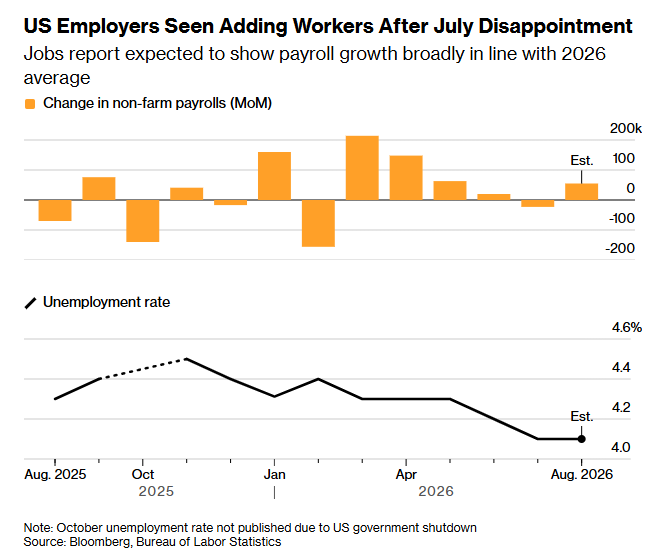
(chart via Bloomberg)
On Sunday, the German region of Saxony-Anhalt holds state elections. These are a big deal in that the AfD is way ahead in the polls at 42% voting intention, double that of the ruling Christian Democrat party. Unless there is an astonishing electoral upset, Germany will get its first far-right state governor since WWII, sending a strong message not just to Chancellor Merz but also other European countries with elections coming up (including France and Spain). Then again, if AfD loses despite its polling advantage, that’s a strong message of a different type.
Reform vs change
We can argue long into the night about when the imbalances that led to the Great Financial Crisis started, and where. Whatever our view, most of us will be at least partially right and partially wrong, and we can agree to disagree. Interpreting history is never as straightforward as it may seem.
Most of us can probably agree, however, that things don’t feel stable now:
A banking sector fighting disruption from innovators while encouraging leverage, hiding risk and accelerating the upward flow of capital
A younger generation more interested in market speculation than in saving for a home they’ll never be able to afford
Professional investors placing outsized bets on an uncertain future, convinced there will be a public bailout if they’re wrong
A currency market changing shape faster than fragmented data indicates
Political divides fed by growing dissatisfaction with orthodox economics, patched over by more government spending
I could go on…
We can debate which wobbly pillar will give way first, and what the response and outcome will be. Countless pixels a day are spent doing just that.
But there’s a bigger question we’re not addressing: why many of the systemic stresses feel eerily similar to those that crashed the global economy almost 20 years ago. Wearing different clothes, perhaps, brandishing different gadgets – but today’s imbalances and risks have similar if not the same roots as those we sought to quelch. Put differently: to recover from the Great Financial Crisis, rather than change the structural incentives, we kicked the can down the road.
Below, I want to sketch out why I think that is, and why it matters for the evolution of crypto in finance.
