


“It turns out it takes 30 years for a new idea to seep into the culture.” – Paul Saffo ||
Hello everyone! I hope you’re all doing well.
Here in Spain, we’re getting excited for the total eclipse later today. I’ve got my special glasses, even though I’m not sure if I’ll be able to see much of it – for totality, I’d need to be further north, and my east-facing apartment is great for sunrises but not so much for eclipses at sunset. Still, it’s a huge occasion and there is nothing quite so humbling as a reminder that we are but little random specks on a celestial body hurtling through space – excitable specks that love a spectacle, though.
👀 You’re reading Crypto is Macro Now, which covers the role crypto is playing in the changing plates of finance, economics, politics, culture and markets. 👀
Production note: as I said earlier this summer, I’m not taking a European-style big vacation but I will be taking days off here and there – like this Friday, for instance.
PUBLISHED IN PARTNERSHIP WITH: ✨ ALLIUM ✨
What do we mean by “onchain data”?
Every transaction on a blockchain leaves a permanent record.
The hard part is turning those raw records into something finance teams can actually use. Our latest guide breaks down what onchain data really is, why it matters, and how it becomes usable.

→ https://allium.so/blog/what-is-onchain-data-a-clear-guide-to-blockchain-data/
And get weekly onchain data and analysis like this from the Allium Research team on Substack.
IN THIS NEWSLETTER
An overlooked liquidity hint?
South Africa’s proposed stablecoin ban
Crypto is Macro Now offers ~daily commentary and updates on the overlap between the crypto and macro landscapes. Plus links and more.
If you’re a premium subscriber, thank you so much!! ❤
WHAT I’M WATCHING:

An overlooked liquidity hint?
Normally, the release of the quarterly refunding statements from the US Treasury are boring events. These detail upcoming issuance plans, specifying amounts and tenors, and generally there are no surprises.
That doesn’t mean there’s no drama, however. Before he took office as Treasury Secretary, Scott Bessent was a vocal critic of his predecessor’s policy of shifting the weight of issuance more to short-term bills, accusing her of using the term structure to artificially goose the economy in the run-up to the 2024 election.
He was correct: Short-term bills (maturity of one year or less) boost monetary liquidity more than do longer-term notes (2-10 years) and bonds (> 10 years) as they are more money-like and a more efficient collateral to support leverage. So, shifting issuance to the short end of the term structure acts as a form of “fiscal easing”, or “fiscal QE”.
And, as the below chart shows, between mid-2021 and early 2024, the Treasury shifted a significant portion of total issuance from bonds and notes (blue and red lines, respectively) to bills (green line).
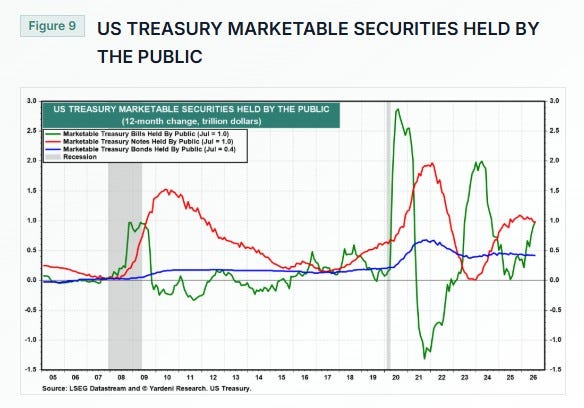
(chart by Yardeni Research)
So, would Bessent unwind the policy he criticized? As you can tell from the above chart, he didn’t.
This isn’t hypocritical as much as it is understandable: not only is it tempting to use Treasury issuance to boost the economy, and – perhaps even more significant – the yield on bills is notably lower than those on longer-term securities, helping to soften the increase in overall federal interest costs.
There’s almost certainly more of this coming – and, we could soon see the shift accelerate.
In the latest US Treasury Quarterly Refunding Statement published last week, the relevant auction sizes – 3-year, 10-year and 30-year – were left unchanged, as expected.
But much like even miniscule word changes in Federal Reserve statements after FOMC meetings can give clues as to the thinking behind any decision, so can word changes in regular US Treasury statements.
One in particular stands out. When talking about future auction sizes for notes and bonds (often referred to as “coupon auctions” as these securities periodically pay out yield), the document usually says: “Looking ahead, Treasury continues to evaluate potential future increases to nominal coupon and [Floating Rate Note] auction sizes.” The latest statement replaces “increases” with “changes”.
