


“You can drive a car by looking in the rear view mirror as long as nothing is ahead of you.” – Bill Joy ||
Hello everyone! I hope you’re all doing well.
Today I look at the role of crypto in sanctions evasion - it’s more complex than you’d think, and there’s a LOT going on there.
I haven’t been talking much about markets this week as we’re all waiting to see what impact Friday’s SpaceX IPO will have on sentiment, and what tone Fed Chair Walsh sets at his first FOMC meeting next week. Even renewed attacks in the Middle East and a headline CPI of over 4% don’t seem to have done much to jolt indices out of their holding pattern. 🤨
PUBLISHED IN PARTNERSHIP WITH: ✨ ALLIUM ✨
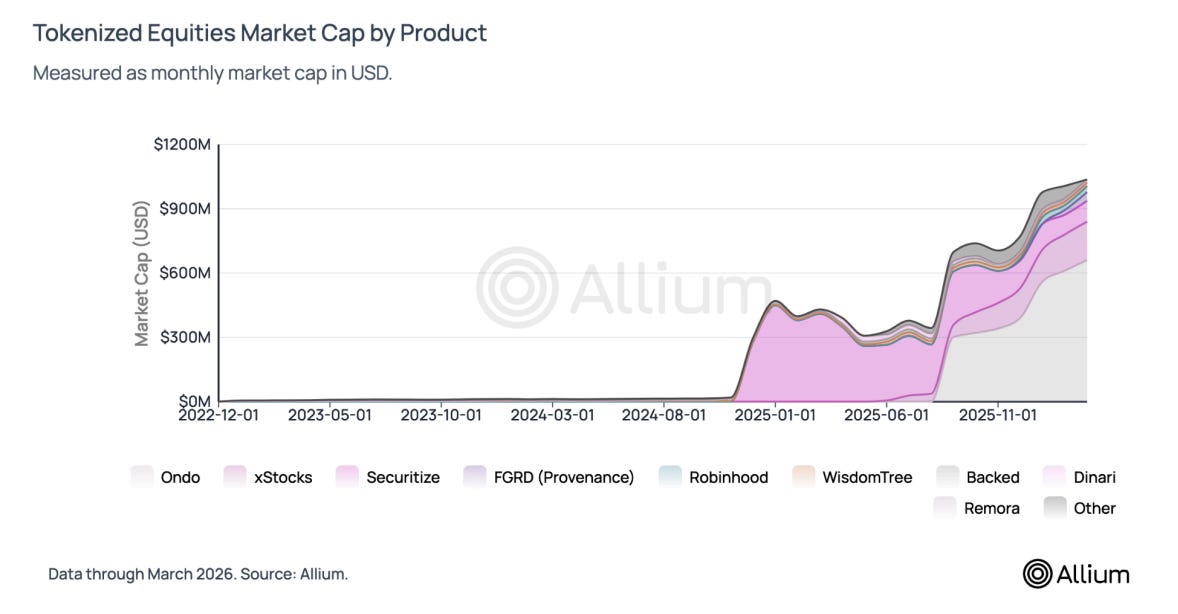
Tokenized equities hit ~$1B in supply since launching in mid 2025. The market structure is more interesting than the milestone.
Allium’s latest research covers where liquidity actually lives, how tokenized prices compare to traditional equities, overnight price discovery, and why ~90% of volume is outside the US.
For fintech platforms, exchanges, institutional investors, and builders evaluating the tokenized equities opportunity.
→ Read the report: https://www.allium.so/reports/allium-tokenized-equities-report-q1-2026
IN THIS NEWSLETTER
Stablecoins and sanctions evasion
Term of the day: Neomercantilism
Crypto is Macro Now offers ~daily commentary and updates on the overlap between the crypto and macro landscapes. Plus links and more.
If you’re a premium subscriber, thank you so much!! ❤
WHAT I’M WATCHING:

Stablecoins and sanctions evasion
In 1966, psychologist Abraham Maslow wrote:
“I suppose it is tempting, if the only tool you have is a hammer, to treat everything as if it were a nail.”
Tempting indeed, to the extent that it becomes instinctive, we don’t even recognize the situational bias at work.
It’s directly applicable to the construction of finance today. If you’ve ever wondered why regulators keep on adding layers to the Bank Secrecy Act – giving banks even more unproductive paperwork and sunk costs in the fruitless pursuit of proof of money laundering – well, Maslow has your answer: adding controls is the only thing regulators can do. So they do it, a lot. And if the action is not producing the desired result, it’s obviously because they’re not doing enough of it.
The same applies to sanctions. They have proven effective in the past, but targets find workarounds which makes sanctions less effective in the future. Yesterday, the EU presented its 21st sanctions package against Russia. I’ll say that again, the 21st. The first 20 didn’t achieve the objective of convincing Putin that he should withdraw his forces from Ukraine, but the 21st should do the trick, right? And let’s remember that the loudly telegraphed threat of sanctions didn’t stop the invasion in the first place.
The futility becomes almost farcical when it comes to sanctioning crypto exchanges and even stablecoins. I’ve written about this before so I won’t repeat myself at length here, other than to say: sanctions on any activity carried out on a global, decentralized network will fail. The only reasonable explanation I can think of for going through the motions is: “it’s all that we can do, so it’s what we’ll do”. Our hammer hopes that the target will behave like a nail.
Given the flurry of related news items over the past week, it’s time for an update.
