


“Despotism has so often been established in the name of liberty that experience should warn us to judge parties by their practices rather than their preachings.” – Raymond Aron
Hello everyone! I hope you’re all taking care of yourselves.
Below I share the latest episode of my series looking at stablecoin hotspots outside the US – this time focusing on the United Kingdom. There’s also some background detail, and my notes on the discussion. 🌍
IN THIS NEWSLETTER
Video: Stablecoins in the UK
Notes on the episode:
Who regulates stablecoins in the UK?
What are the rules?
More on the BoE backstop
Crypto is Macro Now offers ~daily commentary and updates on crypto’s evolving role in the changing geopolitical and financial landscapes. Plus links and more.
If you’re a premium subscriber, thank you!! ❤
PUBLISHED IN PARTNERSHIP WITH: ✨ ALLIUM ✨
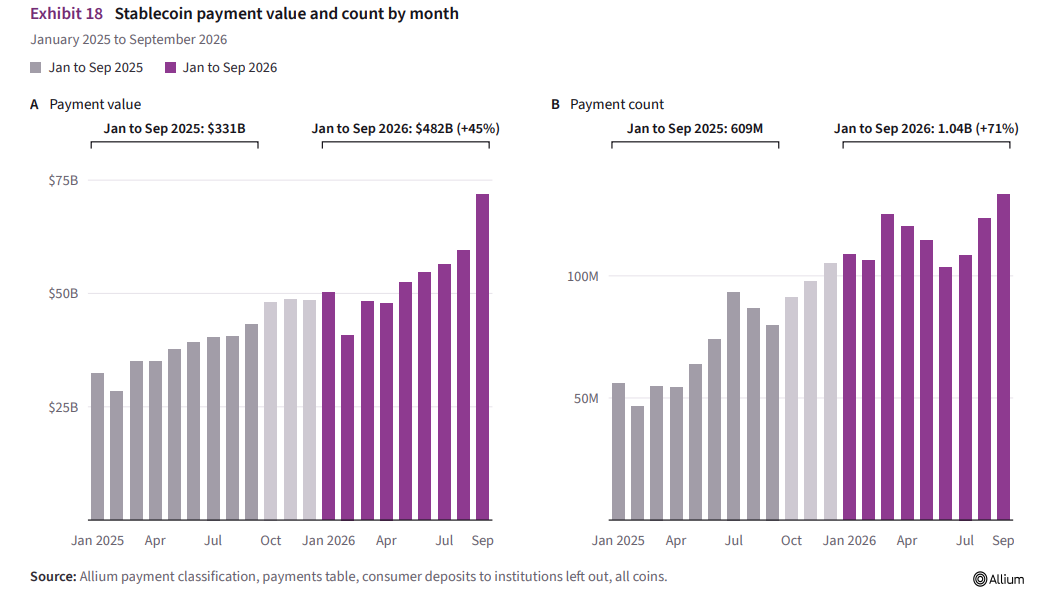
Of adjusted stablecoin transfer volume, roughly 20% is attributed to payments, which grew 45% year-on-year in volume through the first nine months of 2026 and more than 70% in number, while the average transfer size fell around 15%.
Download Allium’s State of Stablecoins and Payments Q3 2026.
And get weekly onchain data and more analysis like this from the Allium Research team on Substack.

WHAT I’M WATCHING

Stablecoins Around the World: the United Kingdom
For the fifth episode in this limited series on stablecoin ecosystems outside the US, I focus on the United Kingdom. To do that, I was fortunate to be able to talk to Rhys Bidder.
Rhys has taught at Cambridge University and Kings College, where he was also Deputy Director of the Qatar Centre for Global Banking and Finance. He’s spent some time working at the Federal Reserve. He’s also worked with the Bank of England, and more recently with the Central Bank of Ireland, focusing on stablecoins, CBDCs, tokenization and digital payments. Most of his time these days is spent advising traditional and crypto firms on the design and application of onchain money and the evolving market structure, and teaching businesses about smart contracts and digital assets.
You can check out his body of published work here, and tune in to the episode for more on his background.
(I’ll also be uploading the episode as a standalone video to Substack, and distributing to Spotify, although I have yet to figure out YouTube and further podcast platform distribution - I’m on it!)
