


“Substitute ‘damn’ every time you’re inclined to write ‘very;’ your editor will delete it and the writing will be just as it should be.” – Mark Twain ||
Hello everyone, and happy Fed Day! This afternoon’s FOMC press conference should be one of the more interesting in recent memory…
👀 You’re reading Crypto is Macro Now, which covers the interregnums we’re living through and the role of crypto in how this all plays out. 👀
It’s a short newsletter today as I’m battling a throat infection 🤒 and absolutely HAVE to get my voice back for tomorrow’s “Press Publish” Substack Live chat tomorrow with Michael Howell – see below for details!
PUBLISHED IN PARTNERSHIP WITH: ✨ ALLIUM ✨
Another long-running crypto exchange shuts down
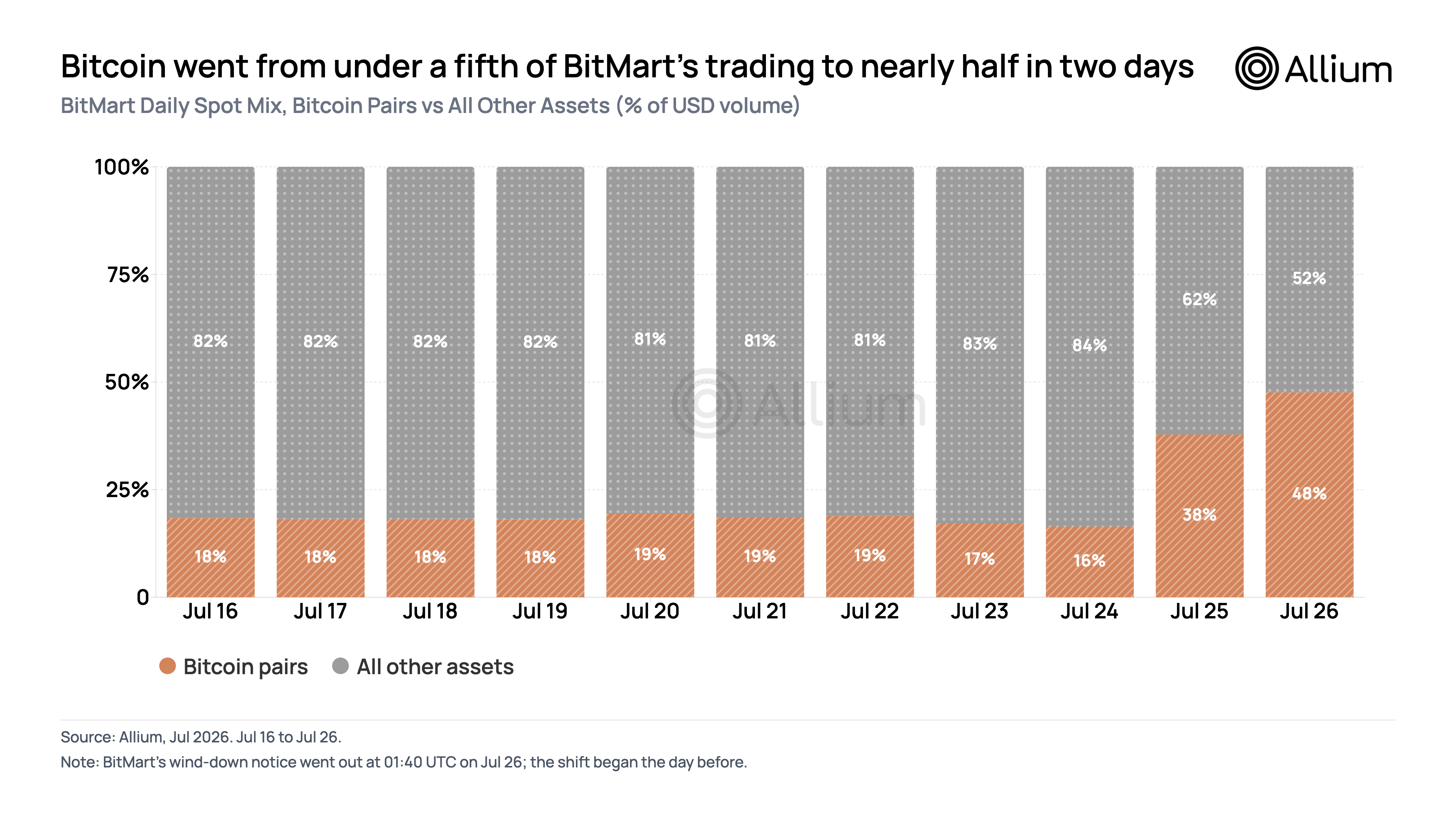
On Sunday, BitMart announced it will cease trading on August 26, with a full wind-down by January 31, 2027.
But volumes started surging a couple of days before, especially in BTC/USDT.
Book a demo: https://www.allium.so/
IN THIS NEWSLETTER
Stablecoins in Africa (2): the last mile
Term of the day: African Continental Free Trade Area (AfCFTA)
Crypto is Macro Now offers ~daily commentary and updates on the overlap between the crypto and macro landscapes. Plus links and more.
If you’re a premium subscriber, thank you so much!! ❤
WHAT I’M WATCHING:

✨Press Publish with Michael Howell✨
Join me tomorrow for a Substack Live chat with Michael Howell, author of the Capital Wars newsletter which offers market insight you’re definitely not going to get anywhere else – no wonder Substack tells me it’s the #1 newsletter in the UK. Many of you will already be familiar with Michael’s deep expertise in global liquidity flows – his book Capital Wars remains the only coherent explanation I’ve read on how they are both a massive force and a complex machine that moves economies as well as markets.
But we’re not going to talk about any of that. Instead, we’re going to discuss Michael’s writing, why he does what he does, how he juggles his time, what he thinks of publishing platforms, and more. A back-room glimpse into how the insightful output gets made.
👉 Thursday, July 30th (tomorrow!) – 3pm BST / 4pm CEST / 10am EST – come join us!
Link to livestream: https://open.substack.com/live-stream/294553
Stablecoins in Africa (2): the last mile
Yesterday, I wrote about the march of digital asset regulation and blockchain payments efficiency across the Sub-Saharan African continent. Today I want to address an overlooked barrier, and a small yet big-name pilot with a direct approach to solving it.
We know the potential of stablecoins in removing the considerable frictions of cross-border transfers in Africa, even more so than in other regions.
In a speech earlier this year, the Governor of Ghana’s central bank pointed out that over 80% of inter-African payments are routed through correspondent banks in Europe or the US, resulting in annual transaction fees of roughly $5.3 billion. Naturally, this takes longer than would a direct settlement, which adds settlement and currency risk.
The reasons for this expensive routing are many:
Africa has over 40 currencies, and thin FX markets. It is much cheaper to convert a local currency into dollars or euros and then back into another local currency, than to attempt a direct conversion.
Most Sub-Saharan trade originates or ends up outside the continent. According to the latest Afreximbank report, only around 14% of African merchandise trade is with other African countries. And much of that is invoiced in dollars or euros. A cap on demand for local currency settlement perpetuates the inefficient liquidity distribution.
Colonial correspondent banking relationships carved deep grooves of trust over the decades and even centuries – trust between African banks does not have a similar history.
Nor are they encouraged to develop this trust, with global AML rules and regulatory reluctance to incur more risk acting as strong guardrails for the existing expensive system.
There are region-wide initiatives afoot to overcome these barriers, such as the Pan-African Payment and Settlement System (PAPSS), backed by Afreximbank and others (I wrote about that here). Adoption is growing with 28 countries now participating. But networks take time.
So, stablecoins are an obvious solution: almost instant direct connections, on networks that already exist, and a mosaic of services eager to help smooth the flow. The past few months have brought a flurry of headlines announcing new stablecoin partnerships, liquidity pools, etc. All fantastic and much needed, but they tend to overlook a key piece of the distribution: the last mile. Getting funds customers can use directly in their accounts, cheaply and quickly.
