


“Not ignorance, but ignorance of ignorance, is the death of knowledge.” – Alfred North Whitehead
IN THIS NEWSLETTER
Coming up this week: central banks, CLARITY, consumer data
Stepping on to the slippery slope
Crypto is Macro Now offers ~daily commentary and updates on the overlap between the crypto and macro landscapes. Plus links and more.
If you’re a premium subscriber, thank you so much!! ❤
Production note: Apologies, I have to miss publication tomorrow, I’ll be away from my desk most of the morning. Back on Wednesday with a new episode of Stablecoins Around the World – I reveal which region further down. 🌎
PUBLISHED IN PARTNERSHIP WITH: ✨ ALLIUM ✨
Onchain, there are three ways to take a position on OpenAI before any listing exists. 1) A spot token tracking a claim. 2) A perp offering leverage on that price. 3) A prediction market pricing whether the listing happens at all. Each delivers something different, and those differences matter more than the headline exposure.
Allium Research wrote up what each one actually gives you.
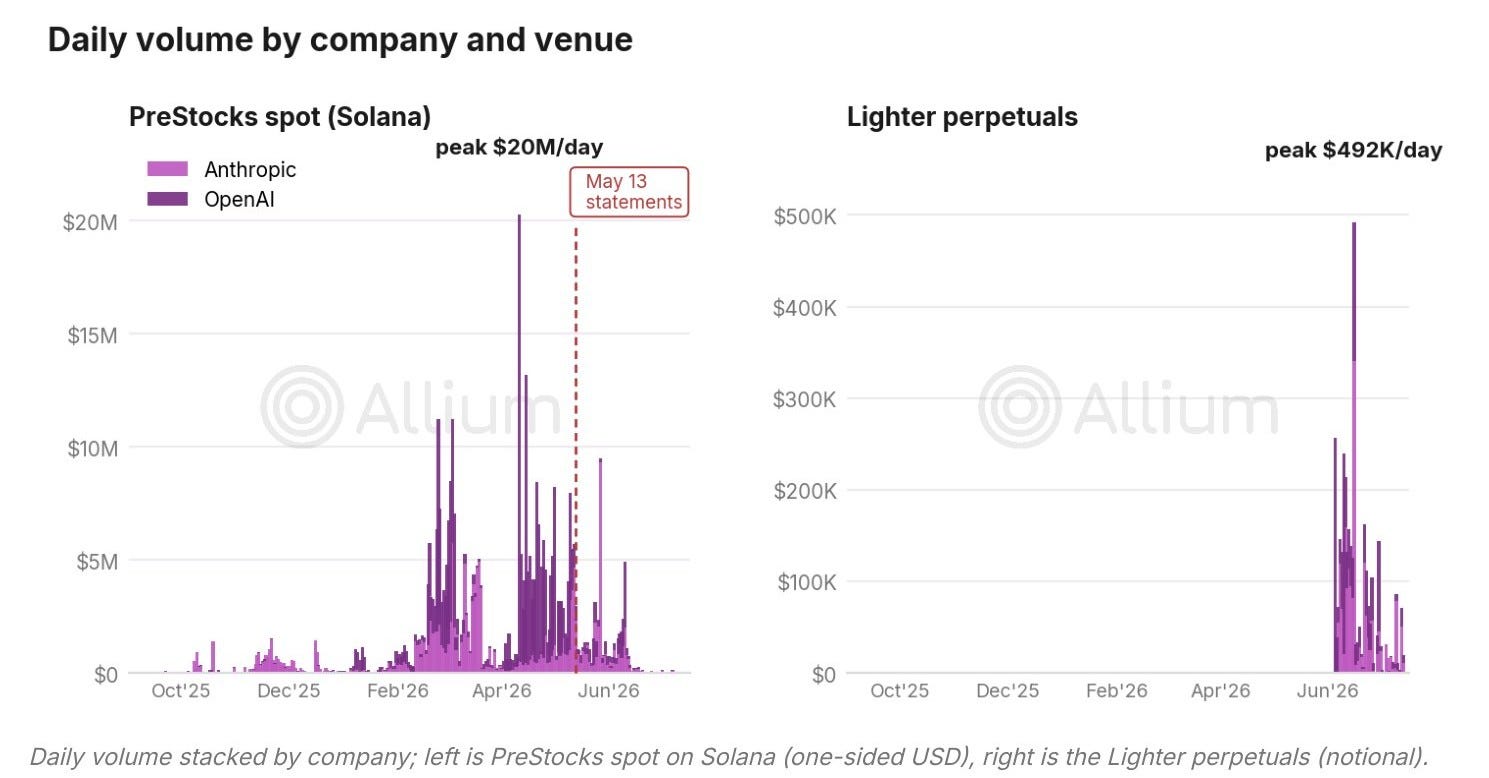
Get weekly onchain data and more analysis like this from the Allium Research team on Substack.

WHAT I’M WATCHING
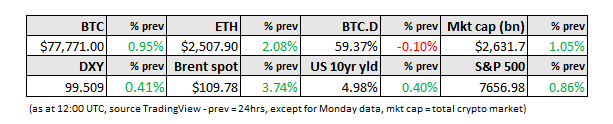
Coming up this week
It’s Fed week! And possibly the beginning of a new hiking cycle in the world’s largest economy. Plus, rate decisions in the UK and Japan. Even apart from potential developments in the Gulf, this should be a volatile week for bonds.
On Tuesday, the US Senate votes on the cloture motion for the CLARITY Act. If it passes (at least 60 votes in support), debate has to draw to a close and the bill moves to a full floor vote. If it fails, it’s back to the drawing board.
Also tomorrow, we get China’s latest retail sales data, unemployment rate and industrial production. Consensus points to a slight improvement, except for the unemployment rate which should hold steady at 5.2%.
On Wednesday, we find out: will the FOMC decide to hike US interest rates? Whether they do or not, Fed Chair Warsh’s comments in the press conference afterwards – possibly soon to become a rare occurrence – will be parsed for hints as to whether this is a one-off or the beginning of several. Equally interesting is whether or not he will give any hint at all, or will he continue to insist on “we’ll see”.
We also get updated economic projections from the Federal Reserve, which should sketch the prevailing mood, but which carry less weight in the face of Warsh’s vocal scepticism of their utility.
We get US retail sales data for August as well as US import and export prices – all are expected to show a notable pickup.
And Circle’s Arc layer-1 blockchain opens to the public.
On Thursday, the Bank of England decides on rate hikes – expectations are for another hold.
And on Friday, it’s the turn of the Bank of Japan. A hike is widely expected – this would be the second of the year, and would take the official rate up to 1.25%, the highest level since 1995.
Russia’s Duma elections (the Duma is Russia’s lower house of parliament) kick off on Friday and last until Sunday. The outcome is not really in question, but of interest is the overall vibe – Putin is hoping to project strong support for the war effort – and whether elections in Russia-occupied parts of Ukraine (Crimea plus portions of Donetsk, Luhansk, Kherson and Zaporizhzhia) transpire peacefully, helping to normalize the annexation.
Monday musings: Stepping on to the slippery slope
(what’s on my mind as we head into the week)
Of all the signals we’ve seen over the past couple of years that politics has pushed economic stability off the rails, none have shrilled louder than President Trump’s blatant attempt to buy votes.
Speaking at last week’s Republican Party convention, Trump promised all Americans a “dividend” of $5,000 each if the Republicans won both the House and the Senate.
In retrospect, the event itself should have given us a hint as to the desperation – the Republican Party has never before, at least not in the modern era, held a national rally just before the midterm elections. What’s more, it’s the first ruling party to ever do so. The Democratic Party has only held one, while in opposition in 1982 (Ronald Reagan was President), and by all accounts it was unsuccessful – they increased their comfortable majority in the House, but failed to win control of the Senate.
But even cynics among us thought that a blatant vote-buying promise would be a step too far.
We were wrong.
Of course, we know that votes are bought in every election via implicit and explicit vows to improve individual financial conditions: lower taxes, more income, better housing, free groceries and so on. And behind the bulk of government spending is a decision to paper over growing inequality with benefits, subsidies, easy credit and other forms of politically motivated financial assistance. As we have seen, even a whiff of a suggestion to remove any of those bandaids would lead to political uproar. Ever since the violent demise of DOGE, this is not even being talked about, while the US fiscal situation continues to worsen.
But there is a line between the politics-as-usual vote buying that assumes at least an attempt at economic contribution from beneficiaries, and “I’ll pay you for voting Republican”.
To be fair, that’s not exactly what Trump said, but it’s close enough.
Will it work? It’s unlikely to sway loyal votes. But those self-classifying as “Independent” are increasing in number as disaffection with both parties deepens.
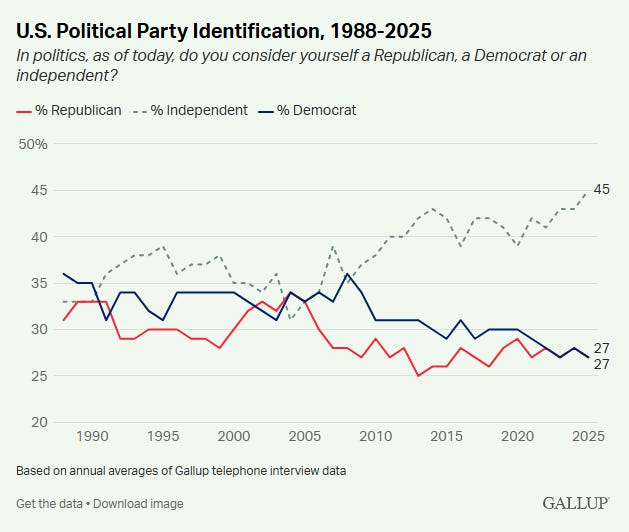
(chart via Gallup)
And we have to acknowledge that voters, especially the young, are disillusioned and so why shouldn’t they vote for some “free” money? We also can’t deny that, for way too many, $5,000 would solve some short-term cash flow problems. For those worried about tomorrow, the longer term can take care of itself.
Even for those not in short-term financial stress, why think about the longer term since there’s a 10% chance AI will kill us all anyway, right? Put differently, even those that may instinctively feel votes are a hard-won right that should not be cheapened by a payout, even those that would not normally think of voting Republican, may decide “whatever, it’s just a stupid election and we’re all screwed anyway”. It wouldn’t take much of a conspiracy theorist to wonder about the timing of the social media fuss around a looming AI apocalypse.
Of course I am not advocating for this line of thought, and I fervently hope that common sense prevails.
And Trump has promised dividends before without delivering, which might mean susceptible voters view his speech with the appropriate scepticism.
But this latest offer comes with a implied condition: a decision at the polling booth. That hits different.
It also sets up a tantalizing yet treacherous path. If it looks like the plan worked, even a little bit, the next frightened ruling party or recklessly ambitious candidate will promise more. And the next one, even more. Of course, each will give a palatable explanation of how it will be paid for. But, in the end, it will come from adding on debt.
That would be a hard sell for the bond market, especially given the likely boost to inflation.
Plus, it wouldn’t be hard to argue for a more productive use of roughly $1 trillion dollars, the estimated total cost of this escapade. For instance, there’s no way of ensuring that the payout is spent in the US, despite Trump’s assurance that it would have to be. A retail CBDC with use restrictions embedded in the code could do it, but the US doesn’t have one and nor will it, since Congress recently passed a law banning the Federal Reserve from issuing a digital currency.
And there’s the probable damage to global confidence in US democracy, which should impact investment flows.
So, it’s unlikely the promise would get the necessary Congressional approval. Hopefully enough sensible officials would understand the fiscal and political consequences and would say no, even if the promise helped win them their midterm race. After all, the Senators that take their seats in January are not up for re-election until 2032, and they will be judged according to how the US economy, markets, currency and world standing are doing then.
But the words were said, the idea was planted, and some elected officials are excitedly preparing the necessary bill.


As a standalone, this is alarming, but not nearly as much as the idea of voter payouts becoming normalized. Once that happens, the debt problem explodes. To keep the economy running, money printing accelerates, so does inflation. The net payout will seem like copper cents compared to the collective wealth destruction.
This is not a slippery slope we want to be on.
Especially because the biggest threat to democracy today isn’t an autocratic populist figure: it’s rising unemployment, and the loss of value in savings as well as fixed incomes either from runaway inflation or an economic slowdown.
And whether or not Trump’s reckless promise gets anywhere, it adds fuel to the fire of uncertainty. True, he says a lot of stuff, usually noise rather than substance and usually not worth more than a passing glance. But this one alarmed me, because it won’t be easy to put this genie back in the bottle.
Which means the debasement play is going to get even more real. Good for gold, good for Bitcoin.
But not good for democracy or the cultural fabric we increasingly take for granted.
