


“Think left and think right and think low and think high. Oh, the thinks you can think up if only you try!” – Dr. Seuss ||
Hello everyone, and happy Friday!!! I hope you have good things planned for the weekend and that the weather wherever you are is not too extreme.
I loved my chat with Marvin Barth yesterday for Press Publish – if you missed it, you can see the playback here.
PUBLISHED IN PARTNERSHIP WITH: ✨ ALLIUM ✨
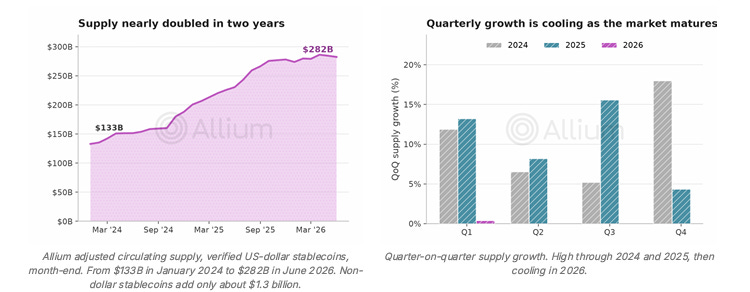
We know stablecoin volumes are climbing, but what about the rate of increase?
Allium research shows that, over the past two years, supply has doubled but the rate of growth is slowing, the signature of a market moving from a land grab into steady infrastructure development.
→ For more, download Allium’s State of Onchain Finance report: https://allium.so/reports/state-of-onchain-finance-q2-26
IN THIS NEWSLETTER
SWIFT and the importance of connectors
Warsh’s heavy-hitting task forces
Term of the day: Count Binface
(The way the EU Chat Control vote was handled is shocking, but I’ll write about that on Monday – it’s more nuanced than the headlines you might have seen imply… but still a very bad omen for what’s coming.)
Crypto is Macro Now offers ~daily commentary and updates on the overlap between the crypto and macro landscapes. Plus links and more.
If you’re a premium subscriber, thank you so much!! ❤
WHAT I’M WATCHING:

SWIFT and the importance of connectors
There are few traditional financial institutions more vulnerable to blockchain disruption than SWIFT, the global transaction messaging platform that connects over 11,500 banks. After all, onchain transactions in theory include both the message and the transfer of value – when value moves directly from A to B, anywhere in the world, you don’t need a separate messaging service.
But that only applies to global, public networks. When you’re looking at a mosaic of permissioned ledgers, you need a coordination layer.
To its credit, SWIFT was quick to see this coming, and knew it had to build itself a role in this evolving landscape. It launched its first distributed ledger proof-of-concept in 2018, and over the years has iterated and tested various applications, eventually landing on a platform to handle cross-border transfers of deposit tokens.
Since then, things have moved relatively fast. The decision was revealed at the entity’s Sibos conference last year, the design was completed by March, and yesterday the platform went live with 17 banks from six continents, including Citi, HSBC, BNP Paribas, BNY, Standard Chartered, MUFG, ANZ, Wells Fargo, DBS, First Abu Dhabi Bank and other big names. It runs on Besu, an open-source permissioned EVM-compatible blockchain.
It’s a clever concept. I’ve written before about the problems with deposit token interoperability which impacts their liquidity and therefore also utility. Consortia and local networks can help, but will always be limited in scope.
