


“The purpose of life is to be defeated by greater and greater things.” – Rainer Maria Rilke
Hello everyone!!!!! What a night… ⚽🏆🎉🎉🎉 Sleep-deprived today, you would not believe the racket in my neighbourhood until the wee hours – but CHAMPIONS!!!!!!
Now for a presumably football-free week…
Production note: 🌞This newsletter will be taking a short break Thursday-Saturday. 🍹
PUBLISHED IN PARTNERSHIP WITH: ✨ ALLIUM ✨
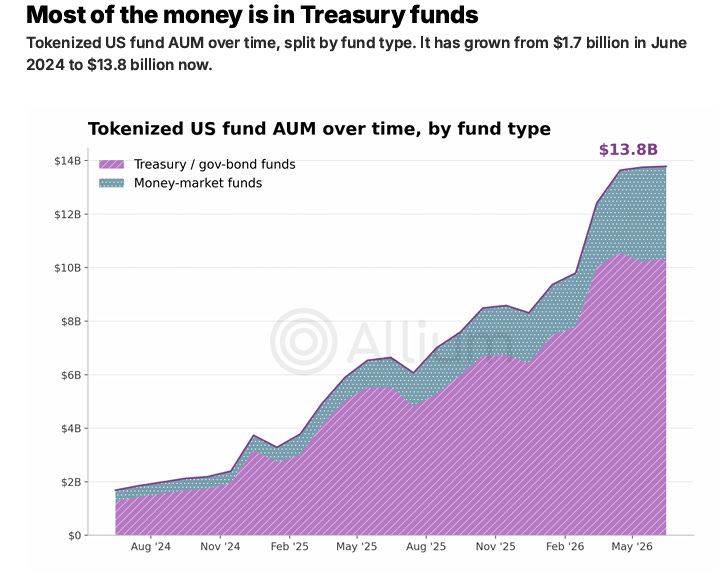
Onchain Treasury funds grew 8x in two years, and currently have around $13.8 billion in AUM.
More than 50% is on Ethereum, concentrated in 5% of wallets. Individual holders prefer lower-fee chains such as Arbitrum, which has 28% of wallets but just 1% of assets.
Want to know more about tokenized fund distribution?
→ For more on tokenized funds, download Allium’s State of Onchain Finance report: https://allium.so/reports/state-of-onchain-finance-q2-26
IN THIS NEWSLETTER
Coming up this week
Monday musings: The AI tide goes out?
Term of the day: Open-weight models
Crypto is Macro Now offers ~daily commentary and updates on the overlap between the crypto and macro landscapes. Plus links and more.
If you’re a premium subscriber, thank you so much!! ❤
✨ Monetary Forces: tomorrow, Izabella Kaminska and I pick at the key headlines that paint the picture of how technology is changing finance. Come join us!
Tuesday, July 21 @ 10am EST / 4pm CEST / 3pm BST
Livestream link: https://open.substack.com/live-stream/284760
WHAT I’M WATCHING:

Coming up this week:
A light week for macro data, and also macro speeches as the Federal Reserve enters its blackout period in the runup to its FOMC meeting next week.
Today, Andy Burnham became the seventh UK Prime Minister in 10 years, after formally becoming the leader of the Labour Party on Friday.
Later, we get the US June Conference Board leading index.
Wednesday brings Q2 results from Alphabet, Tesla and IBM.
On Thursday, the ECB meets to decide on interest rates, with no action expected.
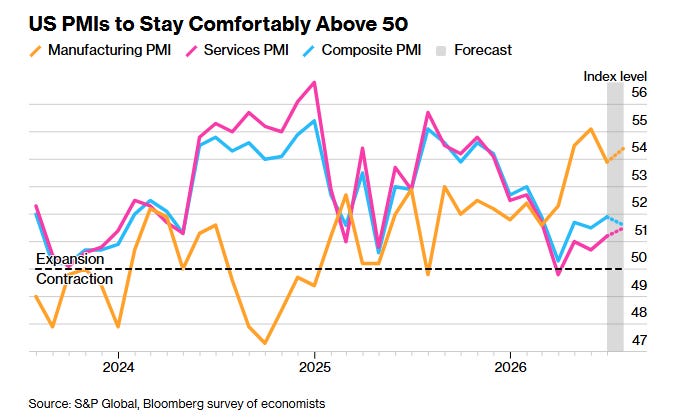
Friday brings global Purchasing Managers Index data from S&P Global, with that for the US expected to show continued improvement in both manufacturing and services activity.
(chart via Bloomberg)
Monday musings: The AI tide goes out?
(what’s on my mind as we head into the week)
It wasn’t that long ago that the unveiling of DeepSeek gave the US stock market a much-needed jolt out of its complacency – it was astonishing back then how few had even considered that China could compete on AI agents.
But investors didn’t take long to pick themselves up, dust themselves off and continue to ride the ingrained assumption that the US would easily win the AI race, and that demand was of course going to exceed expectations so let’s chase those valuations up.
This was despite many of us asking the relevant questions yet getting no thought-through answers: where is this expected demand going to come from and how will it be monetized? What assumptions underpin the eye-watering earnings expectations? And how will the US stop China from doing what it’s good at: recreating good-enough models better and cheaper?
A vibe shift
On Friday, we got two loud signals that these questions are about to start to matter a lot.
1) Chinese leader Xi Jinping spoke at an AI conference in Shanghai. He stressed the importance of AI cooperation, how one of the most urgent tasks is establishing global governance, and China’s intention to work with partners to extend applications. It will set up AI cooperation and training centres in developing countries around the world. And 29 have signed up to join the China-led World AI Cooperation Organization.
Compare this to the US initiative Pax Silica, in which 24 mostly Western countries have committed to reducing supply chain dependence on China for critical AI components, but don’t get assured access to frontier models in exchange.
For China, AI is a public good. For the US, it’s a private profit-seeking asset with national security implications. Which approach do you think will more rapidly gain global adoption?
2) Also last Friday, Chinese AI lab Moonshot released its latest model, Kimi K3, which reportedly beats all US models except for Fable 5 and GPT-5.6, and even those on some parameters. The cost of access to the model is roughly 70% less that of its US competitors. And on July 27th, it becomes open-weight, which means anyone can download and iterate on it (see below for a longer explanation of the term).
This raises further uncomfortable questions: why would global AI adopters use the more expensive closed US models? Some will argue that the Chinese models can’t be trusted to give impartial answers – as if the US models can. And not all users rely on AI to discuss politically sensitive questions.
Extend that line of questioning and you get to the alarming one: what, again, is underpinning the earnings expectations from the leading US AI companies?
The thing is, the accumulating stress is not just about expectations and valuations – who knew they could get ahead of themselves in a tech frenzy. The last numbers I’ve seen for OpenAI and Anthropic put them at valuations of almost $1 trillion each. SpaceX listed last month at a price that gave the unprofitable company a $1.8 trillion valuation.
No, the stress is more to do with market structure. SPCX is now trading 45% below its post-listing high, itself a signal. But it’s the silent signals that are potentially more destructive.
We’re not going to see similar revaluations of SpaceX competitors, because they are private and have no interest in publicly acknowledging the new reality. But it’s telling that OpenAI is reportedly considering postponing its IPO.
Investors in OpenAI and Anthropic also have no interest in publicly acknowledging the new reality, as they are mostly private funds who do not want to have to mark down their investments.
Hiding in plain sight
Lifting the lid on the private funds’ impact reveals how messy this could get.
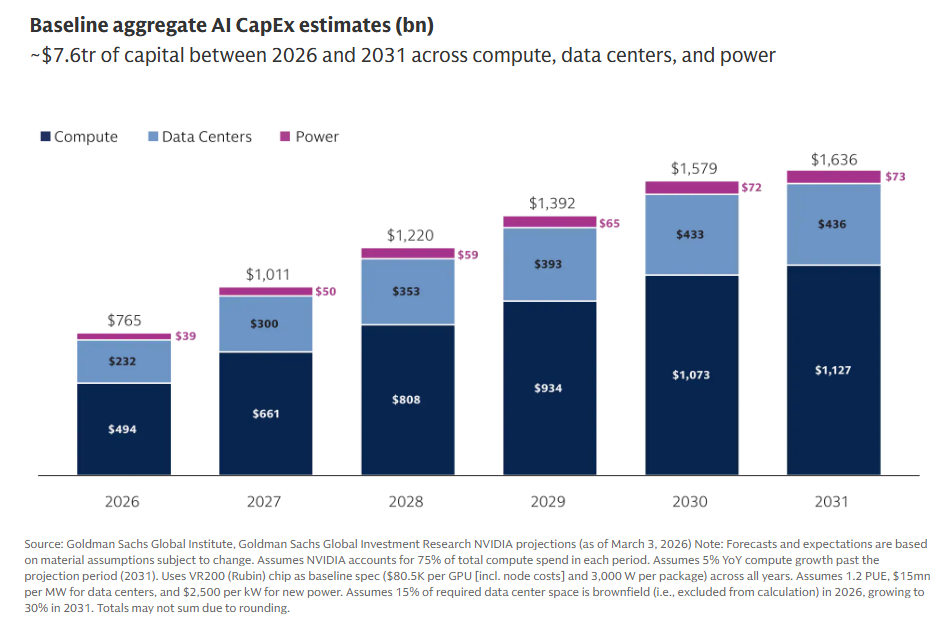
Training AI models and building datacentres requires a ton of capital. Goldman Sachs estimates that expenditure plans for 2027 are on track to exceed $1 trillion, and that the total between now and 2031 will reach roughly $7.6 trillion.
(chart via Goldman Sachs)
For context, that is almost 50% of all US commercial bank lending outstanding today.
Of course, not all of it will come from commercial banks. A considerable amount, yes – AI-related financing is one of the drivers behind last week’s strong US bank earnings reports.
But private credit is playing an increasingly important role. Last week, Morgan Stanley published a report suggesting it could supply roughly half of the external financing needs for datacentre investments alone.
And according to a report out in May from the Financial Stability Board, the AI industry accounted for more than a third of private credit deals in 2025, up from just over 15% in the previous five years.
Any walk-back of either planned expenditure or cash flow expectations would squeeze private credit funds. Only, they have already been feeling pressure from the weakening outlook for software companies as AI agents take over many of their functions – the enterprise services sector is estimated to account for roughly 25% of private credit loans. Redemption requests are reportedly surging, several funds have suspended or capped withdrawals, and lenders are starting to pull back.
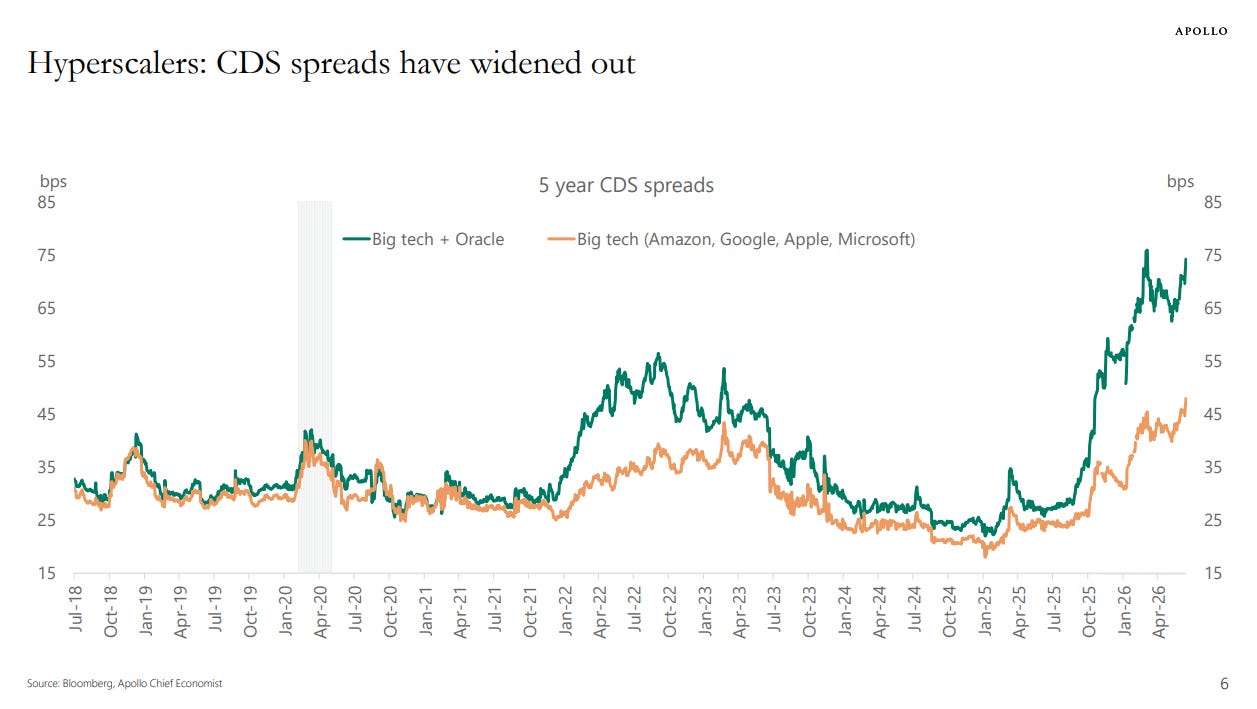
The squeeze could get worse as concerns build around the health of AI-related credit. We’re starting to see this in public markets via the uptick in CDS spreads on the massive amount of corporate bonds issued by hyperscalers.
(chart via Apollo Academy)
It gets political
Here’s where it gets sticky.
