


“One of the great mistakes is to judge policies and programs by their intentions rather than their results.” — Milton Friedman
Well, well, the US political outlook sure has changed…
IN THIS NEWSLETTER
The bigger lesson in electoral waves
The market reaction
Crypto is Macro Now offers ~daily commentary and updates on crypto’s evolving role in the changing geopolitical and financial landscapes. Plus links and more.
If you’re a premium subscriber, thank you!! ❤
PUBLISHED IN PARTNERSHIP WITH: ✨ ALLIUM ✨
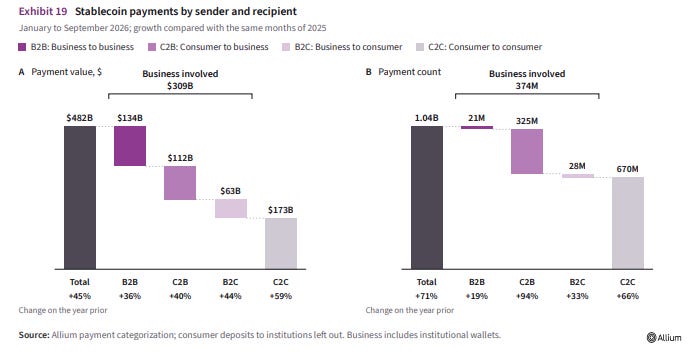
Most stablecoin payment value involved a business while most payments were between consumers. Businesses were involved in 64% of the $482 billion in payments Jan-Sept 2026, but consumer-to-consumer transfers made up 64% of the total payments count of 1.04 billion.
Download Allium’s State of Stablecoins and Payments Q3 2026.
And get weekly onchain data and more analysis like this from the Allium Research team on Substack.

WHAT I’M WATCHING

The bigger lesson in electoral waves
Well, that was quite something.
As I wrote yesterday, it was not clear as voting started that the Democrats would take control of the US Senate… but boy, did they ever. And they swept the House, doing better than even the most optimistic projections. And they won some key governorships. And, and, and…
The most resonant takeaway is the stunning rebuke of President Trump – inflation, the war, the aggressive support for data centers, the re-districting manipulation, the sense that the “common touch” that won him the election had been replaced by an obsession with reflecting pools and ballrooms.
It’s impossible to list here all the seismic shifts that redrew the US political map, but the ones that most stand out include:
The Democrats needed 218 House seats to control the majority – tallies are still coming in, but they’re already up to 228.
They needed to flip four Republican senate seats to reach 51 – so far, they have flipped seven, pushing the total up to 54, and there are still a couple of states yet to report.
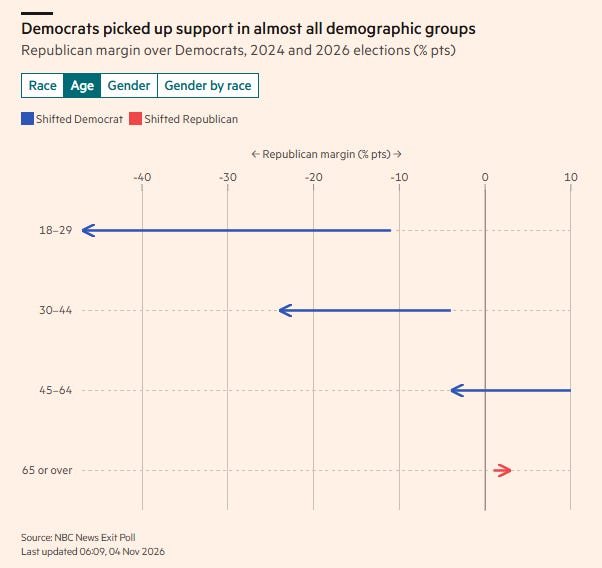
According to the FT, almost three quarters (72%) of 18- to 29-year-olds voted Democrat, up from just over half (54%) two years ago.
(chart via the Financial Times)
Texas has its first Democratic senator since the late 1980s – James Talarico is only 37 years old.
Gina Hinojosa becomes the first Democrat governor of Texas since 1991, and its first Hispanic governor ever.
Pastor Adam Hamilton becomes the first Kansas Democrat elected to the Senate since 1932.
With the win of paediatrician Annie Andrews, South Carolina will have its firs Democrat senator since 1998.
Maine’s Republican senator for the past 30 years, Susan Collins, lost to Democrat Troy Jackson.
Both Iowa and North Carolina elected their first Democrat senators – Roy Cooper and Josh Turek – in 18 years.
The Republican House candidates lost in all the Florida districts the Republicans had re-drawn in order to boost their chances of winning.
There are so many more eye-opening anecdotes from last night… but enough wallowing in the drama.
In question now is what happens in Iran. Trump has said there are no immediate plans to strike, but he said the opposite a few days ago so who knows. The message that this war is resoundingly unpopular has been delivered, and there have been no military or strategic signs yet, eight months in, that it is winnable. Accepting that sooner rather than later could limit the damage to the Republican Party as attention turns to the 2028 election.
Flexing his renowned social media instinct, Iran’s Speaker of the Parliament took the opportunity to suggest that Trump was not serving the American people, and to remind them of the cost of escalation.

As for Netanyahu, it’s possible that Trump blames him for getting the US into the war in the first place. Yesterday – note the timing – Trump said that aid to Israel would end at the end of the year. It’s possible that by then Netanyahu is no longer Israel’s leader as the recent elections have not yet produced a clear winner, and his prospects just dimmed.
Also in question is the trade map – will beleaguered partners continue negotiations in good faith, or will they try to draw things out in the hopes the current momentum continues until 2028?
And the outlook for data centres ran into a reckoning. Among the crowd of things to vote on last night were 45 local ballots to on data centre construction: of the 34 fully counted by 6am ET this morning, 33 voted to restrict.
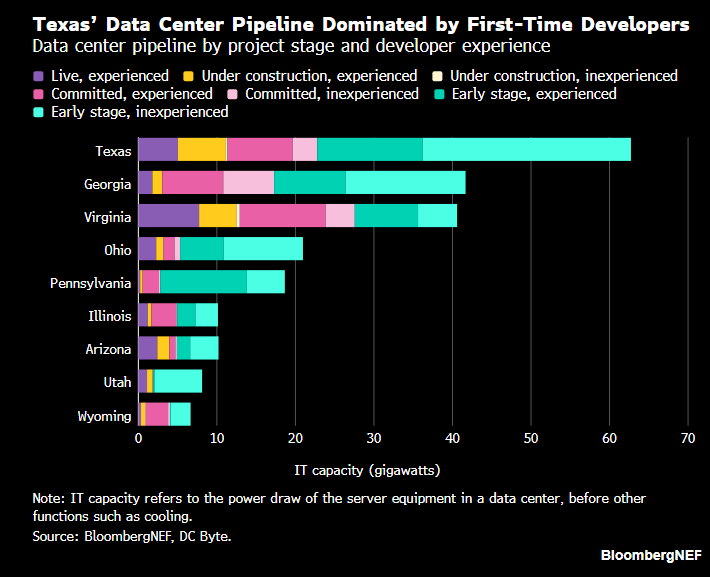
What’s more, the Democratic sweep in Texas is significant, given the state’s lead in planned data centre construction, the vast majority of which is in early stages and can be stopped. One of the campaign promises of incoming governor Gina Hinojosa was an immediate moratorium on data centre permitting in the state.
(chart via @AnnaEconomist)
In Georgia, one of the fastest-growing data centre hubs, incoming Democratic governor Keisha Lance Bottoms has promised a temporary state-wide pause.
In Ohio, also one of the key US data centre hubs, incoming Democratic governor Amy Acton has promised a conditional freeze on new permits until requirements on union labour, environmental standards, community benefit agreements, costs and transparency are met.
None of this will bring data centre expansion to a halt – but it will add to the ongoing slowdown of planned growth, and should send analysts back to the drawing board on their earnings forecasts and studies of credit worthiness.
There’s a much bigger takeaway from yesterday’s results, however, that feels overlooked, both in the US and elsewhere. Peering past the post-election noise of popping champagne corks and angry pointing of fingers, we glimpse a fundamental feature of American life: the escape valve that is democracy, the opportunity it gives for peaceful change when a country wants it. The system worked yesterday, just as it has done every two years going back a very long time. This is one big lesson from the recent drama that I hope the whole world comes to appreciate just a little bit more: democracy is always under threat, from forces both obvious and invisible. And it is rarely perfect and should never be without challenge. But it works, and is worth fighting for.
