


“Those who cannot change their minds cannot change anything.” ― George Bernard Shaw ||
Hello everyone! I hope you’re all doing well. I have found it hard to concentrate today as Pope Leo XIV is hosting a vigil for over a million people on Saturday just a couple of blocks from where I live, and they’re testing the sound system for the giant screens and speakers mounted up and down the main avenue. Distracting, I won’t lie, but the general buzz of excitement is palpable and refreshing. Although let’s see if I still feel this way tomorrow.
PUBLISHED IN PARTNERSHIP WITH: ✨ ALLIUM ✨
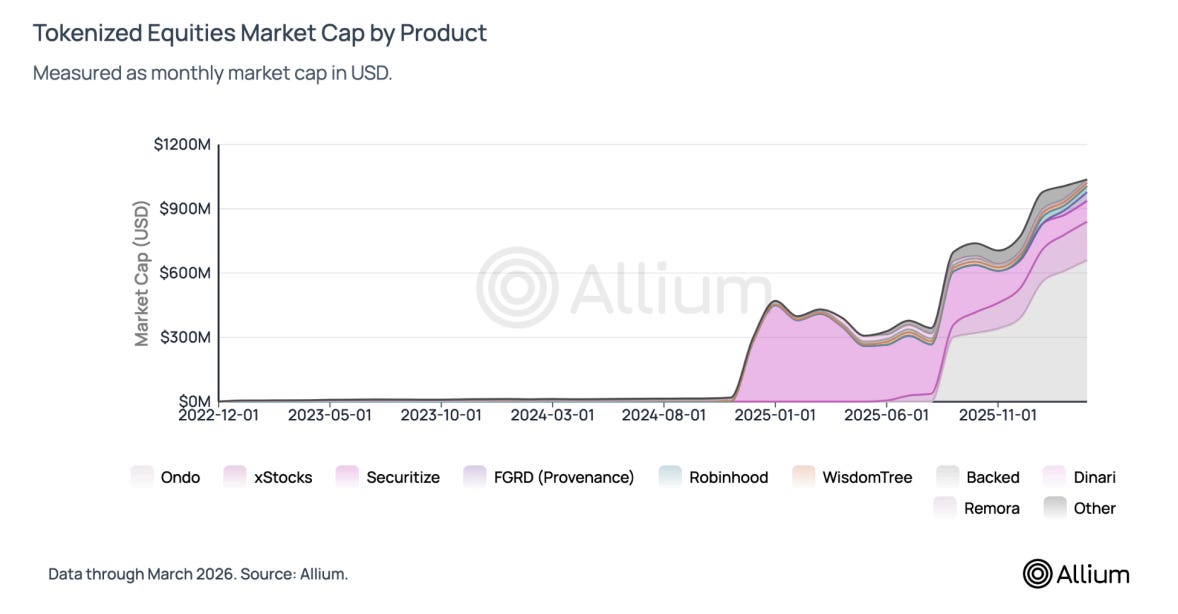
Tokenized equities hit ~$1B in supply since launching in mid 2025. The market structure is more interesting than the milestone.
Allium’s latest research covers where liquidity actually lives, how tokenized prices compare to traditional equities, overnight price discovery, and why ~90% of volume is outside the US.
For fintech platforms, exchanges, institutional investors, and builders evaluating the tokenized equities opportunity.
→ Read the report: https://www.allium.so/reports/allium-tokenized-equities-report-q1-2026
IN THIS NEWSLETTER
The changing shape of reserves
Markets: mining the data
Term of the day: realized profit/loss
Crypto is Macro Now offers ~daily commentary and updates on the overlap between the crypto and macro landscapes. Plus links and more.
If you’re a premium subscriber, thank you so much!! ❤
WHAT I’M WATCHING:

The changing shape of reserves
One of the recurring themes I write about in this newsletter is the changing monetary structure of global finance. This compelling topic draws on the politics of stablecoins, deposit tokens and other onchain representations of money-like assets. It also covers the geopolitical use of CBDCs, the looming threat of capital controls and other methods to more directly influence how money is used. And, it touches on the changing role of the US dollar in global finance: the weaponization of access, the emergence of alternatives and what that suggests for reserve balances going forward. Ultimately, all this is changing our understanding of what money is.
I could write volumes on this (and probably will, so stay tuned), but given today’s limitations of time and space, I want to focus on two pieces of news I’ve seen this week that are ringing a shiny bell.
