


“It is usually futile to try to talk facts and analysis to people who are enjoying a sense of moral superiority in their ignorance.” – Thomas Sowell ||
Hello everyone! I hope you’re all taking care of yourselves – this week feels like a marathon already.
A long one today, with a TON of charts.
🌹Production note: 🌹 it’s a public holiday on Friday where I live, so this newsletter will skip publication. Tomorrow I’ll tell you about San Isidro, our patron saint, you’ll like this story.
PUBLISHED IN PARTNERSHIP WITH: ✨ ALLIUM ✨
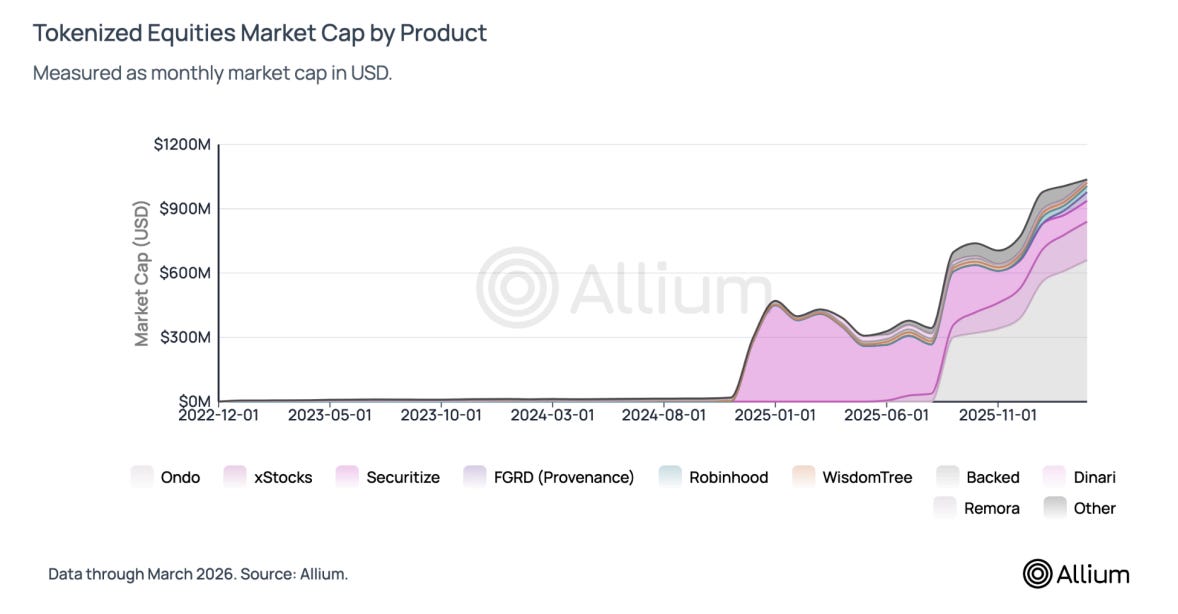
Tokenized equities hit ~$1B in supply since launching in mid 2025. The market structure is more interesting than the milestone.
Allium’s latest research covers where liquidity actually lives, how tokenized prices compare to traditional equities, overnight price discovery, and why ~90% of volume is outside the US.
For fintech platforms, exchanges, institutional investors, and builders evaluating the tokenized equities opportunity.
→ Read the report: https://www.allium.so/reports/allium-tokenized-equities-report-q1-2026
IN THIS NEWSLETTER
The CLARITY markup: what to watch for
Macro: US inflation warming up
Markets: building steam
Macro: a tightening jobs market
Term of the day I: Trimmed mean
Term of the day II: Sticky inflation
Crypto is Macro Now offers ~daily commentary and updates on the overlap between the crypto and macro landscapes. Plus links and more.
If you’re a premium subscriber, thank you so much!! ❤
WHAT I’M WATCHING:

The CLARITY markup
Heading into tomorrow’s CLARITY Act markup by the Senate Banking Committee, here are the key features of the latest draft:
No interest on stablecoin balances, with a $5 million penalty for breach. The latest draft adds Treasury as rulemaker, joining the SEC and the CFTC. Reporting requirements on deposit outflow and on Treasury market effects were expanded.
The Blockchain Regulatory Certainty Act (BRCA) is still in there, clarifying that developers of non-custodial services will not be considered money-transmitters as far as that activity is concerned. A carve-out was added, however, for any developers that deliberately help to move or store illicit funds – they will be charged under money transmitting laws (and probably a few others as well).
The “tokenization of securities and real-world assets” section is reduced to just covering securities under the purview of the SEC, rather than the joint SEC-CFTC regime contemplated in the previous draft. Tokenization of swaps and other types of derivatives would be under the CFTC – since these aren’t specified in this law, they could in the future be subject to legal challenge.
The Regulation Crypto exemptions, which relieve token issuances from the requirements of full securities registration, have been tightened to a token issuance value of $50 million per year (was $75 million), or 10% of the total amount already issued, whichever is greater.
The SEC will have flexibility to adapt the regulatory requirements if it deems that necessary.
And for some reason an unrelated housing bill has been thrown in, to incentivize community development of residences. Because of course.
There is still no ethics text to prevent government officials from issuing tokens, but that will probably be added in markup.
Senators had until 5pm ET yesterday to file amendments, and I gather there are over 100, with 43 just from crypto opponent Senator Elizabeth Warren. The Banking Committee will work through these tomorrow, deciding which ones to incorporate.
One proposes a ban on the Federal Reserve granting master accounts to crypto companies. That could be problematic.
The opposition is fierce – according to reports, the American Banker Association sent more than 8,000 letters to Senate offices urging lawmakers to stop the stablecoin yield compromise. Two Democrat senators (Jack Reed from Rhode Island and Tina Smith from Minnesota) have embraced the bank lobby arguments and introduced an amendment that would force senators to choose between the bank’s version of stablecoin yield and the Senate Banking Committee compromise. Not pretty.
In sum, while any progress is good, there is still much that could go wrong tomorrow. And to ensure passage on the floor of the Senate, the Committee needs more than just the partisan majority, it needs a handful of Democrat senators to vote in favour. If it doesn’t get that, we can expect the current Polymarket odds of passage this year - currently around 60%, not a slam dunk - to drop sharply.
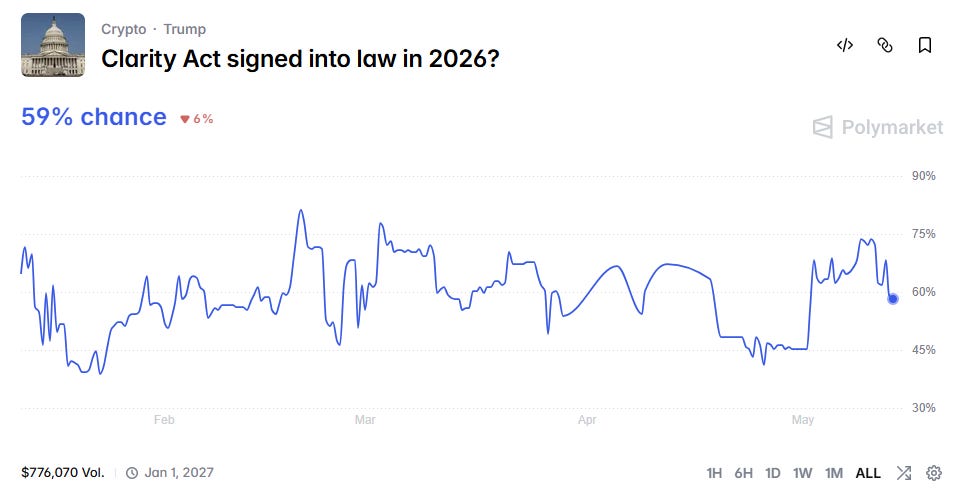
(chart via Polymarket)
