


“In times of change, learners inherit the earth, while the learned find themselves beautifully equipped to deal with a world that no longer exists.” – Eric Hoffer ||
Hey all, welcome to August! The summer is going by too fast.
👀 You’re reading Crypto is Macro Now, which covers the role of crypto in the changing plates of finance, economics, politics, culture and markets. 👀
PUBLISHED IN PARTNERSHIP WITH: ✨ ALLIUM ✨
A futures market on compute?
GPU rental prices are starting to trade months ahead. Take Nvidia’s B200, its flagship AI chip: It costs about $6.58 an hour to rent today.
Kalshi and Polymarket now let traders take positions on what that hourly rate will be months from now.
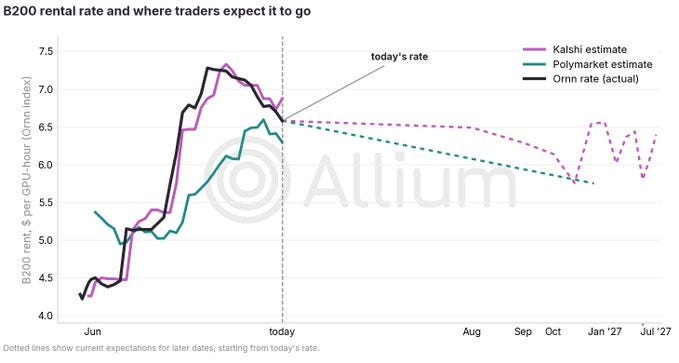
→ Download the report: https://allium.so/reports/gpu-rental-prediction-markets
IN THIS NEWSLETTER
Coming up this week: US jobs data
Monday musings: The cost of geopolitical manipulation
Crypto is Macro Now offers ~daily commentary and updates on the overlap between the crypto and macro landscapes. Plus links and more.
If you’re a premium subscriber, thank you so much!! ❤
WHAT I’M WATCHING:

Coming up this week: US jobs data
A big week for macro data with the flurry of US jobs reports. Other than that, some geopolitical flexing, and maybe, just maybe, some movement on the CLARITY Act before the Senate takes a summer break – one can hope.
Yesterday, President Trump said that another round of US-Iran talks would begin today. Iran says they won’t, nor are there any plans for meetings.
Today we get updated US Purchasing Managers Index data for the manufacturing sector for the month of July, expected to remain in gentle expansion.
On Tuesday, we get the latest Job Openings and Labor Turnover Survey report, forecast to show a moderate slowdown.
In Rome, Israel and Lebanon begin another round of talks.
And SpaceX delivers its first quarterly earnings report as a publicly listed company.
Wednesday brings the private sector ADP payrolls report, with consensus expectations pointing to a net increase of 75,000, lower than June’s 98,000 gain.
We also get the latest US Purchasing Managers Index reports for the services sector and for the economy as a whole – both are expected to move more into expansion territory.
And Taiwan begins its annual five-day defence readiness drills simulating China conflict scenarios. Chinese media calls these “a psychological placebo”.
On Thursday, we get the preliminary Q2 Unit Labor Cost report, a gauge of productivity – growth is forecast to pick up from 1.8% to 2.7% quarter-on-quarter.
Friday brings the official US jobs report, expected to show an 85,000 net increase in payrolls, which would be good news after June’s disappointing 57,000 gain. The unemployment rate is forecast to hold steady at 4.2%.
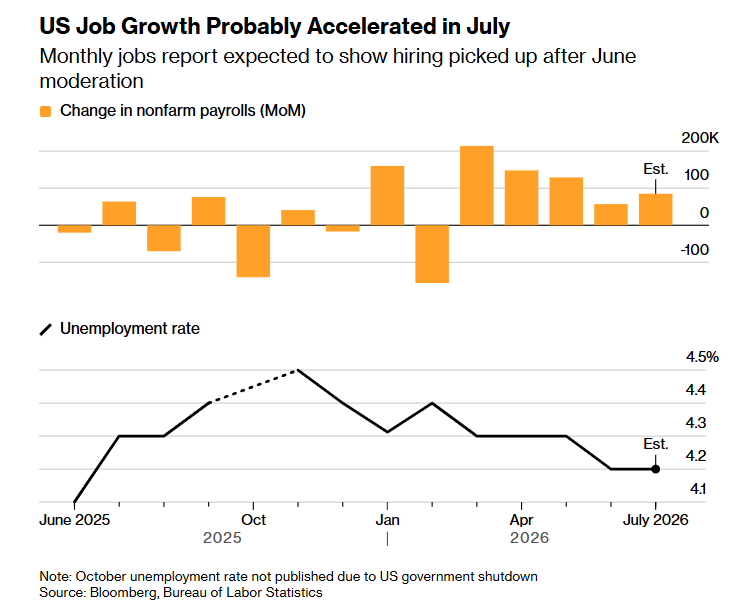
(chart via Bloomberg)
Monday musings: The cost of geopolitical manipulation
(what’s on my mind as we head into the week)
Unless you’ve been staying away from the news (totally understandable), you’ve probably seen or at least heard about the shocking images from Ceuta of rivers of migrants pouring into Spanish territory. You might even have been distracted by the loud political reaction from across the spectrum. You probably have some strong opinions of your own.
As usual, the noise is part of the play – distract with triggers, exhaust with arguments. It almost always works.
And yet, as usual, the deeper narrative lies elsewhere. This incident is not about land claims or borders, it’s not really about Spain, it’s not even about immigration (although of course all three factors are present).
Below, I’ll summarize what happened and the likely reasons. I’ll then touch on how this impacts the geopolitical chessboard, where this fits into my interregnum map, and what this means for markets.
What happened
Last Thursday, reports started coming through of a surge of migrants crossing from Morocco into Ceuta. The story itself is not new, we’ve seen this many times before. What was unusual this time was the scale and the route.
The numbers were indeed jaw-dropping: roughly 60,000 migrants crossed over into Spanish territory. For context, this is over 70% of Ceuta’s native population.
And, unlike most previous border assaults, the migrants were not storming the land barrier – the majority took to the sea and swam around the breakwater. It’s not an easy swim given the currents and the rocks. Police say that around 60 people died in the water.
Probably relevant: A few weeks ago, the Spanish Supreme Court ruled that those who get to Ceuta by swimming will not be immediately sent back, they will instead enter a more lengthy process.
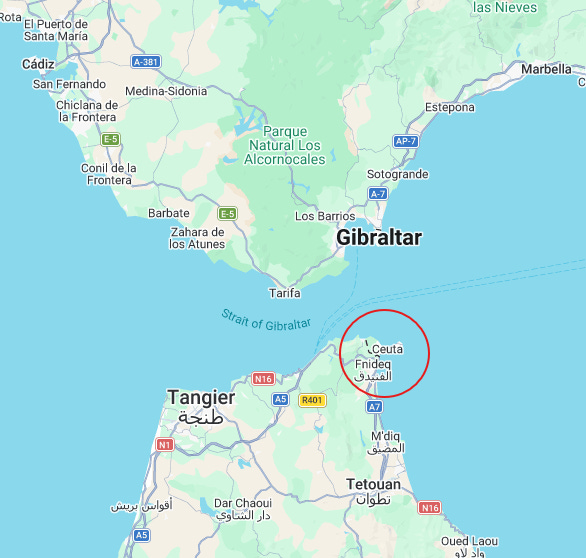
By Friday, the political reaction machine had kicked in, especially from fellow EU members already upset at Spain’s lax immigration policy. Italy announced the suspension of the Schengen Agreement (an EU treaty allowing unrestricted movement between member countries) with Spain. Only, it turns out it can’t legally do that, so it then retreated to promising “random controls” and we all know what that means.
On Saturday, 22 (out of 27) EU members signed a letter to the bloc’s leadership expressing concern and pointing to the Supreme Court swimming decision as a trigger. Spain’s Prime Minister Pedro Sanchez in turn sent a harshly worded missive to EU Commission President Ursula von der Leyen denouncing the “misinformation and prejudice” as well as a lack of European solidarity and a familiarity with the law – Ceuta is not part of the Schengen agreement, and does not allow unchecked entry into Europe.
Meanwhile, the local authorities were erecting a floating barrier to stop more swimmers from reaching Ceuta’s shoreline. By then, officials were insisting that most of the new arrivals had returned to Morocco.
A tragic and infuriating episode that cost the lives of almost 90 young people – behind it all, some absurd geopolitics.
The back-room strings
Many on-the-ground reports insist that Moroccan authorities did nothing to stop the flow – rather, they waved the migrants through, but only if they looked Moroccan. They’re not supposed to do that. What’s more, Spanish press reports that police found Moroccan intelligence agents among the migrants. And the surge was reportedly triggered by social media posts from new accounts announcing that the border was open – these accounts have since disappeared.
So, is this a message from Morocco?
Some regional context might be useful.
