


“Humans beings always do the most intelligent thing… after they’ve tried every stupid alternative and none of them have worked.” – R. Buckminster Fuller
Hello everyone! I hope you’re all taking care of yourselves and managing to either navigate or ignore a surreal news flow. 🎃
IN THIS NEWSLETTER
The Fed: Empty patter and shrinking flexibility
Unrest in Spain: When a simmer becomes a boil
A couple of good reads
Crypto is Macro Now offers ~daily commentary and updates on crypto’s evolving role in the changing geopolitical and financial landscapes. Plus links and more.
If you’re a premium subscriber, thank you!! ❤
PUBLISHED IN PARTNERSHIP WITH: ✨ ALLIUM ✨
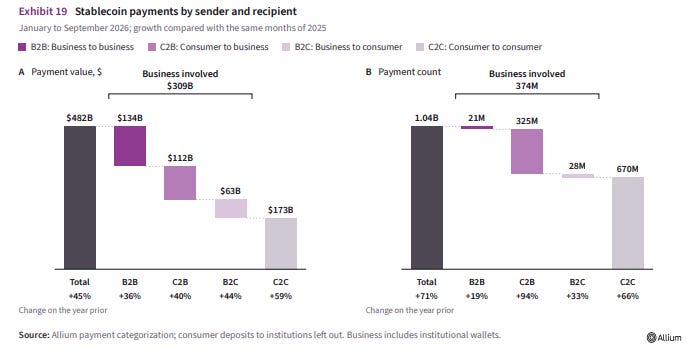
Most stablecoin payment value involved a business while most payments were between consumers. Businesses were involved in 64% of the $482 billion in payments Jan-Sept 2026, but consumer-to-consumer transfers made up 64% of the total payments count of 1.04 billion.
Download Allium’s State of Stablecoins and Payments Q3 2026.
And get weekly onchain data and more analysis like this from the Allium Research team on Substack.

WHAT I’M WATCHING

The Fed: Empty patter and shrinking flexibility
For the first time in ages, I skipped the FOMC press conference last night. (Instead, I found myself in the midst of a riot, more on this below.)
When Warsh first took office, I found his smoothness refreshing – but that lasted all of one session of him saying nothing at all while oozing charm and leveraging the good suit and the politician’s body language. Now, I find his empty patter annoying if not slightly condescending. And apparently, it was in full flow last night.
From reports, I gather he used a liberal sprinkling of filler phrases such as “information-rich”, “doubled down”, “monetary medicine”, “looking out the window”, “willingness to act” – and the top contender for the cringe award: “interrogating reality”.
He also managed to avoid actually answering any pointed questions, instead regurgitating tired talking points.
There was one surprise announcement: next year, one meeting will be set aside for discussing strategy rather than setting rates. In 2028, that number will increase to two.
While this fits in with Warsh’s reluctance to engage with the public, in reducing the number of rate-setting meetings from eight to seven, it does remove some of the central bank’s flexibility to react to economic conditions. By 2028, when it drops to six, it will be a quarter less flexible than it is today, and it may find that as a result it over-reacts in the available window. Of course, it can change monetary policy outside the scheduled meetings, but that tends to be more disruptive for markets.
Still, a positive could be that (although this was not specified) the strategy-focused meetings won’t involve the usual session of questions-and-non-answers. Fewer FOMC press conferences would be a good thing.
