


“There was never a good war or a bad peace.” – Benjamin Franklin ||
Hello everyone! I hope you’re all doing well… I’m sure I’m not the only one that almost wept with relief this morning.
PUBLISHED IN PARTNERSHIP WITH: ✨ ALLIUM ✨
As traditional finance and crypto converge, trusted data is the missing infrastructure layer. Allium provides this data foundation for teams like Visa, Stripe and Grayscale.
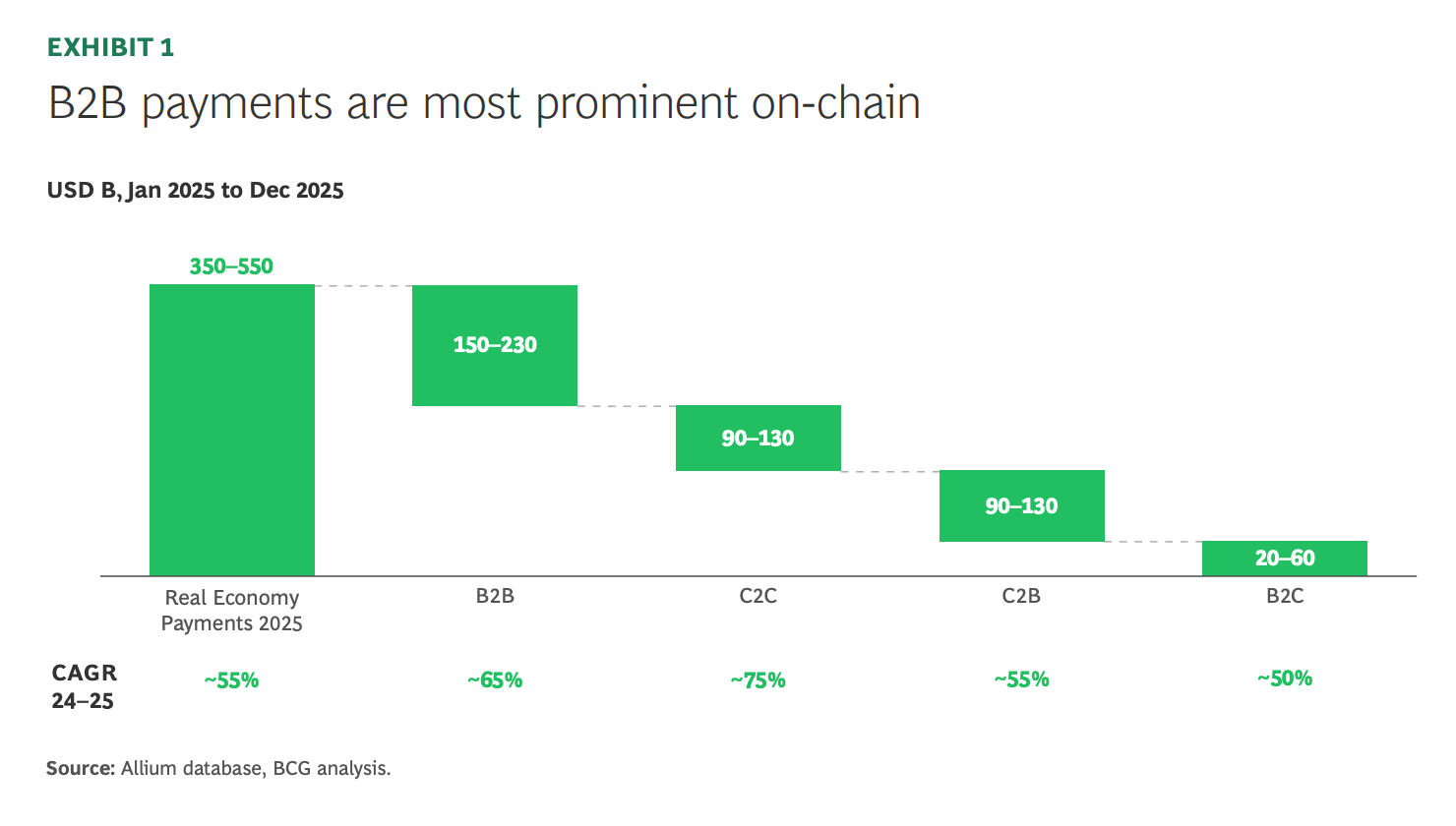
The latest whitepaper published with BCG, Stablecoin Payments: The Truth Behind the Numbers, examines how stablecoins are being used in the real economy today. The analysis estimates $350–550B in on-chain payments in 2025, led by $150–230B in B2B activity, with consumer flows contributing another $200–320B.
If you’re producing institutional crypto research or analytics, start with trusted data. Explore a live demo.
IN THIS NEWSLETTER
Term of the day: naphtha
Markets: the relief
The geoeconomics of bitcoin-backed bonds
Crypto is Macro Now offers ~daily commentary and updates on the overlap between the crypto and macro landscapes. Plus links and more.
If you’re a premium subscriber, thank you!! ❤
WHAT I’M WATCHING:


✨ Use the discount code MACRO for 20% off!
Term of the day: naphtha
(Hi all! Introducing a new feature: definitions. With so much jargon floating around, I want to help clarify confusion while poking at semantics, and refresh overall understanding of relevant terms and sometimes phrases.)
Naphtha is a liquid petroleum product that few have heard of (or can spell) but without which our modern society could not function.
It’s an essential component of most plastics – think garbage bags, food packaging, water bottles, medical supplies, electronics and a whole lot more. It’s an industrial solvent – cleaning products, paint, ink, adhesive, etc. It’s a key component in synthetic rubber which goes into tires, pipes and more. It’s mixed with crude oil to produce some types of gasoline, and it’s involved in the production of some chemicals.
Highly flammable, it is usually between colourless and pale yellow, and smells like gasoline. The largest single-country exporter is Russia, which accounts for around 30% of global traded volume; the Middle East (UAE, Qatar, Saudi Arabia and Bahrain) as a bloc accounts for almost 50%. Most naphtha exported via the Strait of Hormuz heads towards Asia, where factories have been reducing output of finished goods. Starting a couple of weeks ago, I’ve been stocking up on garbage bags as they are one plastic household item I can’t think of a substitute for.
✨Introducing “Press Publish”✨
This Friday, I’m launching a Substack live series – not on crypto nor macro (coming soon!), but on writing newsletters. At 11am ET (5pm CET, 8am PT), I’ll be talking to fellow newsletter writers about why we do what we do, what our days are like, our frustrations, our wins, our advice, where we think media is going and a lot more.
I’ll be kicking it off with my friend and former colleague Christine Kim, one of the leading experts on the Ethereum ecosystem, now also covering Bitcoin, and the author of the ACD After Hours and BTC Before Light newsletters, host of the Ready for Merge and the Meet the Developers podcasts, and more besides. (You can see her recent publications here.)
So, if you’re interested: Friday, April 10th, at 11am ET - join us here.
Markets: the relief
It’s still too soon to know any accurate details about what happened overnight, but the important point, the very big deal, is that there was no “obliteration” and that it looks like a temporary ceasefire is in place. We can hope.
In a Truth Social post 90 minutes before last night’s 8pm ET deadline, President Trump said that, since the US has “already met and exceeded all Military objectives”, the US will hold off on attacking Iran for a period of two weeks, subject to the complete reopening of the Strait of Hormuz.
About half an hour later, in a post on X, Iran’s Foreign Minister Seyed Abbas Araghchi confirmed that if attacks on his country are halted, its “Powerful Armed Forces will cease their defensive operations”.
Both posts stress, using eerily similar face-saving wording, that the US and Iran are acquiescing to requests from Pakistani Prime Minister Shehbaz Sharif – in a separate post, Sharif invited negotiating teams to Islamabad this Friday to start talks. The respective teams will apparently be led by Vice President Vance and Speaker of the Iranian Parliament Mohammad Bagher Ghalibaf.
Cracks are already emerging as Israel’s Prime Minister Benjamin Netanyahu is insisting that his country’s war against Hezbollah is not part of the ceasefire – the Iranians disagree, and are promising to bomb Tel Aviv if the “operations” against their ally don’t stop immediately.
In Trump’s ceasefire post, he said that the US had received a 10-point proposal from Iran which he sees as “a workable basis on which to negotiate”. This is not the same as accepting the proposal, and the English-language version we’re seeing is very different from a version circulating in Persian language media. The former includes the lifting of sanctions and a $2 million transit fee for each ship passing through the Strait of Hormuz to be shared between Iran and Oman. The latter includes demands that the US promise to pull all troops out of the region, cease any aggression against Iran or affiliated groups, accept Iran’s right to enrichment, lift all sanctions and compensate Iran for damages. Lost in translation, perhaps?
There are so many factors that could derail the progress, but the pause is unequivocally good news. The war is not over; but there is now a willingness to negotiate. Unfortunately, “escalate to deescalate” seems to work.
On the surface, the posts overnight look like Iran called Trump’s bluff and the US backed down, and that does feel plausible. But if Iran’s nuclear capability is severely damaged, Trump will claim victory, and we could in coming months see the economic dislocation lead to regime change – a long shot given the country’s boost in international standing, but not out of the question. Since the ceasefire announcements, both sides have been posting away about how weak and desperate the other is, which suggests that the negotiations are not going to go as smoothly as we all hope. Plus, we don’t yet know whether ships will actually start leaving the Gulf via the Strait of Hormuz – Iranian sources are saying that only 10-15 a day will be allowed through (vs a pre-war rate of 100-140).
Still, while I expect to be writing in coming days about how the market is overreacting on the upside to the change in the global outlook, today we can allow ourselves a day of relief-fuelled celebration.
The sharpest market impact is, unsurprisingly, in the oil price – the Brent crude benchmark plunged below $100/barrel and is hovering at around $93 as I type, a drop of almost 18% (one of the largest on record). Fantastic news, but note that this is still a good 30% higher than before the conflict started and that supply disruption is still a given, with the backlog and displacement of ships as well as the closure of some plants and destruction of some production facilities.
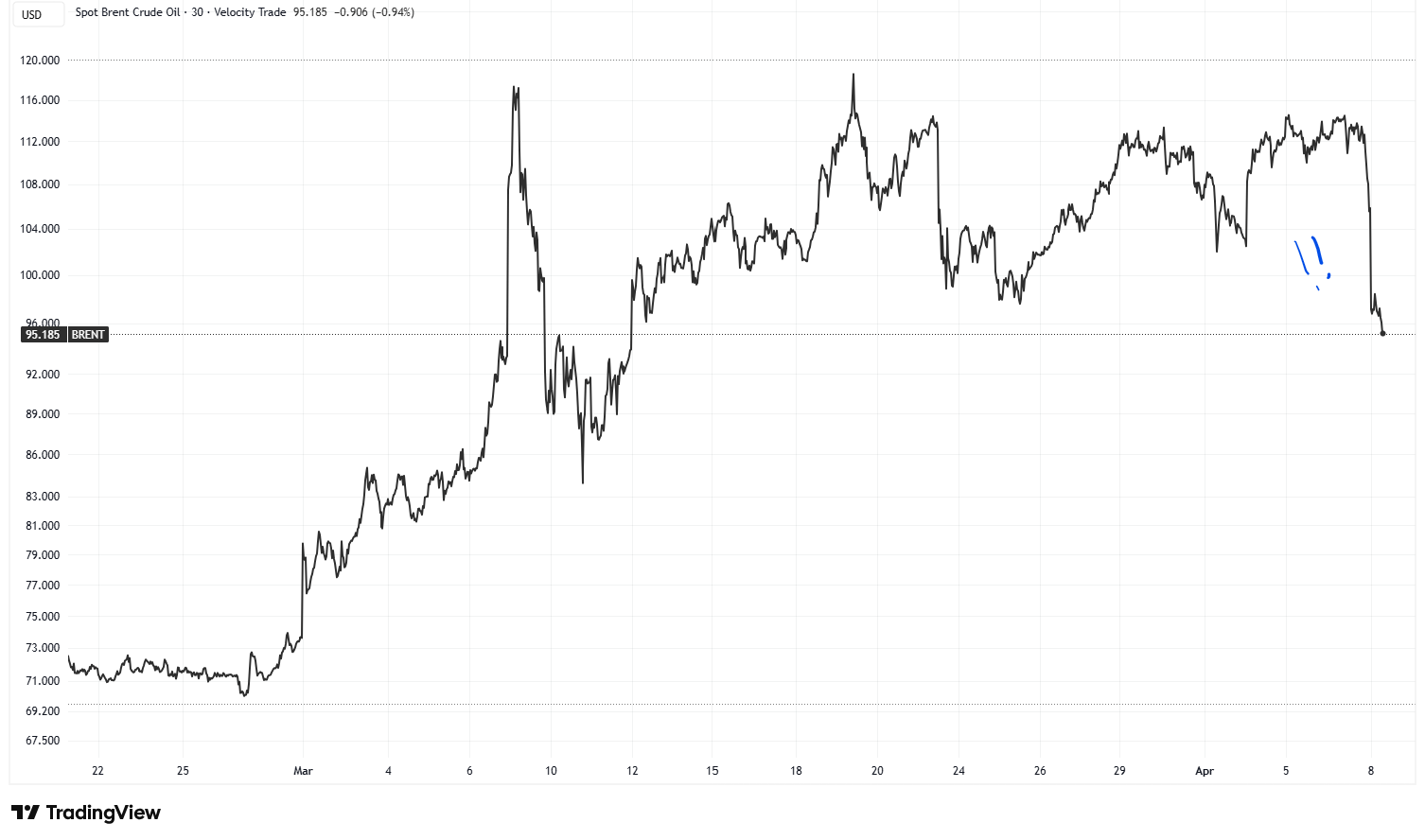
(chart via TradingView)
