


“Not to be absolutely certain is, I think, one of the essential things in rationality.” – Bertrand Russell
Hi everyone! I hope you’re all taking care of yourselves. 🍂
IN THIS NEWSLETTER
The IMF path to tokenization
Macro: US CPI
Crypto is Macro Now offers ~daily commentary and updates on crypto’s evolving role in the changing geopolitical and financial landscapes. Plus links and more.
If you’re a premium subscriber, thank you so much!! ❤
PUBLISHED IN PARTNERSHIP WITH: ✨ ALLIUM ✨
Following granular prediction market data can deliver new insights into the likely November outcome. For instance, the odds suggest that Democrats will win control of the Senate – but by how much?
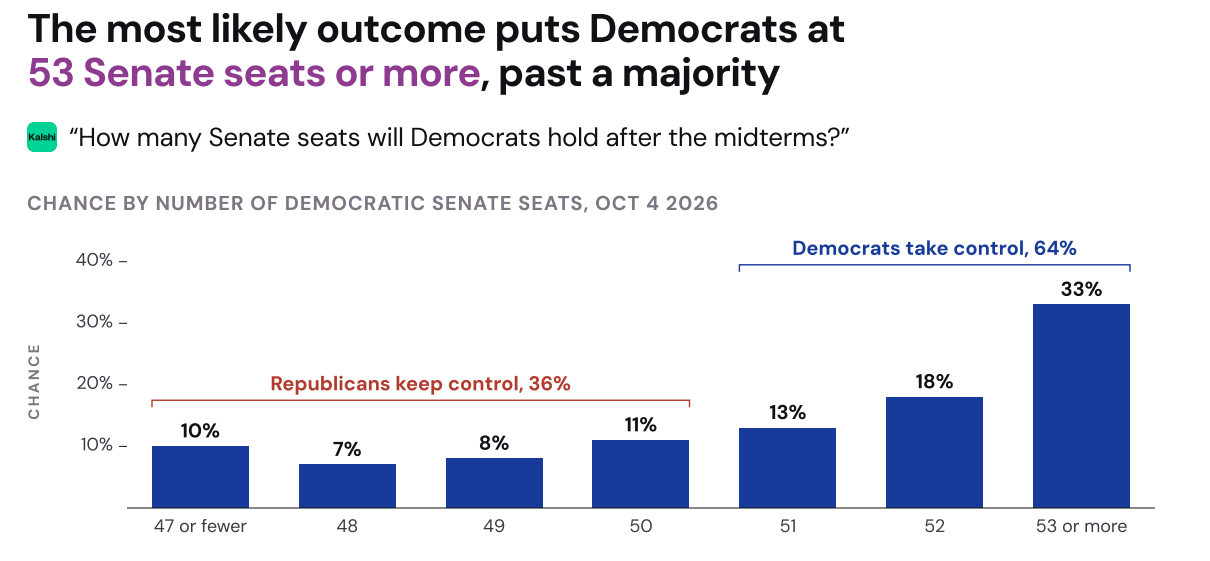
Full report: Prediction markets and a live read on the US midterms
Get weekly onchain data and analysis from the Allium Research team on Substack.

WHAT I’M WATCHING

The IMF path to tokenization
Yesterday, the IMF released its semi-annual Global Financial Stability Report discussing the major trends impacting the world economy. Whatever you may think of the IMF, this report carries weight as a “health check” that aims to identify crises before they blow up, with a focus on financial-sector implications of macro policies and structural developments.
For the first time, the latest report carries an entire chapter on tokenization.
It’s actually pretty good – thought-provoking, balanced and quite well written, with items of interest for both the uninitiated and those already deep in the industry. There is a sprinkling of good charts, and a smattering of “boxes” with related deep dives (I do like reports with boxes, perhaps something to do with the by-the-way choice of distractions).
Below, I’ll highlight one of the more interesting observations from the report, one that tends to be overlooked by market participants but that weaves together the various threads covered.
But first, a summary of key metrics:
A snapshot
At the end of July, tokenized real world assets excluding repo stood at around $65 billion, with the bulk of that in tokenized fixed income (corporate credit, asset-backed credit, and money market fund).
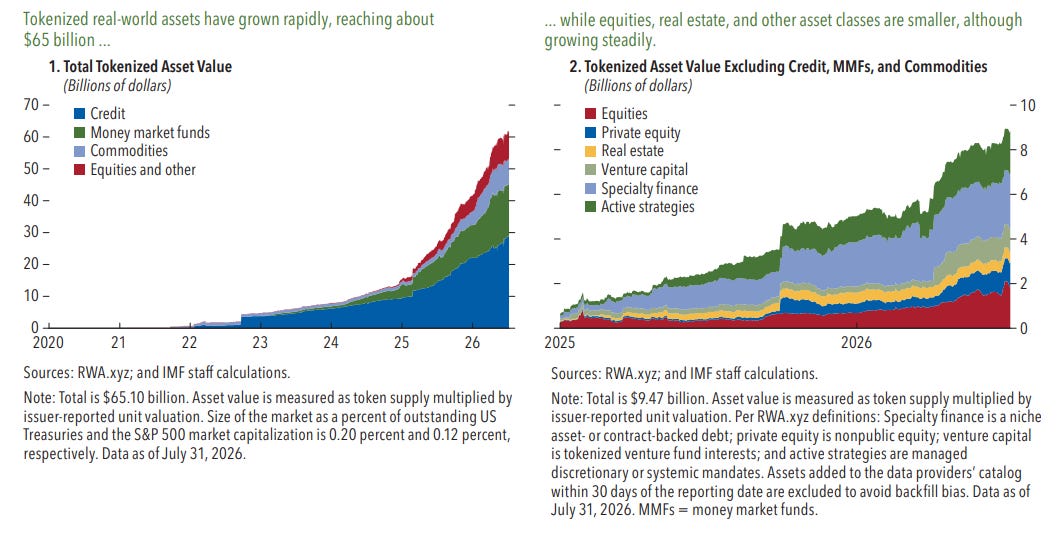
(all charts from the IMF Global Financial Stability Report, October 2026)
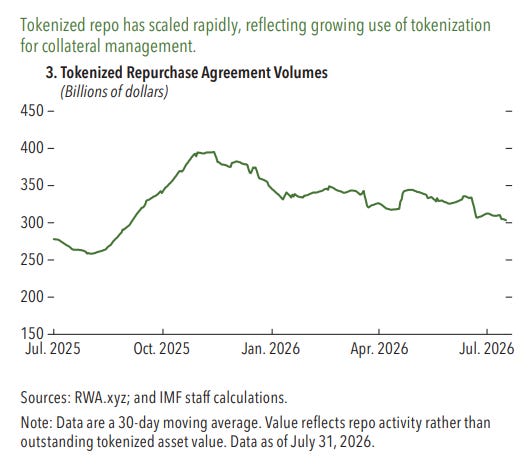
Tokenized repo is not included in that total as it is more about flows than issuance – yet its average daily volumes have for the past year been over $300 billion, an indication that collateral management is one of the most compelling use cases in today’s market.
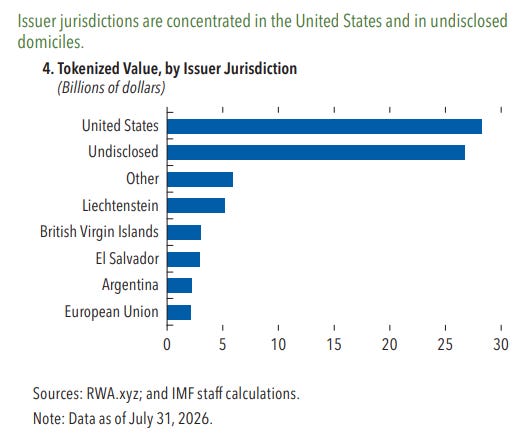
Unsurprisingly, most tokenization currently takes place in the US – but check out the sizeable volume with unknown origin, a blow to those who insist onchain assets are transparent.
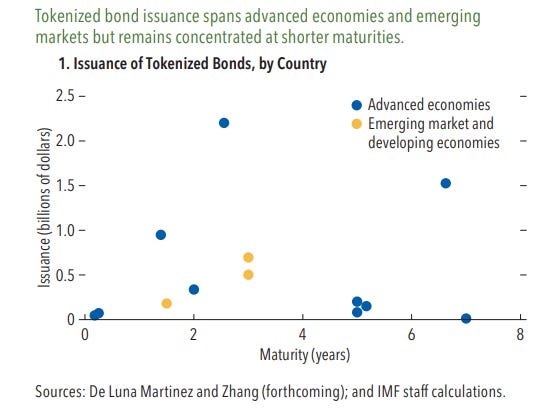
Bonds issued on-chain tend to have short maturities, which makes sense given the relative youth of the technology and the “still testing” approach from large issuers.
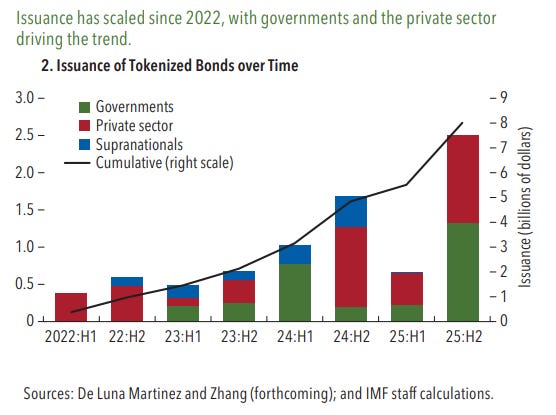
Also interesting is the growing participation from governments (in green below).
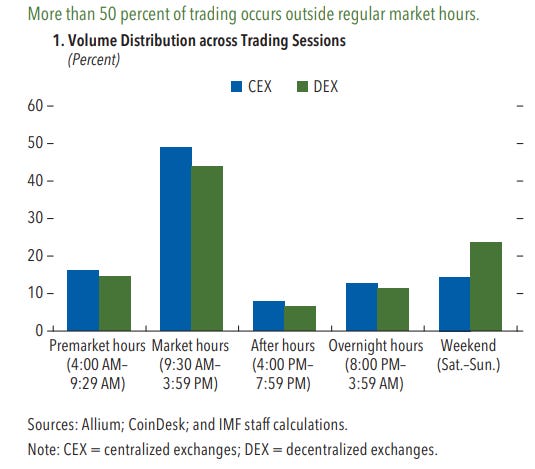
In tokenized equities, it’s notable that around 50% of trading takes place outside typical market hours, suggesting that the always-on nature of onchain markets is a strong draw.
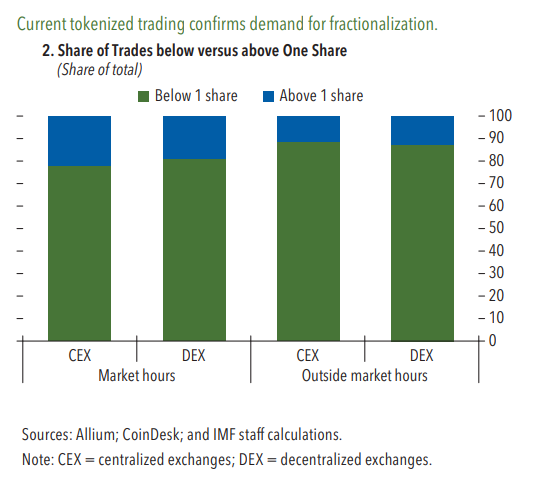
Also, I was surprised by the demand for fractionalization (which reduces investment barriers) – most trades are of less than one share.
Adoption
For a report that aims to identify systemic risks, the chapter on tokenization is surprisingly optimistic, even while taking an original approach to the diagnosis of vulnerabilities.
