


“The past is not what it was.” – G. K. Chesterton ||
Hello everyone, and happy Friday!!! What an insane week…
So, I went along earlier this week to get new glasses as I’m not seeing so well out of my current ones, especially the left eye. Next thing I know, I’m at the hospital being told they need to operate because of cataracts, which I thought was something that only happened to old people (don’t say it…). I find out when on Monday, but I will have to take a few days off immediately afterwards, which I am not happy about. It’s not so much the idea of eye surgery that’s stressing me, it’s not being able to read for a week! Like that’s going to happen – maybe with a patch, right? If any of you have been through this, words of reassurance would be appreciated.
🍂
My American Banker op-ed this week (paywall, sorry!) looks at the recent boom in crypto credit card activity, and how it’s a step towards mainstream adoption, but what kind of adoption? What is the goal here? “Crypto cards are booming, but what they mean for the future is unclear”
PUBLISHED IN PARTNERSHIP WITH: ✨ ALLIUM ✨
As traditional finance and crypto converge, trusted data is the missing infrastructure layer. Allium provides this data foundation for teams like Visa, Stripe and Grayscale.
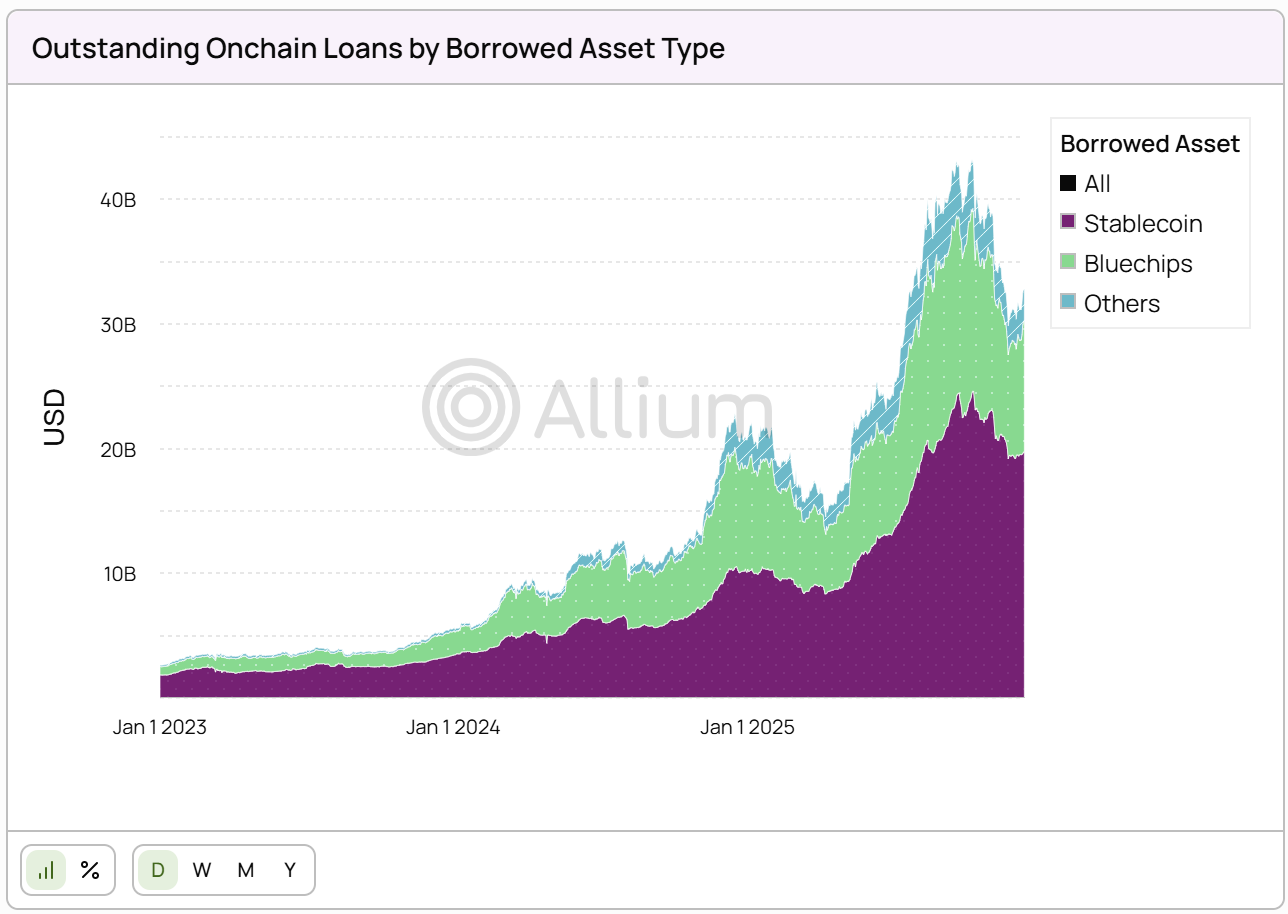
Our latest whitepaper published with Visa, Stablecoins Beyond Payments: The Onchain Lending Opportunity, examines how banks can access emerging credit markets. Looking at the data, outstanding onchain loans reached over $40Bn this year, with stablecoins making up more than half of borrowed assets.
If you’re producing institutional crypto research or analytics, start with trusted data. Explore a live demo.
IN THIS NEWSLETTER:
The price of insularity
Markets: heavy metal
Macro: steaming ahead
Crypto is Macro Now offers ~daily commentary and updates on the overlap between the crypto and macro landscapes. Plus links, a music recommendation (‘cos why not?), and more.
If you’re a premium subscriber, thank you!! ❤
WHAT I’M WATCHING:

The price of insularity
Earlier this week, I shared some charts from the World Economic Forum’s Global Risks Report 2026, a document usually timed to coincide with the annual gathering in Davos.
Another survey with similar timing is the annual Edelman Trust Barometer. I’ve covered this regularly over the years as it chillingly records the “on-the-ground” mood which tends to be more relevant for what’s ahead than the worries of the Davos elite. This year’s report is a continuation of the theme, with some interesting variations.
For background, the survey canvasses almost 34,000 respondents across 28 countries, making it a much broader sample than most. Questions focus on opinions of societal institutions: government, business, media and NGOs. Responses are then compared to previous editions to extract trends, and an overarching theme is selected: this year, it’s “insularity”, defined as a reluctance to trust anyone who’s “different”.
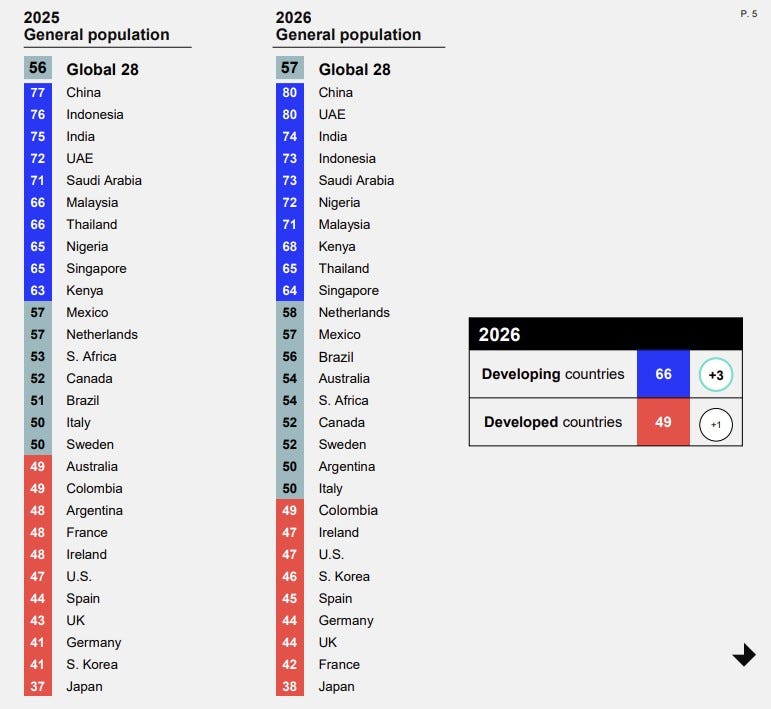
As usual, the highest trust score goes to China – that is, Chinese respondents recorded the highest trust levels in their institutions (you may not trust Chinese institutions, but Chinese people do). This year, the top rank is tied with the UAE. Also as usual, Japan, the US, the UK and much of the EU are in the bottom range, signalling overall “distrust”. Developing countries on the whole scored much better than the developed world. Among Western nations, the Netherlands yet again comes out top on the trust barometer.
(chart via the 2026 Edelman Trust Barometer)
Of course, we can quibble about the scores and shriek in surprise at some, but we have to remember that scores are decided by citizens of the involved countries, not by observers, and different cultures have different priorities. It’s the shifts that are more relevant here.
There is some positive news:
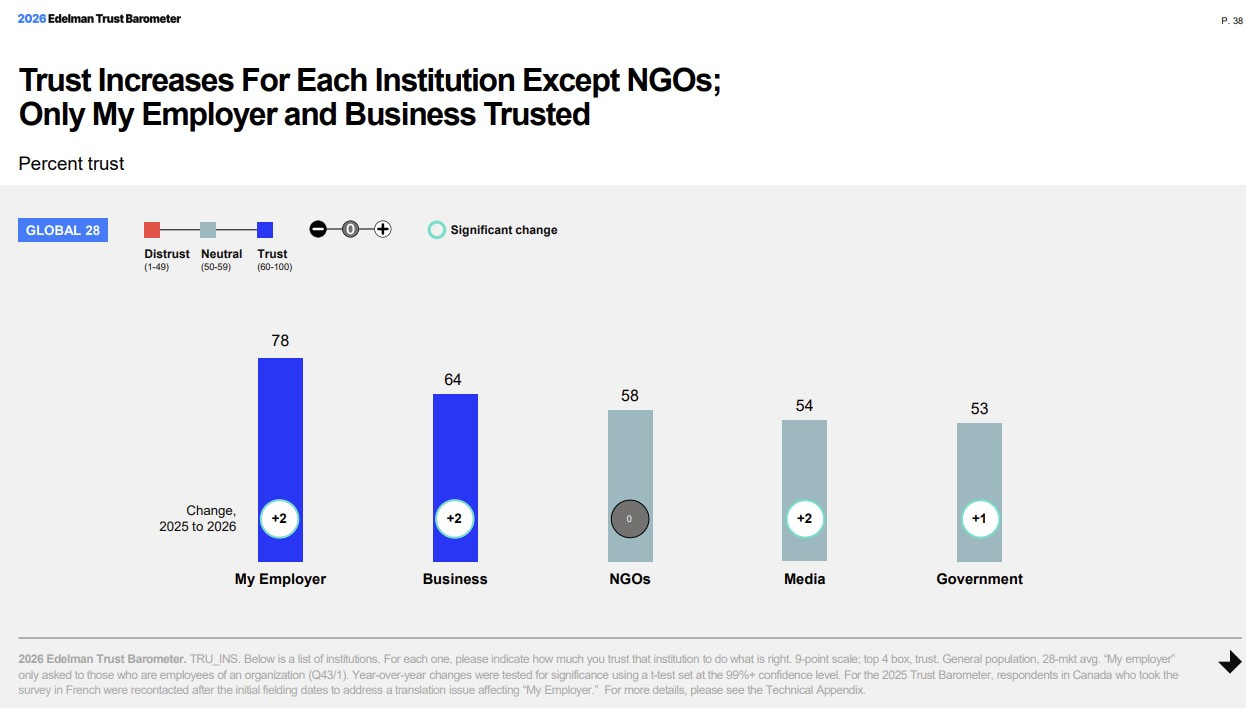
Overall trust increased slightly in all institutions except NGOs – this builds on last year’s slight increase, after a few years of depressing results.
(chart via the 2026 Edelman Trust Barometer)
But, on the whole, the takeaway is of a global society entrenched in fragmentation and echo chambers:
We are living in an insular world – 70% of respondents would be “unwilling or hesitant” to trust someone who does not think like them. This is most acute in Japan (90%!) followed by Germany, least an issue in India and the UAE.
Meanwhile, the percent of respondents who get information from sources with a different political leaning has dropped, with significant falls in 20 of the 28 surveyed countries.
And the share of respondents convinced that “foreign actors” spread disinformation rose in all but three of the 26 countries eligible for this question, reaching all-time highs in more than half. That’s unsurprising, but also alarming.
More than a third of employees say they would work less hard if their manager did not share their political beliefs. Identity is more important than getting ahead? That can’t be good for economic growth, nor for employment prospects given the potential alternative of less contentious AI workers.
The same percentage believe the number of foreign companies operating in their country should be reduced.
Low-income respondents have always been less trusting of institutions than high-income respondents – understandable, but the gap between the two groups is widening (from 6 points in 2012 to 15 in the latest report). What’s more, the gap is at its widest in the US (29 points).
Almost 60% of respondents feel some degree of “grievance”.
What does this mean for markets? The message is not just about insularity – it’s also about the unwinding of globalization as we seek comfort in the familiar even if it means less prosperity. This will have consequences for both inflation (as the cost savings from globalization are lost) and growth.
We also have a flashing arrow pointing to deepening political polarization, which always weakens trust in democracy and leads to greater social unrest. We saw that play out in 2025 with violence on the streets in cities around the world – unfortunately, this is likely to increase in 2026, potentially compounded by electoral upsets. Among significant economies, this year brings mid-term elections in the US, general elections in Brazil, Japan, Sweden and Denmark (geopolitically significant), as well as municipal yet potentially high-impact elections in France, Germany and the UK.
The biggest takeaway, however, has to be this: Trust in institutions is universally regarded as essential for the functioning of society – and yet, for a while now, it has been doing poorly in the West, better in the East. Whether you think this is correct or not is irrelevant; what matters is what those on the ground think. And, leaning into this year’s theme of insularity, we can ignore measurements and conclusions we don’t agree with – or, we can ask ourselves in what way could we be wrong. We can also factor in that the world is complex and our personal lens is usually narrow, and accept that firm yet untested assumptions can so easily cloud judgement.
See also:
What the Davos set is afraid of (Jan 2026)
Trust: more than just surveys (Jan 2025)
