


“As to the evil which results from a censorship, it is impossible to measure it, for it is impossible to tell where it ends.” – Jeremy Bentham ||
Hello everyone! I hope you all had a great weekend, and are ready to embrace the sultry days of summer when the news flow slows down and we can all take a break… right, I know, wishful thinking.
📽 Come join me and Izabella Kaminska tomorrow for Episode 3 of our pilot Monetary Forces livestream series. We’ll be talking about unified ledgers, tokenized deposit networks, OUSD and more. Link below. 📽
Since it’s a long newsletter today, I’ll share my episode listen recommends tomorrow.
PUBLISHED IN PARTNERSHIP WITH: ✨ ALLIUM ✨
Are agentic stablecoin payments becoming a thing?
Software agents now pay each other, for data, API calls or compute – but the volume is tiny. The two main agentic rails are x402 (concentrated on the Base blockchain) and MPP (a protocol on Tempo), and about $4.5 million has moved across them over the last 90 days, in 24 million tiny payments.
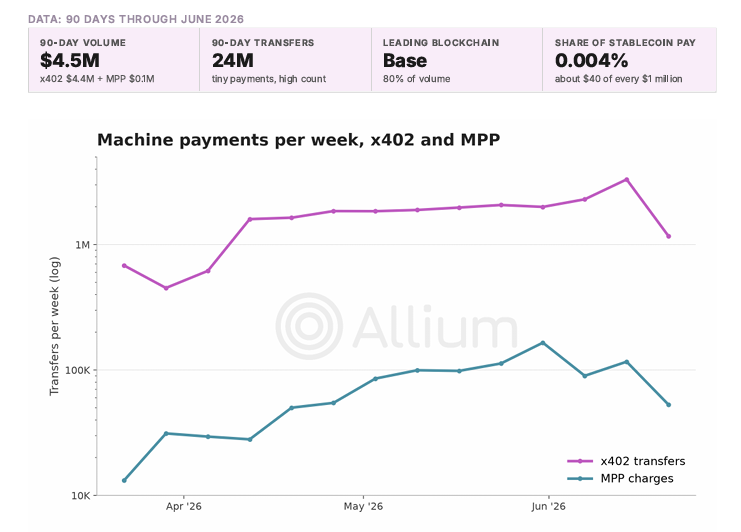
→ For more, download Allium’s State of Onchain Finance report: https://allium.so/reports/state-of-onchain-finance-q2-26
IN THIS NEWSLETTER
Coming up this week: NATO, PMIs
Monday musings: The slippery slope of censorship II
Macro: US jobs
Crypto is Macro Now offers ~daily commentary and updates on the overlap between the crypto and macro landscapes. Plus links and more.
If you’re a premium subscriber, thank you so much!! ❤
WHAT I’M WATCHING:

Podcasts: upcoming streams
✨Monetary Forces: tomorrow, Izabella Kaminska and I pick at the key headlines that paint the picture of how technology is changing finance, and Izabella will dive into the entrails of a paper illustrating an overlooked aspect of the transformation.
Tuesday, July 7 @ 4pm CEST / 3pm BST / 10am EST – livestream link: https://open.substack.com/live-stream/262758
✨Press Publish: on Thursday, I’ll be talking to Marvin Barth about his Seriously, Marvin?! and Thematics Markets newsletters as well as his excellent podcast – we’ll get some insight into how he produces so much quality content, how he navigates the information firehose, how he deals with obstacles, what he thinks of different formats, and more.
Thursday, July 9 @ 4pm CEST / 3pm BST / 10am EST – livestream link: https://open.substack.com/live-stream/261155
Coming up this week:
This week is thin on macro data but heavy on meetings.
Today, we get the ISM and S&P Global reports on activity in the US services sector.
Tomorrow sees the start of the two-day 2026 NATO Summit, held this year in Türkiye – according to reports, authorities there are rounding up journalists and activists that might disturb Erdogan’s projection of power.
And the Digital Euro Association hosts a conference in Berlin, supposedly an informal gathering of policymakers and academics but I haven’t been able to find much information on content.
On Wednesday, we get the minutes from the recent FOMC meeting, Kevin Warsh’s first as Chair. Hopefully we’ll get some insight into what a “good family fight” looks like.
Thursday brings China’s PPI and CPI.
Monday musings: The slippery slope of censorship II
(what’s on my mind as we head into the week)
It couldn’t possibly happen here.
I’m talking about censorship, which is a feature of daily life in totalitarian societies run by dictators – we know this because we read our local headlines, we watch the exile interviews, we’ve read the novels or the history books, we’ve seen the movies that depict conformity bred in fear. Censorship happens across the border or in lands far away, not in Western societies that pride themselves on their hard-won “liberal values”.
But I’ve unfortunately had occasion over the years to write about how, yes, it can happen “here”, wherever that may be – there are examples on both sides of the ocean. And the scary part is the lack of coverage and of vociferous protest.
There are exceptions, of course, and brave pockets of outrage that have achieved some redress. But the march of speech control finds new paths, and it does so cloaked in law-abiding virtue, convincing most of us that it’s all fine, smart, sensible, necessary for protection. That’s how we let it in, how we get used to it.
In sum, censorship takes root when it’s sold as “for our own good”, when we’re ok with the adverse consequences happening to people we don’t much like anyway.
Last Thursday, the Court of Justice of the European Union (CJEU) dropped a ruling that is ringing alarm bells.
Some background:
