


“The most erroneous stories are those we think we know best – and therefore never scrutinize or question.” – Stephen Jay Gould ||
Hi everyone! What was I thinking… this morning I started poking at something I read last week regarding the US Treasury market and next thing I know I’m deep in the weeds, trying to claw my way out. That’s why this is a bit late going out, and why there’s no market comment (although the Treasury market situation is certainly relevant).
🌼
Production note: some choppy publication coming up. No newsletter this Friday (but do tune in to my Substack Live chat with Irina Slav, more details below). And I’ll be skipping next Friday’s due to a national holiday where I live.
PUBLISHED IN PARTNERSHIP WITH: ✨ ALLIUM ✨
Event: BCG x Allium Webinar - The Truth About Stablecoin Payments
Date/Time: Tuesday, April 21 at 6pm EST – TODAY!! Last chance to register!
Speakers: Inderpreet Batra (BCG Global Head of Fintech & Payments), Ethan Chan (CEO, Allium), Max Zevin (BCG MD & Partner)
Topics:
What’s driving institutional interest right now, and how regulation (GENIUS Act, MiCA) is shaping the conversation
What Allium’s stablecoin data reveals: use case breakdown (B2B, C2C, cross-border), blockchain distribution, and why volume estimates vary so widely across reports
Implications for different players: banks, fintechs, PSPs, and where to focus
Where the market goes over the next 12–24 months
Register: https://bcg.zoom.us/webinar/register/WN_gm6eFezTSQC6gaNw5aLamQ

IN THIS NEWSLETTER
US Treasuries: how safe is safe?
Term of the day: Auction tail
Crypto is Macro Now offers ~daily commentary and updates on the overlap between the crypto and macro landscapes. Plus links and more.
If you’re a premium subscriber, thank you!! ❤
✨Press Publish with Irina Slav✨
Come join me for a Substack Live this Friday, April 24th, at 7am EST / 1pm CEST when I talk to energy expert Irina Slav.
One thing you need to know about Irina, other than her charm and depth: she writes. A lot. With punch and humour and flow. There’s her Irina Slav on Energy newsletter, which is how I discovered her work (and was the first Substack I paid for). Then I found out she also writes for OilPrice.com, several articles a day. And she has two other newsletters, both enchanting and on wildly different topics.
So, come and join us for a chat about why she does what she does, how she manages to juggle so much, what advice she’d give anyone starting out or struggling to grow in Substack, and more.
📽
And if you missed my Substack Live “Press Publish” session with Brady Dale on Friday, where we talked about media, newslettering, Substack, platforms in general, and a whole lot more, you can catch the replay here. Plus, check out the playback of the session I did with Christine Kim about her journey from big-brand research into self-publishing, how she gets so much done, what she’d do differently, and more.
WHAT I’M WATCHING:

US Treasuries: how safe is safe?
When a former US Treasury Secretary uses the phrase “break the glass”, it’s worth asking why. Sure, good sound bites get attention, but that’s unlikely to be the motive here, this particular individual gets plenty of that anyway. So, I dug a bit deeper.
Last week, Henry Paulson gave an interview to Bloomberg in which he urged the US Treasury to prepare “an emergency break-the-glass plan which is targeted and short-term, on the shelf, so it’s ready to go when we hit the wall”.
Note that Paulson uses the word “when”, not “if”.
This is coming from the man who led the US Treasury during the Great Financial Crisis (GFC) of 2008. But as he explains, back then the US had some fiscal leeway to deal with the credit meltdown – government debt was around 60% of GDP. Today, with government debt at over 120% and climbing, it doesn’t.
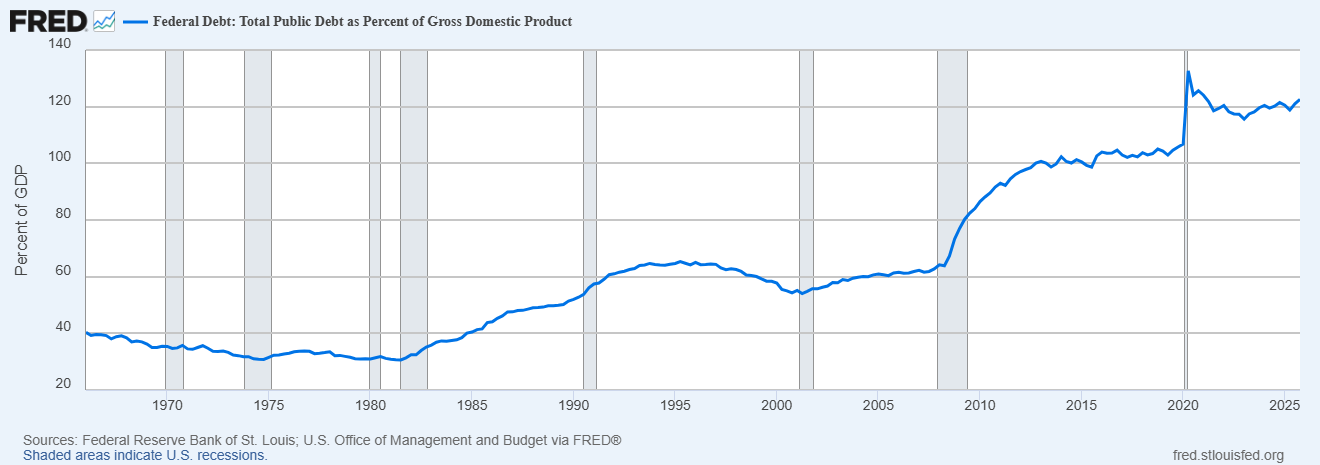
(US debt/GDP, chart via the St. Louis Fed)
What’s more, the GFC was triggered by opaque and risky credit. There’s a strong chance that any Treasury market ructions in coming months or years would be triggered by the Treasury market itself, further constraining any potential fiscal response.
Paulson points out that the US has a lot of distractions at the moment, such as the conflicts in Iran and Ukraine. But he argues the fiscal deficit should not get pushed into the background as it’s not going away. And sooner or later, he implies, investors will start to lose confidence in US debt.
There’s an argument to be made that the rally in the gold price over the past year is a sign that has started.
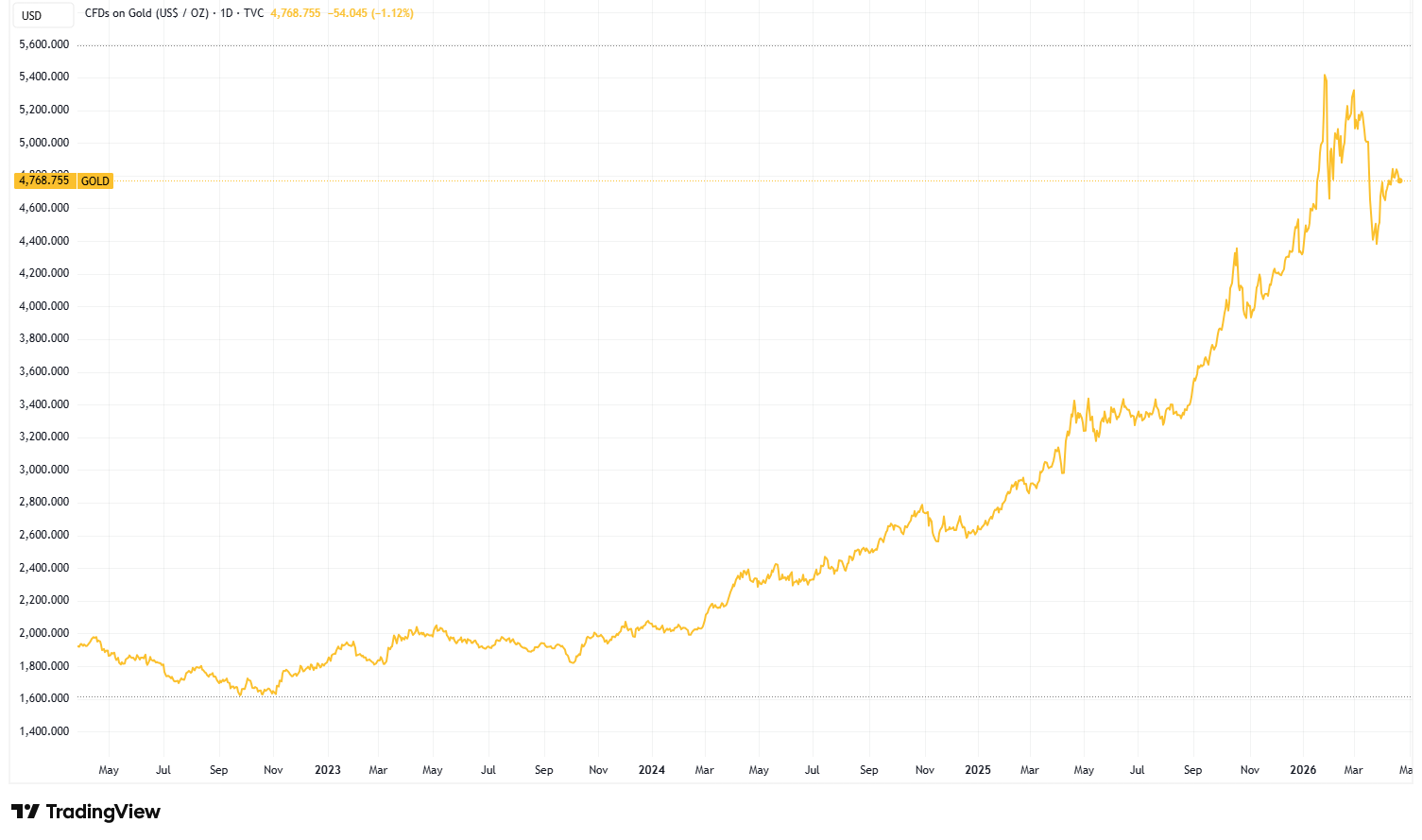
(gold price $/oz, chart via TradingView)
There are others, none of them five-alarm fires yet but all worth keeping an eye on. I’ll highlight a few, and then pull on why all this matters both for crypto markets and for what’s happening on Capitol Hill today.
