


“If you have an apple and I have an apple and we exchange these apples then you and I will still each have one apple. But if you have an idea and I have an idea and we exchange these ideas, then each of us will have two ideas.” – George Bernard Shaw ||
Hello everyone, and happy Friday!!!
Production note: As I mentioned earlier this month, my plan is to take days off here and there this summer, rather than the typical extended holiday. My fuzzy brain is pleading for a break from deadlines, so I’m going to start with next Thursday-Saturday. I have no set plans other than to catch up on reading, get ahead of some writing, pootle around a few air-conditioned museums, perfect my watermelon cocktails, that sort of thing. Bliss.
PUBLISHED IN PARTNERSHIP WITH: ✨ ALLIUM ✨
Where are stablecoins most used?
Allium filters stablecoin volumes for non-economic actions such as inter-group transfers – it turns out that most is outside the US, with 52% in Asia-Pacific and 26% in Europe, the Middle East and Africa.
The leading destinations are South Korea, Indonesia, Mexico and Turkey, places with currency pressure, active remittance corridors, or both.
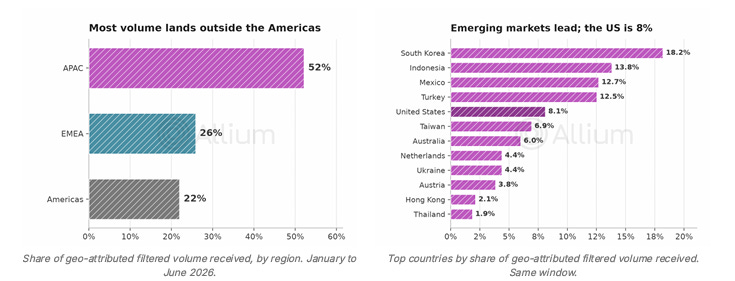
→ For more, download Allium’s State of Onchain Finance report: https://allium.so/reports/state-of-onchain-finance-q2-26
IN THIS NEWSLETTER
Crypto is Macro Now offers ~daily commentary and updates on the overlap between the crypto and macro landscapes. Plus links and more.
Visa’s stablecoin platform: more of the same?
Markets: ominous rumblings
Podcast recommendations
If you’re a premium subscriber, thank you so much!! ❤
WHAT I’M WATCHING:

Visa’s stablecoin platform
I’ve written before about the evolution of the stablecoin narrative over the years from “product” (USDT and USDC) to “service” (white-labelling, transfer coordination) and now to “infrastructure”. We don’t hear so much about stablecoins as a “thing” anymore, nor do we talk about how easy launching your own stablecoin can be. Rather, the attention-grabbing news these days is more about platforms, packaging the stablecoin products and services and putting them where the clients already are.
Yesterday, we got another key example, with the unveiling of the Visa Stablecoin Platform (VSP), designed to enable the payment company’s enterprise clients to:
mint and burn the OUSD stablecoin,
create and manage wallets on Ethereum, Solana and Tempo,
handle compliant self-custody,
and send OUSD around the Visa network.
At first glance, it’s potentially powerful – it would in theory embed stablecoins into existing payment flows with only minor operational tweaks, while still ensuring compliance and security. For large enterprise, brand name matters, and Visa is trusted.
Not only that, it also has extensive reach, which itself ensures adoption – even the most convenient payment option is not convenient if your counterparties don’t accept it.
Less clear is how VSP fits into Visa’s other blockchain initiatives.
