


“Doubt is not a pleasant condition, but certainty is an absurd one.” – Voltaire
Hello everyone! I hope you’re all doing well. Only 72 days left until the end of the year. How did that happen.
A late send today, apologies – this morning I dove into a well of Bitcoin-gold-money arguments that turned out to be deeper than I expected, but worth it. More below.
IN THIS NEWSLETTER
What is money? And why should we care?
The money hierarchy
The alternatives
Crypto is Macro Now offers ~daily commentary and updates on crypto’s evolving role in the changing geopolitical and financial landscapes. Plus links and more.
If you’re a premium subscriber, thank you!! ❤
PUBLISHED IN PARTNERSHIP WITH: ✨ ALLIUM ✨
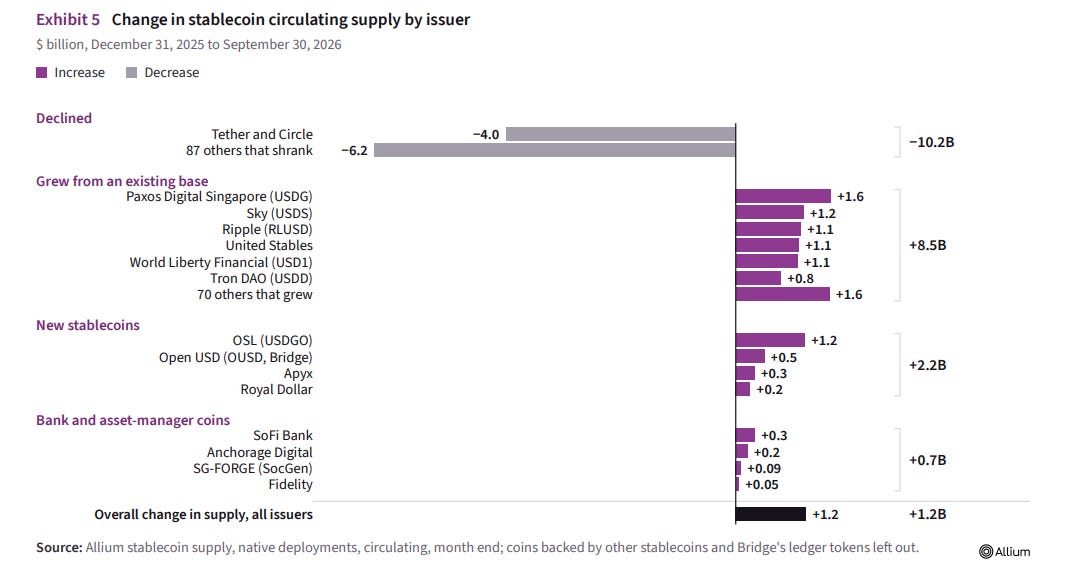
While the circulating supply of stablecoins from Tether and Circle dropped by $4 billion in the first 9m of 2026, overall supply increased by $1.2 billion (0.4%) and the number of issuers with more than $1 billion outstanding climbed to 15, up from 11 in 2025.
Download Allium’s State of Stablecoins and Payments Q3 2026.
And get weekly onchain data and more analysis like this from the Allium Research team on Substack.

WHAT I’M WATCHING

What is money? And why should we care?
I mentioned last week that I had a stack of papers to summarize for you – this morning, I finally opened the first one, and it ended up being SO much deeper and more interesting than I expected, hence the late send today.
It’s the kind of paper that’s worth reading more than once, even if you disagree with the premise, for the new paths it carves in how to view the global monetary system and the relationships it relies on.
Written by Iñaki Aldasoro of the BIS Monetary and Economic Department, the paper’s title is “Money and the architecture of trust”. It takes a run at the conventional definition of money, and in so doing, highlights the evolution and societal role of both the incumbent monetary system, and those which hope to disrupt it.
The main premise is that money is not a thing, nor is it a technology: it is a system. Back in my more naïve new-money days, I suggested that anything could be money if we decide it is – but now I realize that scalable acceptance requires trust which requires structure which requires time and testing. Not a thing, a system. But what Iñaki sees as a definition, I see as a perimeter – more on why below.
