


“Error is the price we pay for progress.” – Alfred North Whitehead ||
Hi everyone! I hope you’re all taking care of yourselves – here in Europe, we’re bracing for yet another heatwave. And I truly can’t remember the last time it rained here in Madrid. Things are feeling crispy.
👀 You’re reading Crypto is Macro Now, which covers the role crypto is playing in the changing plates of finance, economics, politics, culture and markets. 👀
Production note: as I said earlier this summer, I’m not taking a European-style big vacation but I will be taking days off here and there – like this Friday, for instance.
PUBLISHED IN PARTNERSHIP WITH: ✨ ALLIUM ✨
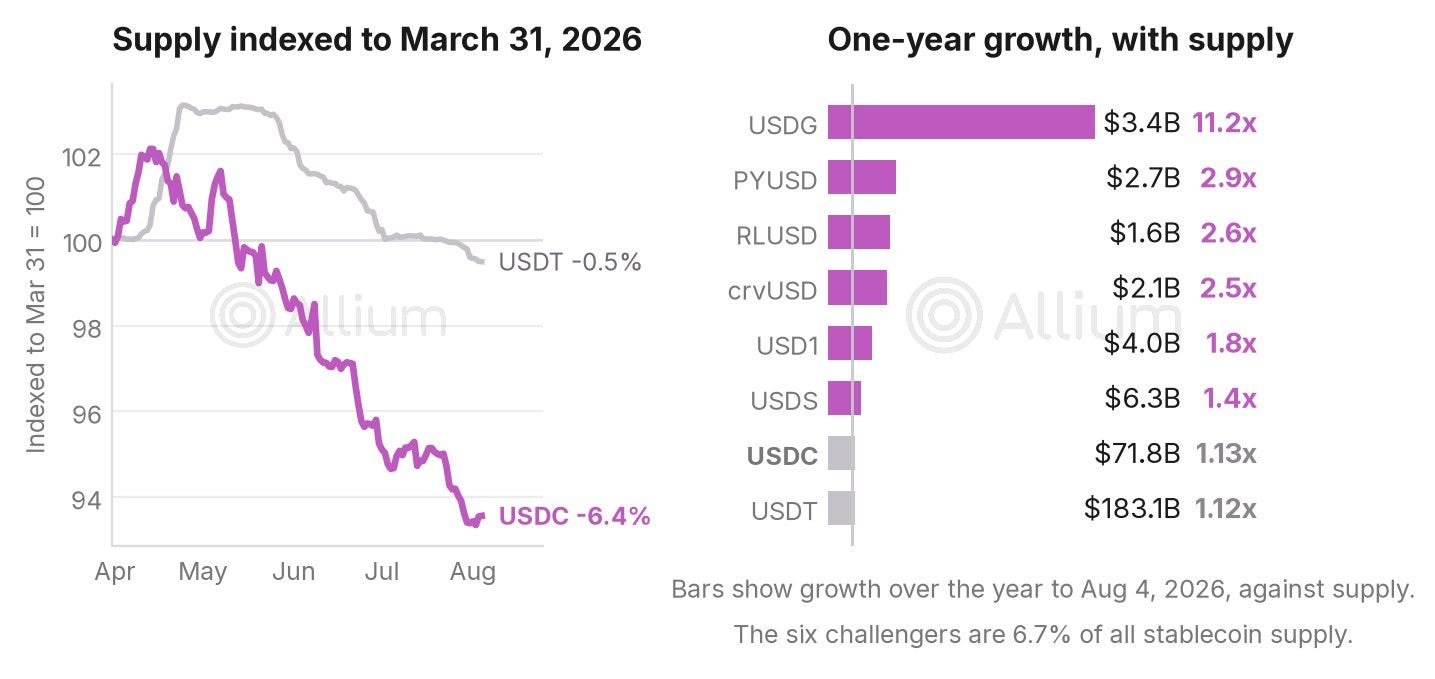
USDC absorbed 82% of the stablecoin market’s Q2 decline.
Stablecoin supply fell $4.4B between March 31 and June 30. USDC accounted for $3.6B of that fall, while USDT added $0.4B and challenger stablecoins continue to grow.
→ Download the full report: https://allium.so/reports/circle-q2-2026-usdc-revenue
And get weekly onchain data and analysis like this from the Allium Research team on Substack.
IN THIS NEWSLETTER
Why CLARITY’s delay hurts banks more than crypto
Term of the day: cloture
Crypto is Macro Now offers ~daily commentary and updates on the overlap between the crypto and macro landscapes. Plus links and more.
If you’re a premium subscriber, thank you so much!! ❤
WHAT I’M WATCHING:

Why CLARITY’s delay hurts banks more than crypto
Is the CLARITY Act dead?
No. It’s not doing well, but it might pull through.
Below I’ll briefly summarize what happened to this key piece of financial market legislation last week, what could happen next, and what that would mean for both crypto markets and the banking industry.
What happened?
First, some background: the CLARITY Act is a bill working its tortuous way through Congress that would establish a federal framework for crypto asset markets. It’s a long one, over 600 pages, so I won’t try and summarize it here. But the key features include:
The definition of token categories
The distribution of regulatory responsibility between the SEC and the CFTC
A format for legal token fundraising from the public (known as “Regulation Crypto”)
Protection for developers from prosecution relating to use of their code
A safe harbour for certain decentralized finance activities
The right to self-custody and peer-to-peer transactions
Activity-based rewards on stablecoins
Bankruptcy treatment of digital assets
Ways banks can engage in and offer digital asset activities
The CLARITY Act is not exactly new in that it threads together crypto bills proposed with bipartisan support as far back as 2022. But it has evolved through hard-won compromise and both House and Senate votes, and is tantalizingly close to getting enough support in the Senate for passage.
Close, but not close enough – there is still much that can go wrong, and last week delivered a meaningful setback. Despite plenty of scurrying and calling and pleading, the CLARITY Act did not get a floor vote before senators took off for the August recess.
Now what?
This is a blow as momentum counts for a lot in Congress, and the CLARITY Act just lost what momentum it had.
Maybe it could get some back. Senate Majority Leader John Thune has filed cloture (see below) which could put the bill on the agenda for a vote in September.
But by then, senators will be consumed by the upcoming midterm elections, with much at stake. And there are still unresolved issues such as ethics (limits on crypto activities of elected officials), illicit finance safeguards and stablecoin rewards.
Furthermore, the delayed vote means that the crypto political action groups (PACs) don’t yet know which senators will vote against and so cannot efficiently plan how to spend their considerable sums on opponents’ campaigns.
What’s more, support for CLARITY is becoming increasingly partisan, a trend that will intensify as the midterms approach. Many Democrats in Congress understand the cost of not creating a framework for financial market innovation in the US, but cannot risk being seen as supportive of the Trump family’s enrichment from crypto assets. And a recent Normington Petts poll showed that Democrat voters overwhelmingly hate crypto – almost 60% hold a “very unfavourable” view of the industry, with another ~20% opting for “somewhat unfavourable”. Crypto fared much worse than AI, datacentres and pharma companies, which is quite something.
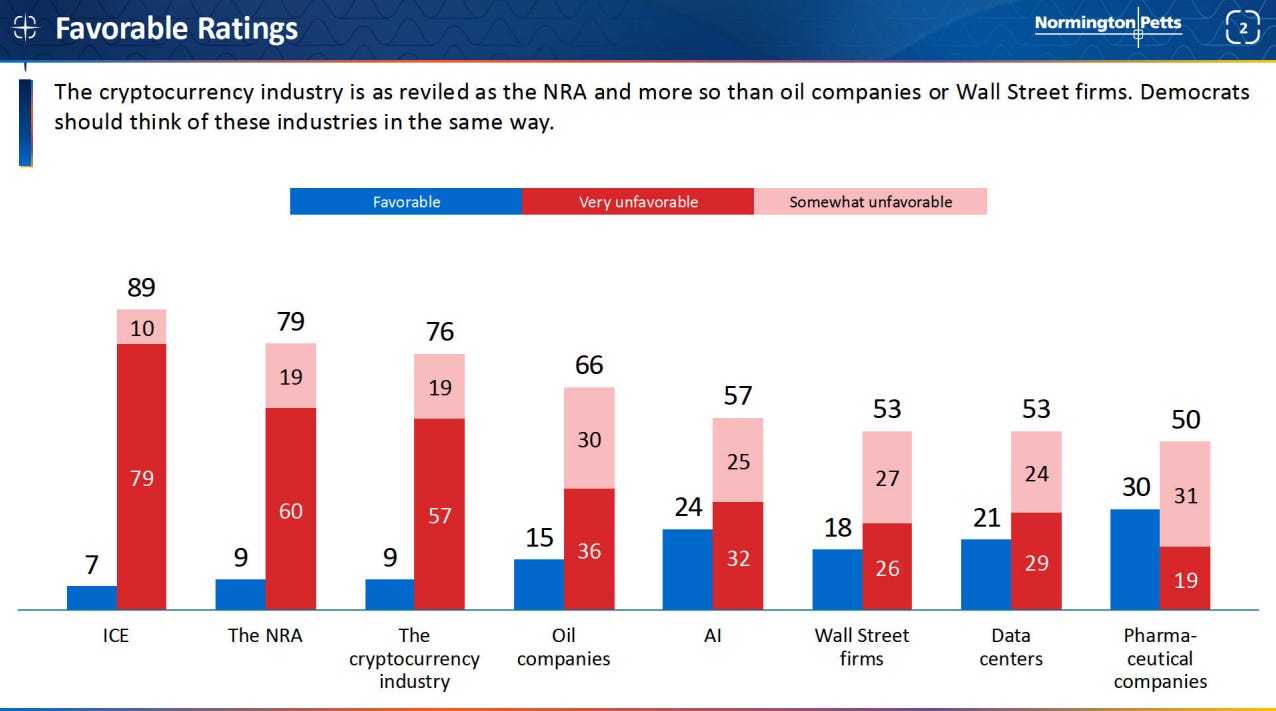
(chart via Normington Petts)
With the midterms looming, will any Democratic Party candidates want to risk votes? It’ll be in their interests to delay a CLARITY vote until after the November elections.
Yet even some Republican senators have indicated they will vote no unless the provision for stablecoin rewards is tightened – the bank lobbies have been hard at work flexing their long-standing relationships with Senate politicians.
The frustration among pro-crypto Republicans and industry lawyers and executives is palpable – they have been working so hard on this. But, while tempting, it’s technically not fair to point the finger at the Democrats or even at the banks, at least not exclusively. In a recent poll on X that asked who was to blame, the Democrats tied with the Trump family.
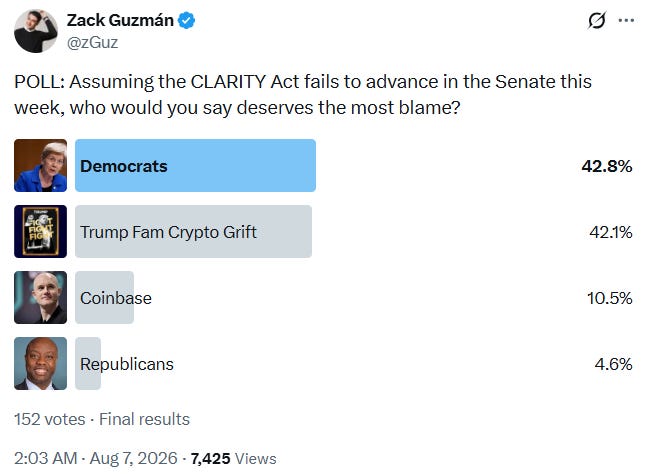
(post by @zGuz)
Unless there is meaningful movement on the ethics provisions, passage is unlikely, especially once Democrat senators are “posing for the camera” amid midterm election scrutiny. The bank lobby objections could probably be softened with further explanations as to why they’re misleading, but that will require more time and anyway is unlikely to be enough.
But a delayed vote is better than a failed vote, which would have been a much bigger blow to momentum.
Still, it’s worth looking beyond CLARITY and contemplating a scenario in which it fails in September.
