


“In fact, the mere act of opening the box will determine the state of the cat, although in this case there were three determinate states the cat could be in: these being Alive, Dead, and Bloody Furious.” – Terry Pratchett ||
Hello everyone, and happy Friday!
📽 Just over HALF AN HOUR TO GO until my live chat with Izabella Kaminska, author of The Peg and The Blind Spot newsletters – we’re NOT going to talk about stablecoins nor finance nor geopolitics, we’re going to talk about newslettering, exercising the writing muscle, coping with the flood of information + more. 📽
Come join us! Today, Friday June 19th, at 3pm UK time / 10am Eastern: https://open.substack.com/live-stream/239917
PUBLISHED IN PARTNERSHIP WITH: ✨ ALLIUM ✨
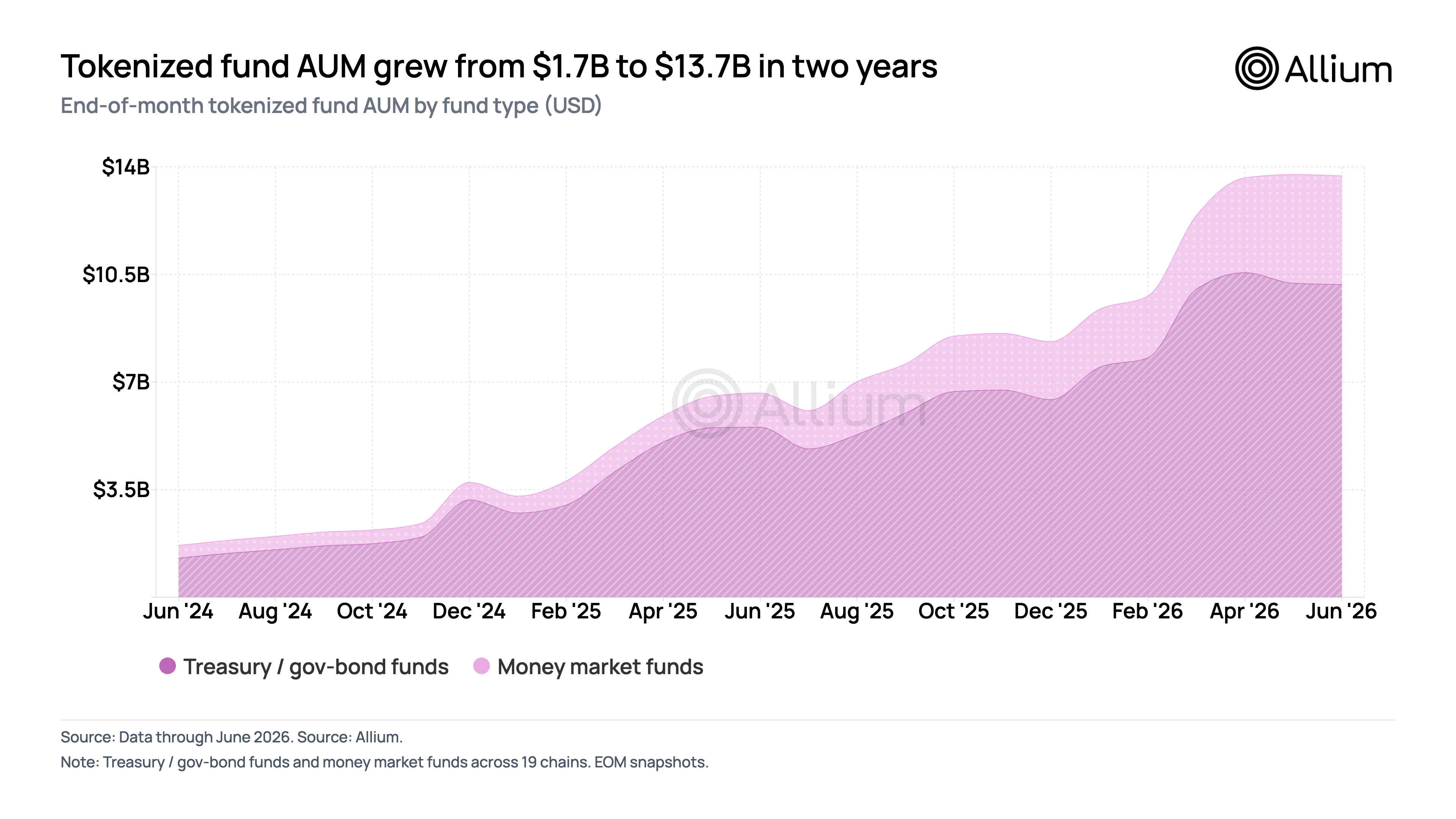
Tokenized US money-market and Treasury fund AUM reached $13.7B in June 2026, up roughly 8x in 24 months, with more than $4B added in the first half of this year alone. Four issuers hold 76% of the market – who are they, and on which chains are their funds concentrated?
To find out more, check out Allium’s data-driven look at where US money-market and US Treasury / government-bond funds live onchain in June 2026, covering issuers, funds, chains and the wallets that hold them.
→ Read the report: https://www.allium.so/reports/tokenized-us-funds-june-2026
IN THIS NEWSLETTER
China plays its governance card
Podcast episode recommendations
Crypto is Macro Now offers ~daily commentary and updates on the overlap between the crypto and macro landscapes. Plus links and more.
If you’re a premium subscriber, thank you so much!! ❤
WHAT I’M WATCHING:

China plays its governance card
A key development this week in geopolitical relations was surprisingly overlooked in Western media – I haven’t seen any reference to it at all, and it is a big deal.
On Wednesday, China’s State Council Information Office published a white paper titled “More Just and Equitable Global Governance: China’s Principles, Proposals and Actions”. That’s a typical mouthful for an official paper – but the gist is simple: China is urging the world to join it in a quest to restore faith in global governance.
The paper adds bulk to the Global Governance Initiative (GGI) proposed at the Shanghai Cooperation Organization summit last year, highlighting how much China has already done to foster global cooperation, and how all countries have to band together to continue the progress. The text contains a lot of hard-to-digest mumbo jumbo, but the overall message is startling and quite ingenious. What’s more, the strategy is well positioned to have a quiet yet significant impact on the global economy by realigning allegiances, redrafting trading patterns and further fragmenting the global financial landscape. There’s of course a geopolitical angle as well.
What the paper says
To briefly summarize:
The first section goes on about the need for more effective global governance given the disruptive changes and conflicts impacting the world economy. Deglobalization is fragmenting networks; unilateralism and hegemonism are encouraging a disregard for international law; and the influence of the United Nations and other multilateral institutions is waning.
The second section urges a focus on multilateral development and a return to the respect of sovereignty. The international rule of law must be rigorously enforced, and new rules need to be created for new domains such as the polar regions, deep seas, outer space and cyberspace, as well as for rapidly developing sectors such as artificial intelligence.
The third section highlights how China has been helping to strengthen global cooperation, via diplomatic interventions and humanitarian aid as well as its efforts in fighting the drug trade and maintaining regional security. (I know, I know, this is full state propaganda, bear with me.) It highlights how many trade agreements China has signed, its investments via the Belt and Road Initiative, and how active it is in the multiple intergovernmental organizations it has joined and even initiated.
The fourth section stresses how China is the right entity to lead this global governance initiative, from the emphasis of the Communist Party on “the pursuit of progress for humanity and great harmony for the world”, to its more-than-5000 years of peaceful (??) civilization, to how it has never had a “winner takes all” mentality (“unlike some” is left unsaid).
The final section concludes with some pleasing rhetoric about “the baton of history is in our hands” and how we can only leave the world in a better place for the next generation if we work together, that sort of thing.
The message
Permeating throughout the document is the implication, sometimes subtle but often blatant, that China is best positioned to support the Global South because it is part of the Global South. “Choose me because I am one of you.”
On the surface, this may seem like China taking advantage of the vacuum left by the US Administration’s new approach to long-standing trade relationships, international organizations and soft power commitments. Indeed, the US is barely mentioned in the document, but that doesn’t mean it is absent:
“In recent times, however, unilateralism, protectionism, and hegemonism have been spreading unchecked, while deficits in peace, development, security, and trust continue to expand.”
And:
“Disregarding the purposes and principles of the UN Charter, a certain major power has withdrawn from international organizations and agreements, defunded key bodies, blocked Security Council resolutions, and paralyzed the World Trade Organization’s (WTO) dispute settlement mechanism. These actions have seriously disrupted the international order and caused further damage to multilateral mechanisms, eroding the foundation of trust in multilateral cooperation.”
A, cough, certain major power…
Yet China is careful to stress it does not want to replace the US on the world stage – a smart step in earning trust.
And the extension of influence is not a new strategy. The dismantling of USAID, the events in Venezuela, the war in the Gulf, the threat of withdrawal from NATO and the possible annexation of Greenland are definitely seen as an opportunity, but they were not a catalyst.
Rather, this white paper is another step in China’s “long game” of soft power that started when it joined the WTO in 2001, accelerated with the launch of the Belt and Road Initiative, and is being extended via the internationalization of the digital yuan.
To see why this is more than just political windbagging, we have to look more closely at the Global Governance Initiative that this paper builds on.
Presented by President Xi Jinping at the 2025 SCO Summit, the GGI’s explicit goal is to boost the voice of the Global South on the international stage. As the paper points out, based on purchasing power parity, the Global South now makes up over 60% of the world’s economy and contributes 80% to its growth – yet it is underrepresented in economic governance. The GGI insists that the imbalance needs to be addressed, which is no doubt music to the Global South’s collective ears.
(I doubt that it’s a coincidence this paper was released during the G7 Summit in France, to which China was not invited despite being the world’s second largest economy.)
To establish the GGI footprint at the United Nations, last December China created the Group of Friends of Global Governance with 43 founding member countries. Almost half of these are in Africa. The paper updates the figure to over 60 without naming names, but I’ll bet the bulk of the newcomers are also in Africa.
A return to greater respect for international law is important, not least because it boosts prosperity. Most of us will agree on that. And China is clearly positioning itself as a more stable strategic ally than the United States.
But it’s also not hard to spot an underlying commercial motive. Africa produces a significant amount of many of the global commodities increasingly essential for the hardware to support AI demand. It could also represent a large source of demand for Chinese exports, especially if the region’s economic development improves.
Meanwhile, the US has significantly reduced its presence in Africa. Russia is trying to increase its influence but more via military presence in the Sahel, which is not as appealing or as durable as the olive branch of commercial and governance support.
So, the territory is China’s to gain.
But this is not just about trade – it’s also about gradually increasing international use of the yuan, and deepening liquidity in Chinese markets.
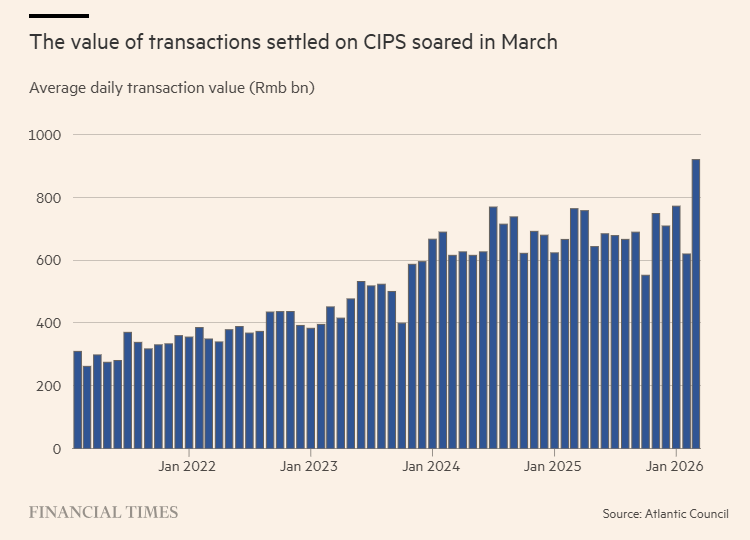
The past few months have delivered a drumbeat of headlines informing us of African countries issuing yuan-denominated debt, and of large African lenders joining China’s CIPS cross-border payments system. Zambia recently started allowing Chinese mining companies operating in its territory (and there are many) to pay taxes in yuan. And these are just the headlines I’ve noticed, I’m sure there are many more in a similar vein.
(chart via the Financial Times)
It’s also about payments resilience. Earlier this week, I covered the launch of China’s cross-border digital yuan platform. Reports suggest that the multi-CBDC platform mBridge that China leads is close to commercialization.
And just a couple of days ago, Vice Premier He Lifeng announced moves to protect Chinese businesses against sanctions. No doubt they have watched closely the impact on Russia and Iran of banks and businesses getting access to trade settlement cut off. They’re understandably building out alternative rails while making sanctions more politically dangerous to apply.
All this is happening as China is fast approaching a trade war with Europe, and needs greater diversification away from the US market.
This leads us to what is most likely the overarching goal – world peace, of course, but also greater economic resilience. Multipolarity can lead to a more stable trading environment, but only if the rule of international law is respected. Often, that can be achieved by sheer size, and the broader the Chinese web of alliances, the less the whims of Western leaders can disrupt its growth.
It helps to remember that the US plays chess, which is about killing your opponent’s king, while China plays Go, which is about patiently conquering territory. In this case, soft power is doing the work: no sermons on “values” or lectures about sensible economic stewardship – China is taking the diplomatic “I see and respect you” approach, while subtly sealing attractive trade deals and infrastructure contracts.
Meanwhile, it is shoring up its payment rails, including by extending use of its digital currency, to further protect its “territory” from the weaponization of the dollar system.
Of course, despite China’s insistence to the contrary, this does not necessarily make the world a safer place. Earlier this week, Kenya – one of the founding members of the GGI, and one of several countries that have recently converted some of their dollar debt into yuan – barred delegates from Taiwan from attending a conference on oceans. They were detained at the airport, their passports and phones were confiscated for more than 20 hours, and then their visas were revoked and they were sent home.
I’m not sure how this respects the international rule of law. The incident, which happened on the same day as publication of the white paper, highlights how subjective China’s goals are here.
Still, the map China has laid out should concern all of us trying to figure out what the geopolitical and financial landscape will look like in coming decades. Change is always an opportunity, but we don’t necessarily end up in a better place, especially if we fool ourselves into thinking we can keep track of the multiple threads weaving new patterns while masking new threats.
See also:
China’s digital currency goes international (Jun 2026)
The changing shape of reserves (Jun 2026)
