


“The valor that struggles is better than the weakness that endures.” – GW Hegel
IN THIS NEWSLETTER
Global crypto: it’s not about the price
Term of the day: logarithmic scale
Crypto is Macro Now offers ~daily commentary and updates on crypto’s evolving role in the changing geopolitical and financial landscapes. Plus links and more.
If you’re a premium subscriber, thank you so much!! ❤
PUBLISHED IN PARTNERSHIP WITH: ✨ ALLIUM ✨
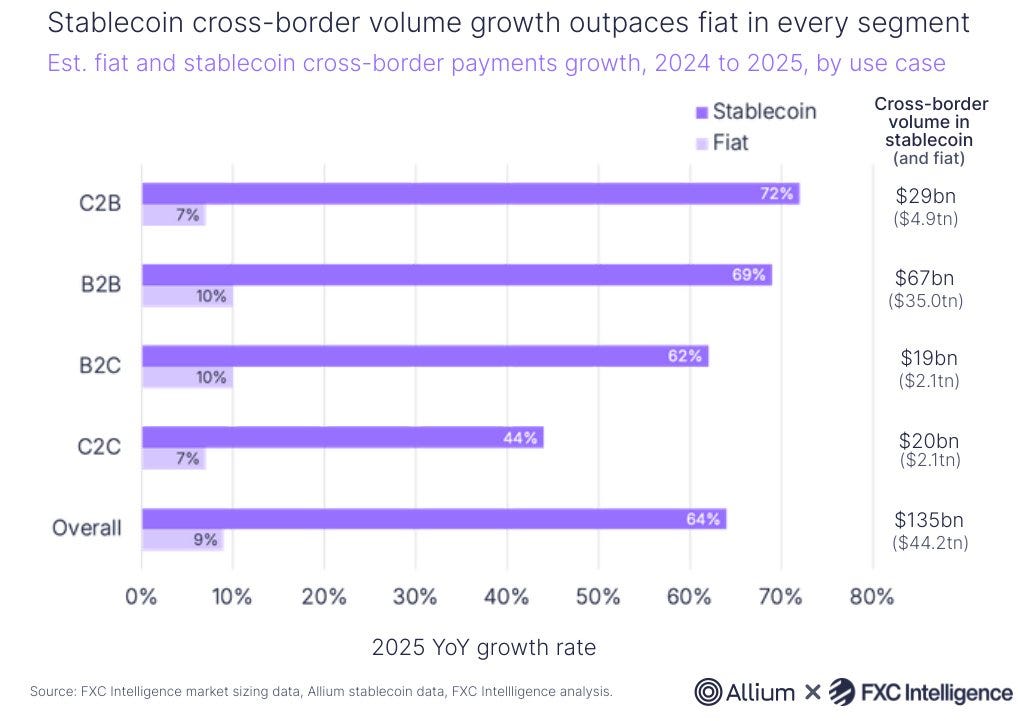
Every segment of the retail cross-border market grew faster on stablecoin rails than on fiat through 2025. Consumer-to-business led at 72%, B2B at 69%, business-to-consumer at 62% and consumer-to-consumer at 44%, against 7% to 10% for the fiat equivalents.
Full report: Stablecoins in Cross-Border Payments
Get weekly onchain data and more analysis like this from the Allium Research team on Substack.

NEWSLETTER STUFF
Production note: this newsletter will skip publication Thursday-Saturday – I explained why yesterday (celebratory reasons!).
WHAT I’M WATCHING
Global crypto: it’s not about the price
Once a year, Chainalysis publishes a report on global crypto adoption, always worth perusing as they paint a portrait of the different “characters” of regional development and highlight that the technology means different things to different people – for some it’s trading, for others it’s a market and payments technology, for many it’s resilience.
The team does this by breaking down different types of crypto-related activity across geographies into segmented indices and then aggregating them into a Global Adoption Index – this aims to represent trends in broad adoption, not just trading or transaction volumes, and not just business activity.
The full report is not yet out, but we do have a synopsis and there are some surprises.
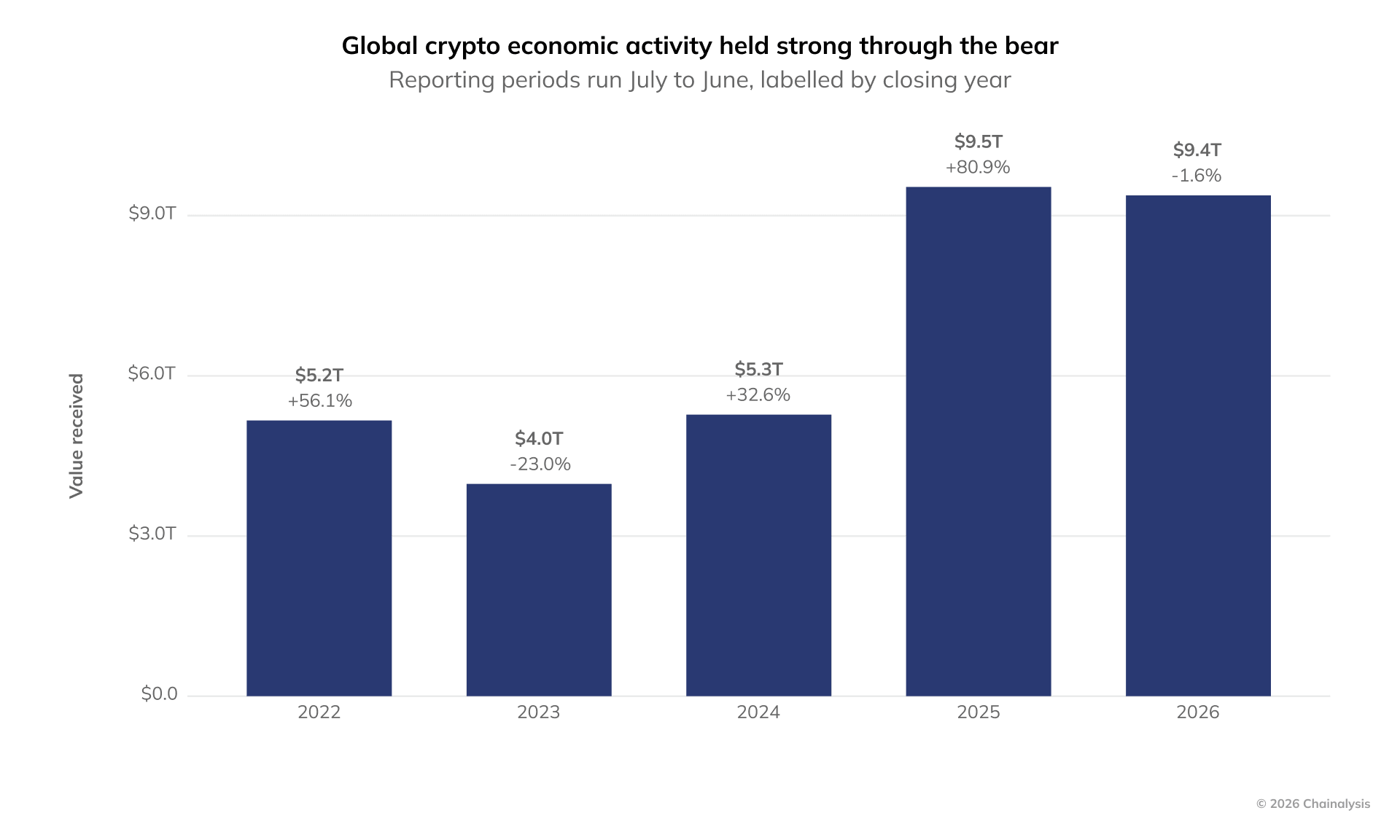
One is that, in a year (July 1 2025 – June 30 2026) in which crypto market cap dropped by almost 50% from peak to trough, the overall crypto “economy” (estimated from adjusted onchain movements and balances) fell by less than 2%. For contrast, in the 2022-23 price slump, the crypto economy contracted by 23%! As I’ve been saying for a while, asset prices are the least interesting feature of the technology’s potential – and now we’re seeing that they matter less for the industry’s growth. Of course, when they pick up, we’ll see a growth spurt as new funding and new users pile in. But it’s heartening to see other drivers at work.
(charts in this section from Chainalysis)
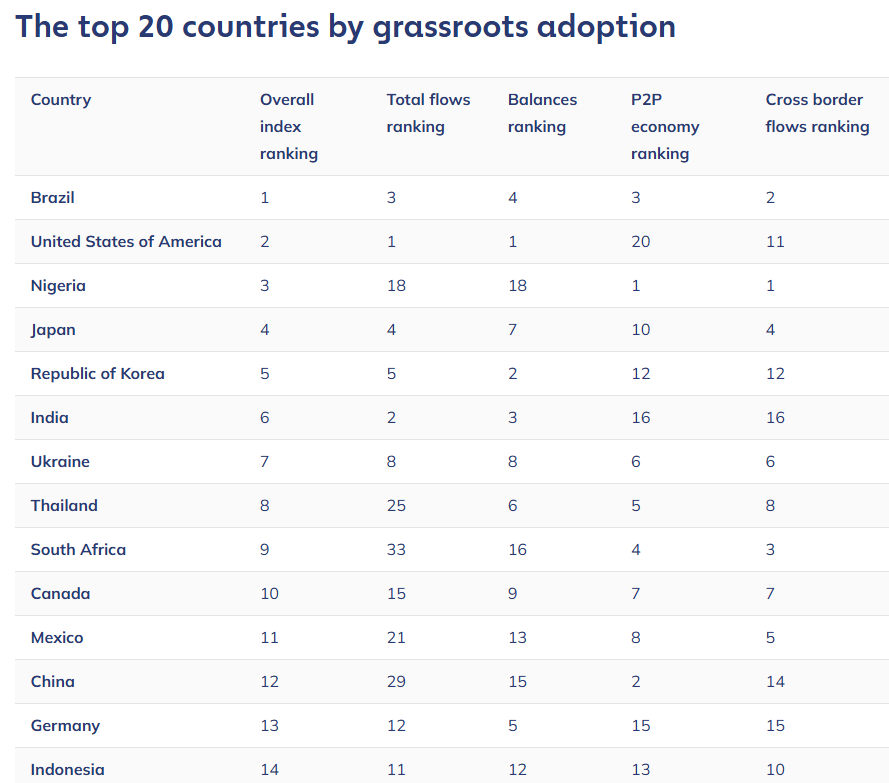
Another surprise is the ascent of Brazil into first place on the adoption index, up from 5th last year.
(I discussed Brazil’s adoption trends and other developments in my recent Stablecoins in Brazil episode with Aaron Stanley.)
Last year’s #1, India, dropped to #6, perhaps due to what looks like paralysis on crypto regulation. The US came out on top in terms of total flows and balances, but is notably lagging in P2P and cross-border activity. These were dominated, unsurprisingly, by Nigeria.
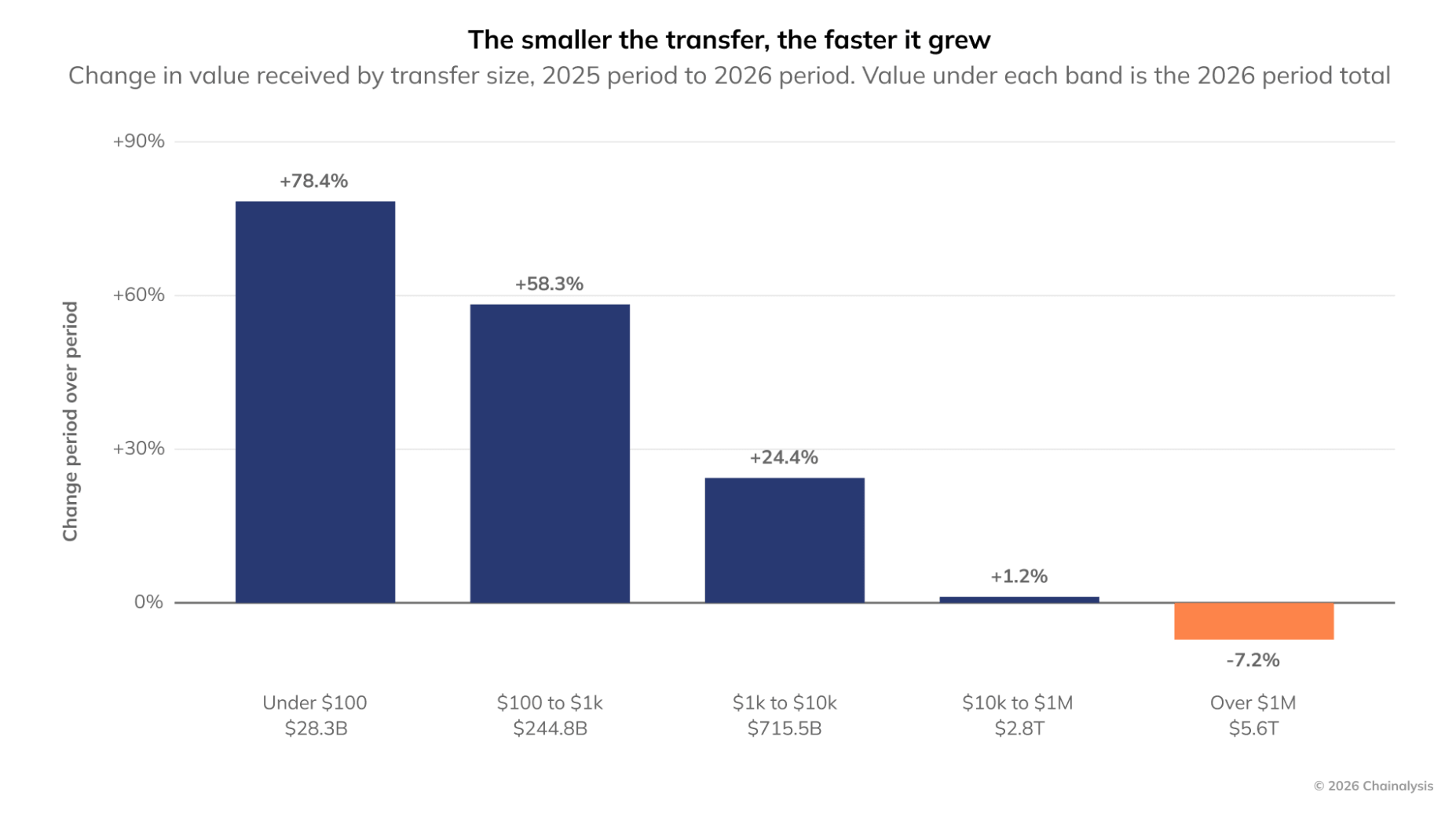
Another sign that crypto is going “mainstream” can be seen in the growth of retail-sized transactions. The number of transfers of less than $100 jumped by almost 80%, while that of transfers between $100 and $1,000 increased by almost 60%. Again, this is at a time when crypto markets were relatively dormant. We can see more of a crypto market impact in the slump in large crypto transfers, but even this was relatively muted.
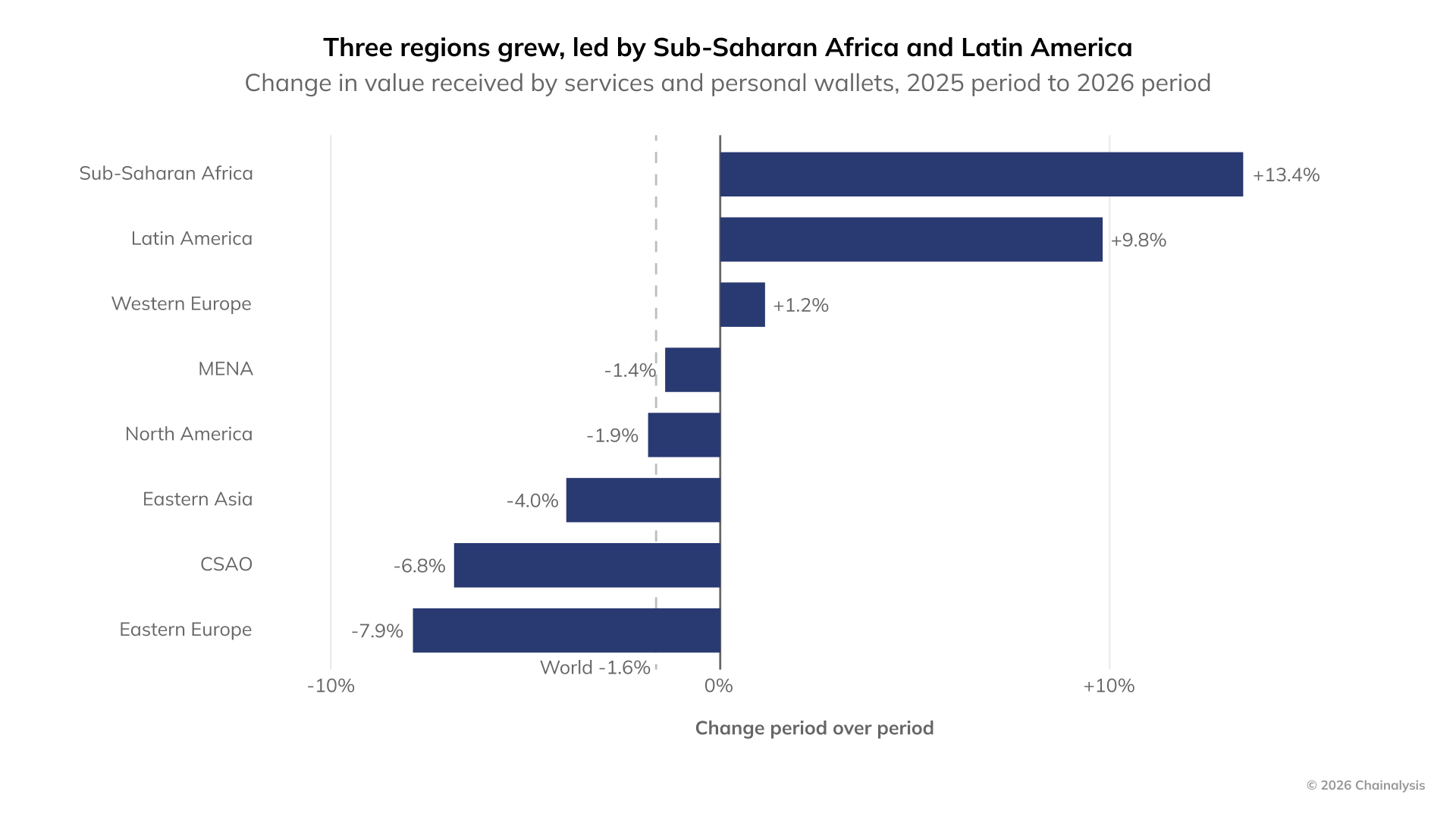
The region with the strongest growth in “value received” (flows into centralized and decentralized exchanges, institutional platforms, lending protocols and bridges) was Sub-Saharan Africa, followed by Latin America. The sharpest contraction was seen in Eastern Europe, which is odd since that includes Ukraine which topped the 2025 list, adjusted for population.
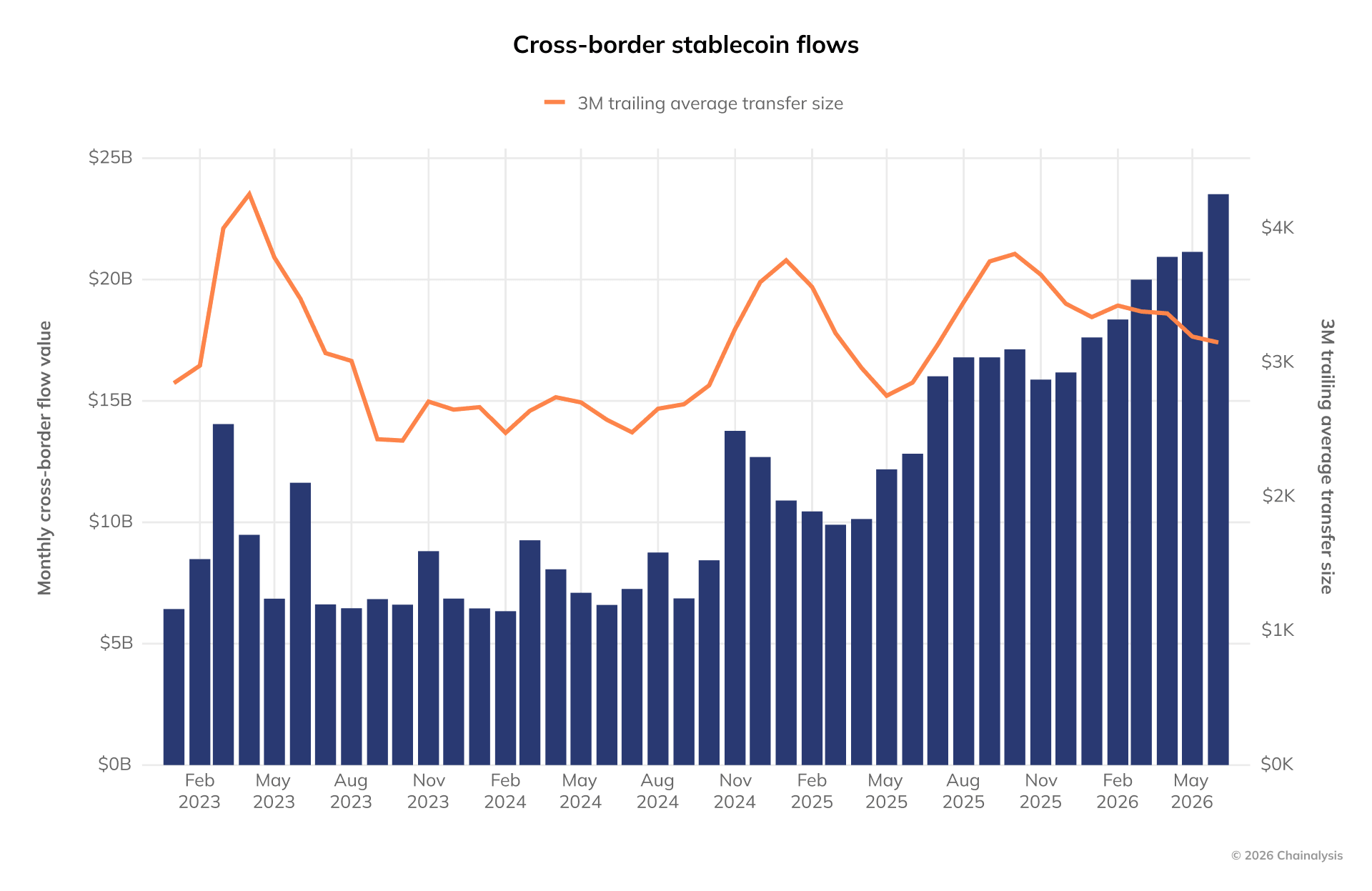
The use of stablecoins in cross-border transactions continues to grow (I wrote recently about an Allium report that shows the same). The below chart shows a notable consistency in the growth, again suggesting that use outside of crypto market transactions is increasing.
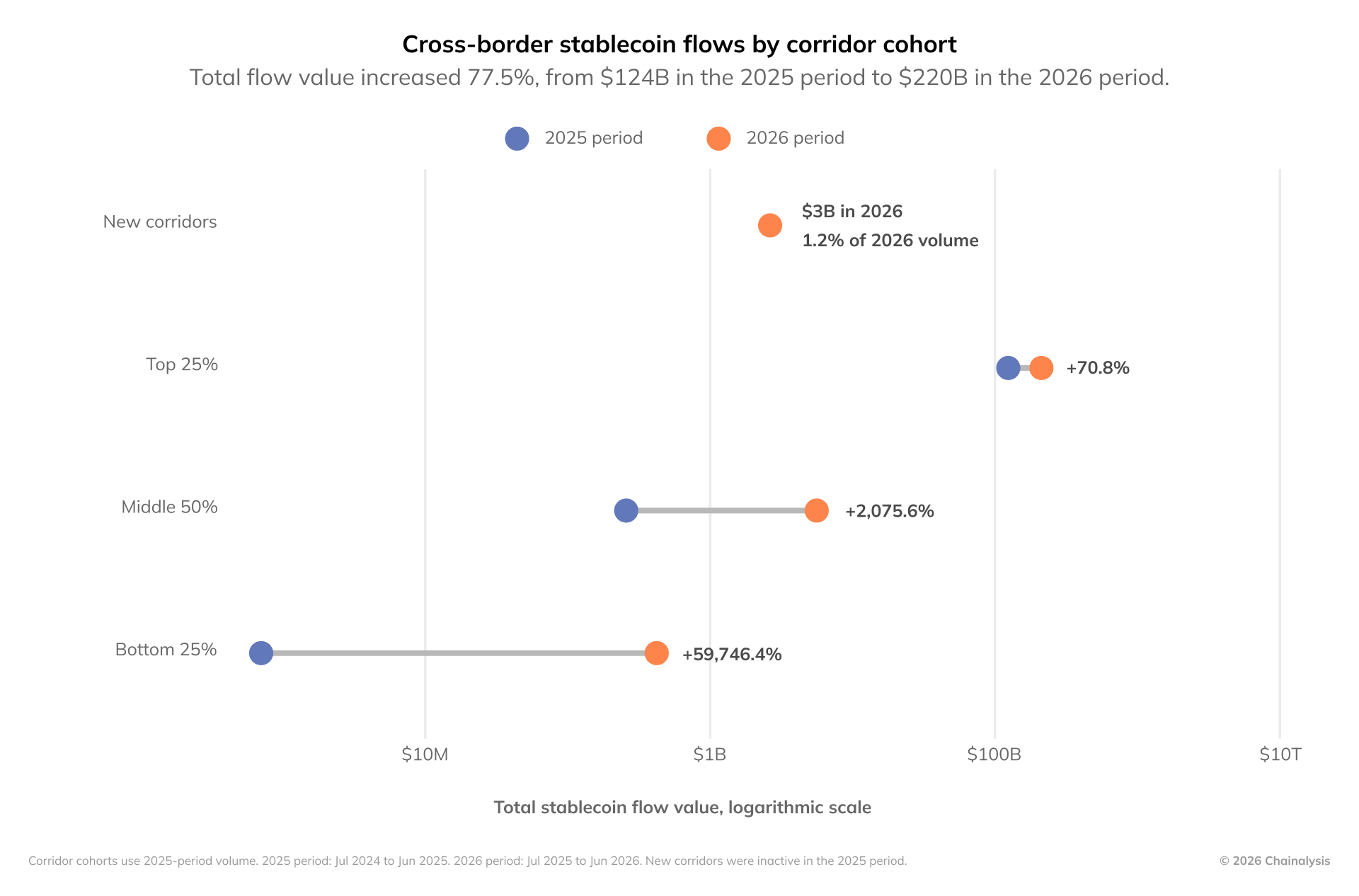
What’s more, the cross-border flows are becoming less concentrated in the top corridors, further evidence of increased breadth of adoption. Note the distance between the blue dot (2025 transfers) and the orange dot (2026) in the bottom quartile of corridors by transfer size. The top quartile still dominates, easily (the scale below is logarithmic - scroll down for more on that), but the gap is narrowing.
Especially intriguing, for those of us that care about open access and decentralization, is the growth in peer-to-peer transfers – this feature is, after all, blockchain’s original proposition, to be able to transfer value without passing through an intermediary (here’s a link to the Bitcoin white paper in case any of you want a refresher).
As the crypto industry becomes increasingly institutionalized, it’s encouraging to see that P2P activity continues to spread. While value flowing into exchanges, DeFi protocols and other businesses fell by more than 4% over the period, that moving directly between personal wallets jumped by more than 300%! It’s still a tiny percentage of overall crypto activity, but it has increased from around 0.6% to 2.5%. Also, it’s notable that 96% of peer-to-peer activity is in stablecoins.
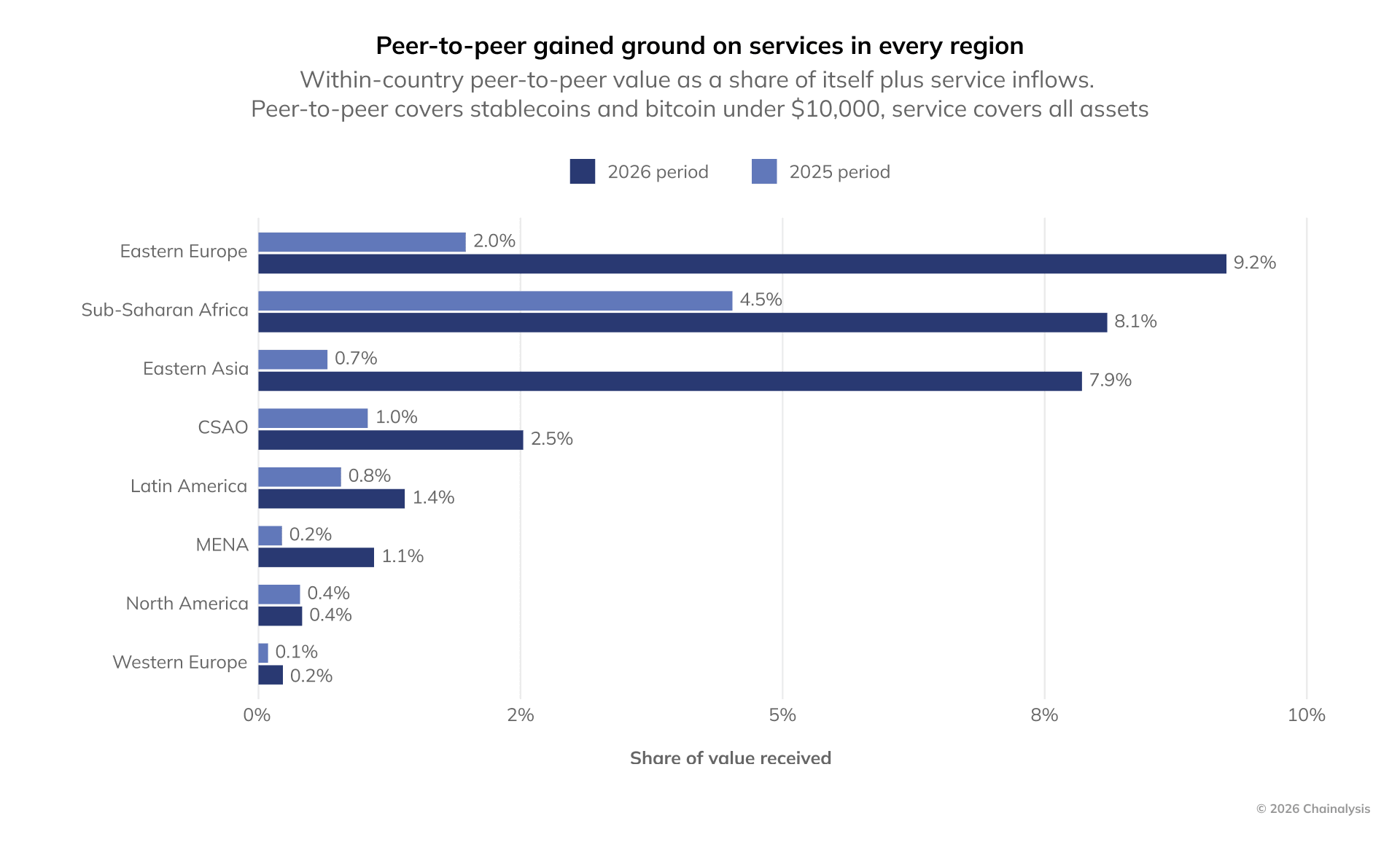
In sum, over the past year stablecoins have been an anchor for crypto ecosystems around the world – growing in use and also in relative value as crypto trading fell along with asset prices.
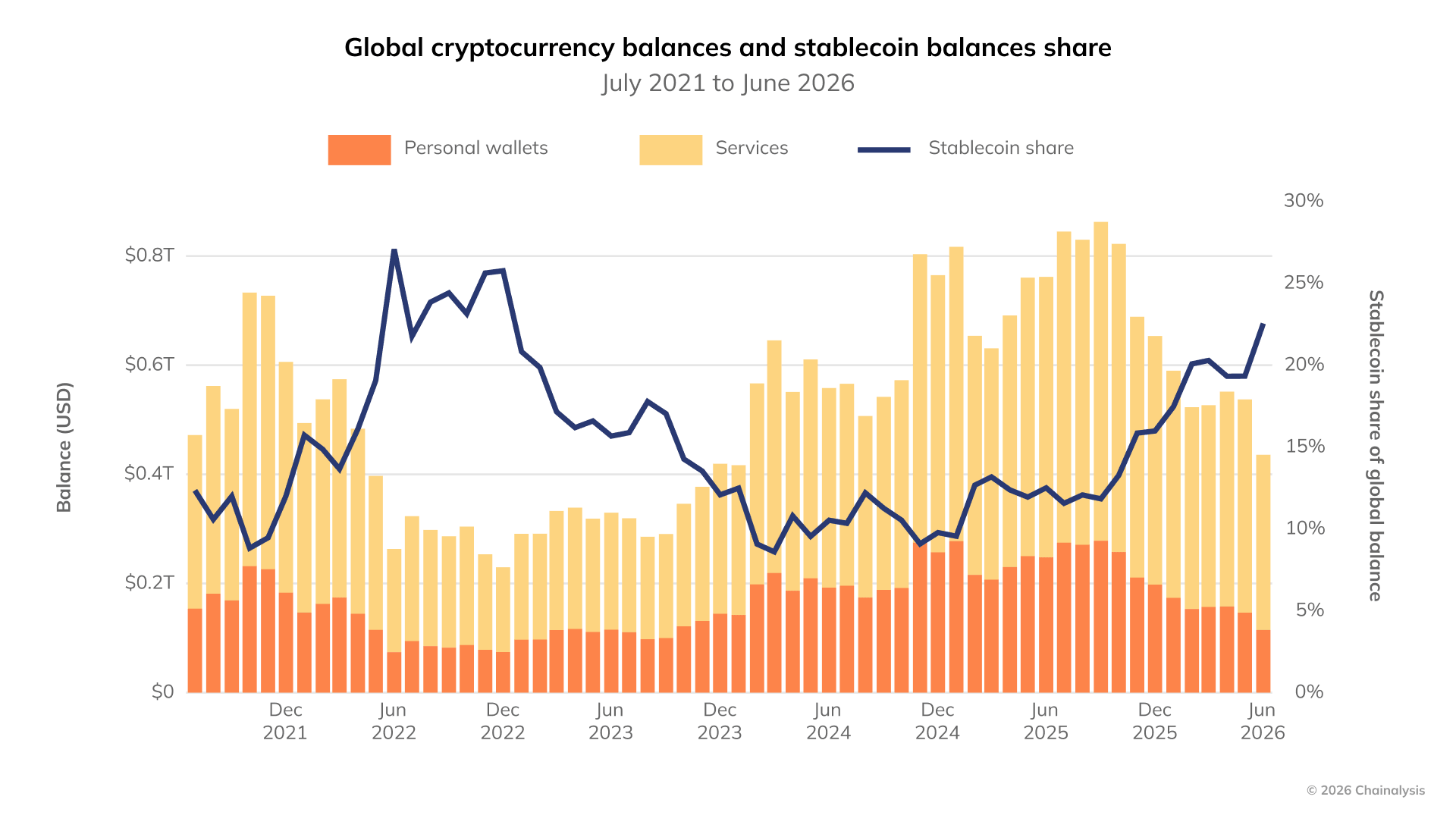
This is one of the reasons I’m excited about exploring stablecoin use outside the US – it’s where we’ll see real grass roots activity, and lasting infrastructure change. So far, I’ve recorded episodes on Japan and Brazil (as I mentioned above), and this week will be releasing an episode on the EU in which I talk to Marieke Flament.
Hats off to Chainalysis for this work – it’s painstaking and meticulous, thoughtful and insightful, and it paints not only a useful global snapshot of adoption trends and use cases, but also a more interesting picture of the technology’s potential than “number go up”. The full Global Adoption report should be out in a few days – you can sign up here.
See also:
Stablecoins Around the World Ep. 2: Brazil (Sept 2026)
Stablecoins Around the World Ep. 1: Japan (Sept 2026)
Brazil’s stablecoin separation (May 2026)
Global crypto adoption (Oct 2025)
The global crypto scramble (Jan 2025)
