


“We must plan for freedom, and not only for security, if for no other reason than that only freedom can make security secure.” – Karl Popper
IN THIS NEWSLETTER
Coming up this week: lots of macro data
Who controls the money innovation narrative?
Crypto is Macro Now offers ~daily commentary and updates on crypto’s evolving role in the changing geopolitical and financial landscapes. Plus links and more.
If you’re a premium subscriber, thank you so much!! ❤
PUBLISHED IN PARTNERSHIP WITH: ✨ ALLIUM ✨
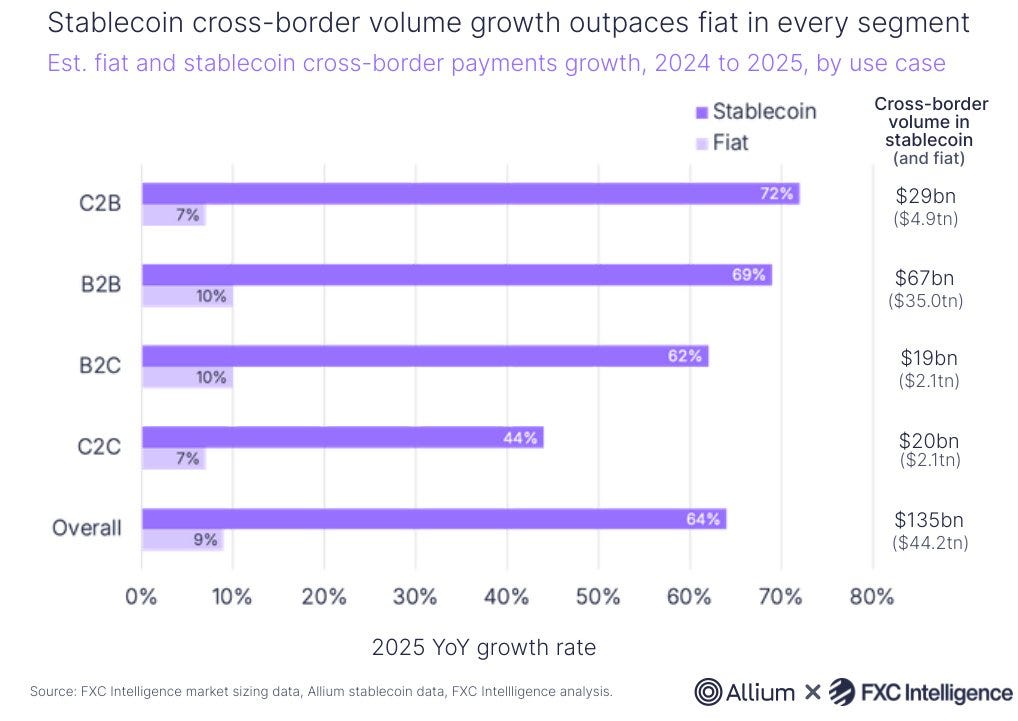
Every segment of the retail cross-border market grew faster on stablecoin rails than on fiat through 2025. Consumer-to-business led at 72%, business-to-business at 69%, business-to-consumer at 62% and consumer-to-consumer at 44%, against 7% to 10% for the fiat equivalents.
Full report: Stablecoins in Cross-Border Payments
Get weekly onchain data and more analysis like this from the Allium Research team on Substack.

NEWSLETTER STUFF
I’m still finding this hard to believe, but Crypto is Macro Now turns FOUR YEARS OLD this week!!! 🥳🥳

I started “soft sends” (quiet, no subscribers) on Monday, September 26, 2022, and that weekend sent the very first promoted public one from a hotel room in Kingston-upon-Thames where I was visiting my father for his birthday. I vividly remember the tiny table, the uncomfortable chair and the nerves, with my daughter cheering me on. Since then, the format has evolved as I’ve adapted to feedback and tried to be more useful – I hope I never get complacent – but I’m proud that it still goes out most days (this is post #1,150!!) and that I’m still excited to fire up the screen each morning. Thank you so much for reading, you are much appreciated.
So, two things to announce:
I’m again going to visit my father this week for his birthday (he turns 95, which is pretty darn impressive!) – but this time I’ll be taking a few days off (Thursday-Saturday) to be more present for family.
Once back at my desk next week, I’m going to do some look-backs at what I was writing about four years ago, to gauge just how much things have changed. That’s probably not going to be much fun – 2022 was a rough year – but perspective is healthy.
WHAT I’M WATCHING

Coming up this week:
It’s jobs week! And more inflation data! Both of which could lead to rate hike expectation swings. Buckle up.
As geopolitics quietens down (we hope), this week we get bombarded with high-impact macro data.
Today, SIBOS - SWIFT’s annual gathering – kicks off in Miami, with an agenda dense in tokenization and stablecoin talk.
On Tuesday, we get August US job openings, expected to show a slight decline.
We also get the latest US Conference Board consumer confidence indicators.
And tomorrow sees the start of Korea Blockchain Week, one of Asia’s largest crypto events.
On Wednesday, we get the US Personal Consumption Expenditure (PCE) index for August, expected to increase by 3.8% year-on-year and 0.5% month-on-month, which would be the steepest monthly increase in more than 12 months. The core PCE index increase, ex-food and energy, is forecast to accelerate to 3.4% year-on-year (from 3.3%), and to 0.3% month-on-month from July’s 0.2%. This is the Fed’s preferred inflation gauge, so we can expect some rate expectation volatility, whatever the outcome.
Also on Wednesday, the Bureau of Economic Analysis will issue revisions to Q2 GDP as well as annual updates to GDP going back to 2021.
We get the private sector ADP US payrolls report for September, expected to show an increase of 70,000, roughly double that seen in August.
And we get manufacturing indicators from China.
On Thursday, we get the Institute for Supply Management (ISM) and S&P Global September reports on US manufacturing activity, with both expected to show an uptick.
On Friday, we get the official September US employment data, with the consensus forecast suggesting an increase of 100,000 vs August’s 162,000 (likely to be revised down). The unemployment rate is expected to increase slightly to 4.2% from 4.1%.
And we get the flash EU September inflation report, expected to show a jump from 3.2% to 3.5%, and from 2.4% to 2.6% for the core index. More Eurozone rate hikes are almost certain.
Monday musings: Who controls the money innovation narrative?
(what’s on my mind as we head into the week)
One of the deepest lessons the crypto industry has taught me over the 12 years I’ve been swimming in these waters is that we have to question assumptions, however obvious they may seem. I used to work in traditional finance and I assumed I knew what money is – Bitcoin showed me that I didn’t. I’ve always thought that people will choose freedom over restrictions when offered – that was naïve. And I’ve trusted that efficiency-boosting innovation will transform creaky legacy structures – the jury’s still out on that.
This is front-of-mind these days because the now-parallel race between stablecoins and tokenized deposits is picking up.
What are we talking about?
For those of you new here (hello!), some basic definitions:
Stablecoins are tokens representing fiat currency on public blockchains – they hold their peg via 1:1 reserves held in safe, liquid assets denominated in the same currency.
Tokenized deposits are tokens representing fiat currency held in bank deposits, that can move on the bank’s distributed ledger. (I’ve written before about how they should be called deposit tokens rather than tokenized deposits, but here I’m going to respect the now-common form, grumbling as I do so.)
The differences between the two are legion. It’s not just that tokenized deposits are issued by banks and stay within banks, while stablecoins can be issued by non-bank authorized issuers and can move pretty much anywhere. It’s not just that tokenized deposits have, for now, limited functionality while stablecoins can fit into innovative applications active today as well as those that have yet to be invented. It’s not just that one has a legacy hue while the other wears the colours of disruption.
It’s also that tokenized deposits are traditional money on a new rail, while stablecoins are a new type of money – essentially tokenized assets that can substitute for fiat in onchain transactions. Tokenized deposits don’t change our idea of what money is; stablecoins do. (If you’re interested in more philosophy on this, and just how radical stablecoins’ use as money is, here’s what I wrote on the topic a couple of years ago.)
