


“Believe those who are seeking the truth. Doubt those who find it.” – Andre Gide ||
Hey everyone! I hope you’re all taking care of yourselves.
In case you missed yesterday’s newsletter, a couple of new features to announce:
1) A new section defining terms most of us think we know but probably don’t, not really, or just simply are not familiar with.
2) Come join me on Friday for my first Substack live episode! Kicking off a series I’m calling “Press Publish”, I’ll be talking to fellow newsletter writers about why and how we do what we do.
PUBLISHED IN PARTNERSHIP WITH: ✨ ALLIUM ✨
As traditional finance and crypto converge, trusted data is the missing infrastructure layer. Allium provides this data foundation for teams like Visa, Stripe and Grayscale.
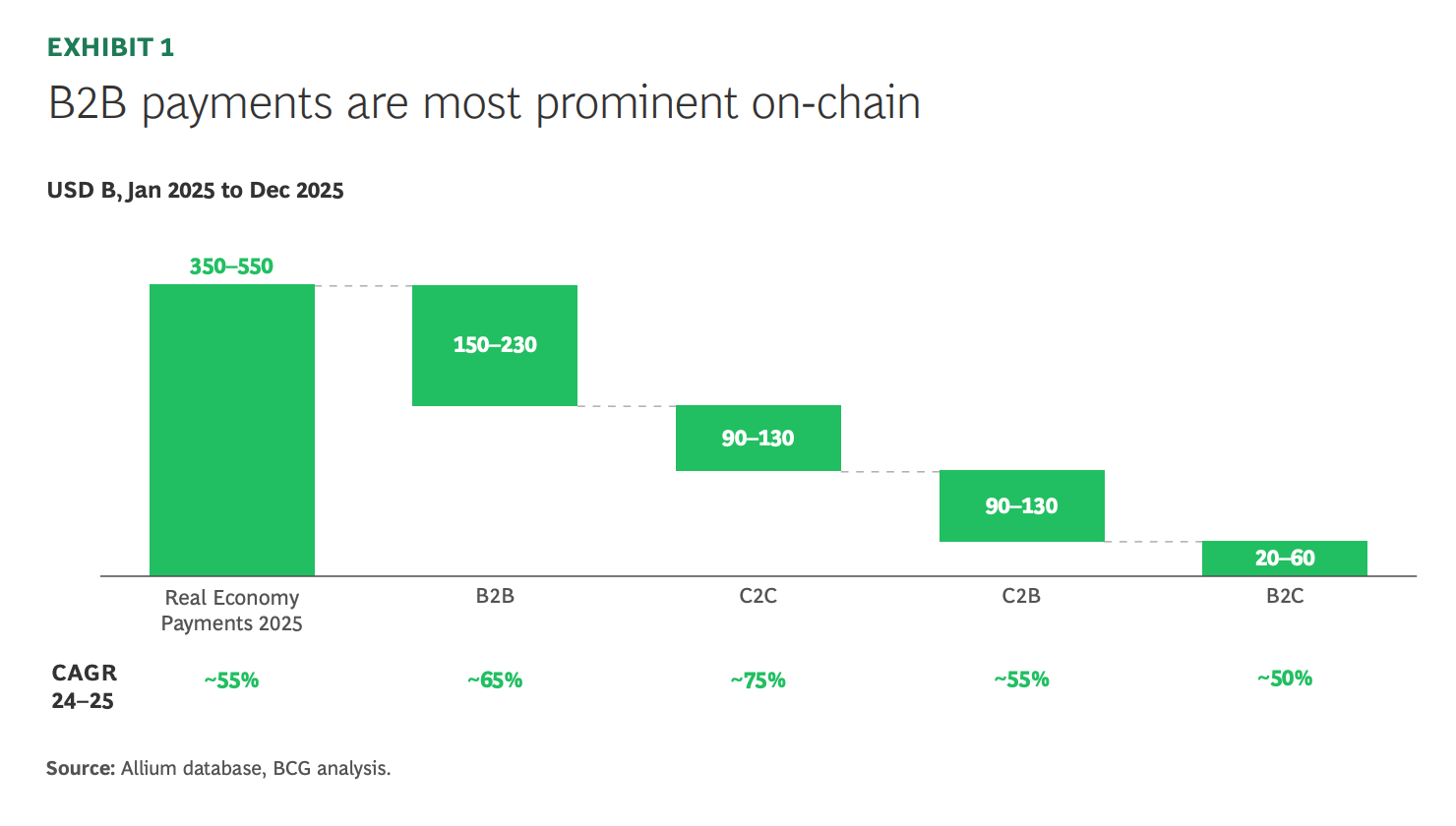
The latest whitepaper published with BCG, Stablecoin Payments: The Truth Behind the Numbers, examines how stablecoins are being used in the real economy today. The analysis estimates $350–550B in on-chain payments in 2025, led by $150–230B in B2B activity, with consumer flows contributing another $200–320B.
If you’re producing institutional crypto research or analytics, start with trusted data. Explore a live demo.
IN THIS NEWSLETTER
Term of the day: decimate
Russian stablecoins in Africa
Markets: the talk
Macro: US services activity
Crypto is Macro Now offers ~daily commentary and updates on the overlap between the crypto and macro landscapes. Plus links and more.
If you’re a premium subscriber, thank you!! ❤
WHAT I’M WATCHING:


✨ Use the discount code MACRO for 20% off!
Term of the day: decimate
(Hi all! Introducing a new feature: definitions. With so much jargon floating around, I want to help clarify confusion while poking at semantics, and refresh overall understanding of relevant terms and sometimes phrases.)
Decimate has to be one of the most debated words in circulation today, with many insisting it is being mis-used while others push back, maintaining that definitions change.
Historically, it has meant “reduce by a tenth”, and stems from the brutal form of discipline applied to parts of the ancient Roman army in which a legion of soldiers would collectively pay for an infraction committed by a member with the execution of one out of ten men, randomly selected.
But these days, you’re more likely to hear it used as a substitute for… what’s that other word that President Trump likes?... oh yes, “obliterate”.
Obviously, there’s a big difference between one tenth and pretty much everything. When it comes to actual destruction – as in, “every bridge in Iran will be decimated by 12 o’clock” – this difference matters a lot.
Pedants like me think we should stick to the original meaning, to avoid confusion. But we also recognize this is a losing battle and that heated rhetoric never pays attention to detail anyway.
✨Introducing “Press Publish”✨
This Friday, I’m launching a Substack live series – not on crypto nor macro (coming soon!), but on writing newsletters. At 11amET, I’ll be talking to fellow newsletter writers about why we do what we do, what our days are like, our frustrations, our wins, our advice, where we think media is going and a lot more.
I’ll be kicking it off with my friend and former colleague Christine Kim, one of the leading experts on the Ethereum ecosystem, now also covering Bitcoin, and the author of the ACD After Hours and BTC Before Light newsletters, host of the Ready for Merge and the Meet the Developers podcasts, and more besides. (You can see her recent publications here.)
Come and join us at 11amET at the following link: https://open.substack.com/live-stream/154954?utm_source=live-stream-scheduled-upsell (I think that’s the link, I’m still getting the hang of this.)
Russian stablecoins in Africa
Regular readers will know that I often write about the role of stablecoins in geopolitics. They don’t just represent a potential extension of the reach of the US dollar, further cementing its role as a global store-of-value and trading currency. They also facilitate the use of dollar alternatives, potentially weakening both the dollar’s international position and the power of the US and other western powers to punish uncooperative nations by cutting off their access to the dollar-dominated system.
One example I’ve cited a few times is Russia’s use of stablecoins in trade; its CBDC is due to launch later this year, but crypto assets including stablecoins have been legal for cross-border settlement since mid-2024. With most of Russia’s banks sanctioned, this has been a lifeline for many of its businesses.
Of course, Western powers have tried to stop this. Last year, the EU applied sanctions to one of the key stablecoins powering Russian cross-border trade: A7A5, pegged to the rouble. At the time, I wrote that this was a futile move as the entities using the token weren’t going to care much about a few more sanctions. And anyway, a stablecoin is just a few lines of code, easy to copy and paste under a different name. (I’m simplifying, of course, but the point that they are not hard to replicate holds.)

Indeed, the sanctions don’t seem to have worked. A7A5 today is the 21st largest stablecoin in circulation by market cap and has considerably more market cap than the largest euro stablecoin EURC, according to data from DeFiLlama.
What’s more, its operations are expanding.
