


“Hypocrisy is the tribute that vice pays to virtue.” – François de La Rochefoucauld
IN THIS NEWSLETTER
Grab bag: Tokenized money market funds, deposit tokens, gold market infrastructure
Term of the day: Regulation Q
Markets: the narrative in the divergence
Crypto is Macro Now offers ~daily commentary and updates on the overlap between the crypto and macro landscapes. Plus links and more.
If you’re a premium subscriber, thank you so much!! ❤
PUBLISHED IN PARTNERSHIP WITH: ✨ ALLIUM ✨
Crypto buybacks are having a moment. But the headline numbers can be misleading. $638M has been spent on buybacks YTD, yet HYPE and PUMP buybacks currently represent <2.5% of trading volume. At that scale, the buybacks matter more for reducing supply than for supporting prices.
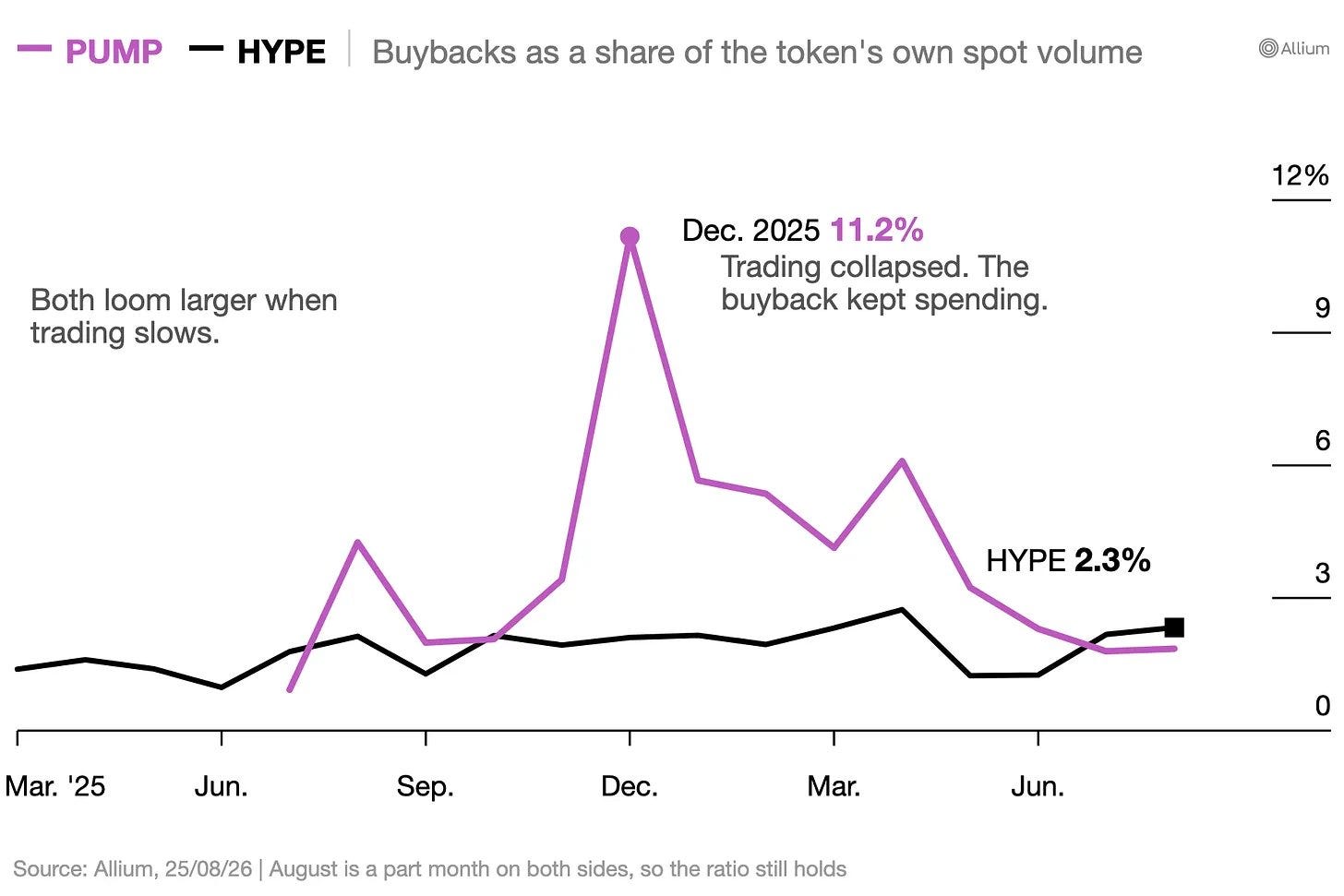
See more: Crypto Buybacks Are 2.5% of Trading Volume, Too Small to Drive Prices
And get weekly onchain data and more analysis like this from the Allium Research team on Substack.

Hello everyone! To my fellow symmetry lovers, happy 9th of the 9th.
WHAT I’M WATCHING

Grab bag: TMMFs, deposit tokens, gold market infrastructure
Back with the regular roundup of some interesting recent crypto/macro pieces written by others.
Stuart Cook – Money at Rest, Money in Motion
Like most of us, you’re probably tired of hearing about stablecoin yield in the US – should it be allowed, what about rewards, but the damage to deposits, and on and on.
So it’s worth noting when an original take emerges.
In a recent post in his newsletter Atomic Settlement, Stuart Cook maps the yield issue onto functionality, and in so doing, highlights a threat the bank lobbies seem to have overlooked.
First, he divides the onchain money landscape into stablecoins, which can move freely but can’t earn yield, and deposit tokens, which can earn yield but can’t move freely.
There’s a trade-off here: yield vs flexibility.
Then Stuart introduces an overlooked monetary asset: tokenized money market funds (TMMFs). These don’t directly represent dollars, although they are similar in form and value to a stablecoin backed by cash and short-term government debt. But they aren’t stablecoins, which means they can earn a yield. And they can sit next to stablecoins in digital wallets, holding and remunerating idle balances.
Regular readers will know that I’ve written about this often before: in my view, stablecoins shouldn’t earn yield as that distorts incentives, and they won’t need to once tokenized money market funds become more accessible to all.
Stuart adds an interesting twist to this argument.
He suggests that the debate is essentially dividing “money” into distinct buckets according to function – which, in turn, highlights that our understanding of the term “money” needs to evolve.
Money that earns yield doesn’t move. Money that moves doesn’t earn yield.
But the real battle, he points out, isn’t between banks and stablecoins. It’s between banks and capital markets.
Money market funds (MMFs) emerged in the 1970s as a workaround to legal limits on what banks were allowed to pay on deposits (see below for more on Regulation Q). They passed through to holders the bulk of the interest earned on short-term government and corporate debt, repo agreements, etc., giving savers a market-based yield on their savings, notably more than what they could get from their bank.
By 1980, they held $77 billion in funds; today that total has multiplied by more than 100x.
But MMFs are securities, not checking accounts – a very different functionality. However, in 1977, Merrill Lynch started offering a checkbook and card along with its money market fund. The difference narrowed.
Today, the evolution is similar, but heading in a different direction. Rather than give tokenized MMFs a checking-like interface, we’re bringing them into existing wallet formats. It’s not checking account activity being pasted onto MMFs, it’s MMFs coming into the new type of checking account. Now your digital wallet can offer a checking account-like service (stablecoins) and a yield-earning savings option (tokenized MMF). What’s more, wallets can be configured to automatically move funds between the two, as needed.
This, Stuart suggests, is the real threat to banks: the convenient format combined with programmability. In a wallet, depositors can combine checking and saving, and not even have to think about the separation. They can just know that idle balances are earning, up until they are needed.
Having access to the two functions (yield and payments) in a bank usually requires two sets of paperwork, two management strategies, more operational friction and, probably, a lower return.
So, banks are focused on stablecoins when the real threat is elsewhere. They can’t fight tokenized MMFs just like they couldn’t fight the original money market funds (which, by the way, turned out to be phenomenally popular but did not lead to the collapse of the banking industry). Banks can’t fight capital markets.
Instead, they could push for smoother yield-payment hybrid services for their existing customers, before these customers discover that a more convenient solution exists. For now, tokenized MMFs are still a bit clunky, subject to transfer restrictions and investment minimums. But this is changing.
See also:
Big moves in tokenized MMFs (May 2026)
Stablecoin rewards and bank deceit (Mar 2026)
Dallas Fed – Tokenized deposits could affect bank liquidity, maturity transformation
It turns out that tokenized bank deposits are not bank deposit-neutral. They may not change the overall amount of deposits on a bank’s balance sheet, but they do change the nature of a bank’s liabilities.
This is the main argument in a paper published last month by researchers (Rosie Levy and Srini Ramaswamy) at the Federal Reserve Bank of Dallas. It got my attention because it’s a departure from the usual efficiency hype, and it highlights an overlooked yet relevant structural feature of banking. What’s more, it ties in with what Stuart was saying above.
To start with, deposit tokens may be less flexible than stablecoins in that they don’t have freedom of movement – but, unlike stablecoins, they exist within a mature regulatory structure, which large incumbent institutions will find reassuring. So, as tokenized markets expand, we can expect their popularity to also grow.
This will matter for wholesale deposit duration. Wait, aren’t all wholesale (business) deposits short-term bank liabilities that can be withdrawn at any time?
Technically, yes, but banks don’t see them as all the same. Rather than just rely on product categories, banks classify deposits according to behaviour:
Operational wholesale deposits are funds in business accounts that are required for cash management. Non-operational wholesale deposits are surplus balances.
Operational deposits tend to be “sticky” as business clients usually use a range of banking services, which adds friction to changing banks. But non-operational balances are less so, and are more likely to move where they’ll earn more, such as in money market funds. If the non-operational balances are held in tokenized form, instant settlement into tokenized money market funds (TMMFs) would make this move easier and therefore more likely. It could even be automated.
Also, greater use of instant payments via tokenized deposits could bring down the optimal level of operational deposits for businesses. This would push more of an account’s balance into the non-operational classification, with the same yield-seeking risk mentioned above.
The thing is, non-operational wholesale deposits typically have a longer average duration, or lifespan, than operational ones. From a bank’s point of view, a longer weighted average life (WAL) narrows the maturity mismatch between liabilities and deposits. Reduce the amount of funds in non-operational deposits, and the mismatch widens, in theory shrinking the capacity for long-term lending. This could be at least partially offset by boosting longer-term liabilities such as debt issuance; but this is more expensive for banks and could lift the cost of credit for businesses and consumers.
So, meaningful adoption of tokenized deposits would increase the volatility of deposit balances. Greater uncertainty as to deposit outflows means a bank would need to hold a greater proportion of high-quality short-term liquid assets in its portfolio. This would, in theory, push more demand into short-term Treasuries, Fed reserves or similar, to the detriment of longer-term assets and the overall yield earned.
Combine the lower portfolio returns with competitive hikes in deposit rates in an attempt to hold onto customer funds, and you’re looking at an overall squeeze on bank margins. This, in turn, could incentivize banks to invest more in higher-yielding assets of lower quality, potentially weakening bank resilience.
I know, banks are likely to be fine – as an industry, they are doing spectacularly well, going by Q2 results. For now, they can afford a margin squeeze. But the paper does remind us that any shift in consumer behaviour will have consequences. And if these aren’t monitored, they could bite.
OMFIF – Gold’s return as monetary collateral
One of the areas of focus of this newsletter is the emergence of a new global monetary order, with greater fragmentation and a return to a more commodity-based system. More trade settling in local currencies on new rails, often blockchain-based, is one manifestation. Greater reserve diversification into commodities is another.
Throughout history, the key commodity monetary reserve has been gold – this is unlikely to change any time soon given its scarcity, durability and (sort of) fungibility. But currencies have a key advantage over a shiny metal: lively marketplaces with fast settlement enabling almost instant realization of their value when needed.
In comparison, the gold market is clunky and inefficient.
This was the focus of a recent piece by Steven Feldman for central bank think tank OMFIF, in which he points out that we are moving away from a fully fiat system, but market infrastructure is not keeping up.
Some demand data to back this up:
Central banks bought nearly 1,000 tonnes of gold per year between 2022-2024, nearly 3x the average for the previous 11 years.
Official gold holdings are approaching their Bretton Woods peak of 38,000 tonnes.
According to the IMF, last year gold surpassed US Treasuries in share of official reserves. A recent World Gold Council survey showed that 95% of central banks expect official gold reserves to grow over the coming year, the highest reading in the survey’s history.
This trend is also reflected in the world’s leading stablecoin: gold is now over 10% of Tether’s USDT backing reserves, up from 5% a year ago even as the total amount of reserves has increased.
But for gold to truly become an efficient global reserve asset, it needs a global, transparent and efficient market. It doesn’t have one:
Custody is spread out across vaults around the world that cannot reconcile with each other in real time.
Most gold trading happens over-the-counter (OTC) in bilateral trades rather than on a public exchange.
More than 90% of gold OTC trading clears through unallocated accounts, which means the holder has a contractual claim against the clearer rather than title to specific bars – systemic counterparty risk for an asset in demand to counter counterparty risk.
Steven doesn’t address how the gold infrastructure can improve (I’m assuming, going by the average length of their articles, it’s because OMFIF asks for a word limit).
But keep an eye on what Singapore and Hong Kong are doing to establish themselves as international gold clearing and storage hubs, essentially setting up a bridge between global and Asian bullion markets.
Steven is right: buying strategies are ahead of the infrastructure development gold would need to be a monetary asset in modern markets. But the gap could soon narrow.
