


Hello everyone, and welcome to May!
You’re reading the free weekly Crypto is Macro Now, where I re-share a couple of posts from the week and add some assorted links.
On Monday, I was a guest on Scott Melker’s Macro Monday show, where I joined Mike McGlone and Peter Tchir in a characteristically spicy debate about macro and crypto, you can see the replay here.
PUBLISHED IN PARTNERSHIP WITH: ✨ ALLIUM ✨
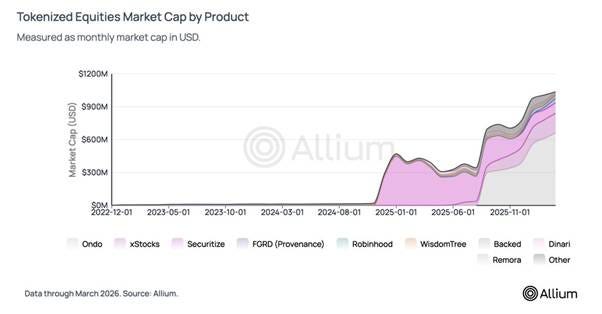
Tokenized equities hit ~$1B in supply since launching in mid 2025. The market structure is more interesting than the milestone.
Allium’s latest research covers where liquidity actually lives, how tokenized prices compare to traditional equities, overnight price discovery, and why ~90% of volume is outside the US.
For fintech platforms, exchanges, institutional investors, and builders evaluating the tokenized equities opportunity.
→ Read the report: https://www.allium.so/reports/allium-tokenized-equities-report-q1-2026
In this newsletter:
Meme coins and the crypto blues
Western Union and modern banking
Assorted links: American songwriters, infinity, saving humanity, listening vs deskwork, cooking for one.
Weekend: a global take on an iconic song
Crypto is Macro Now offers ~daily commentary and updates on the overlap between the crypto and macro landscapes. Plus links and more.
If you’re a premium subscriber, thank you!! ❤
✨Press Publish with John ‘Alyosha’ Johnston✨
Next Friday, May 8th, come join me in a conversation with John ‘Alyosha’ Johnston, author of the Market Vibes newsletter on Substack.
If you don’t already know JJ’s work, it’s an essential read for anyone interested in markets and/or commodities, written by someone who brings decades of trading experience to your inbox and yet still treats each day as an adventure in learning and sharing. We’re not going to chat about price uncertainty or macro, we’re going to discuss newslettering – why he does what he does, how he gets so much done, what’s worked for him on Substack and what hasn’t, what advice he’d give others starting out, and more.
Join us next Friday, May 8th, at 11am EST/5pm CEST.
Some of the topics discussed in this week’s premium dailies:
Coming up this week: central banks!
Monday mood: Meme coins and the crypto blues
Term of the day: meme coin
Western Union and modern banking
Term of the day: Kharg Island
Markets: disbelief
When cracks become fractures
Term of the day: Exchange Stabilization Fund
Markets: pull the other one
he Fed surprises
Macro: US and Eurozone data
Term of the day: Eurozone
Bitcoin benefits from AI wealth
Meme coins and the crypto blues
A high-profile event last weekend inadvertently highlighted what I think is an overlooked explanation for the “crypto blues”, that jaded feeling of ennui that many long-time advocates have been struggling to put a finger on.
I’m not talking about the drama at the White House Correspondents’ Dinner. Rather, I want to focus on Trump’s meme coin lunch held at his Mar-a-Lago estate in Florida.
If that statement triggered an instinctive recoil, that’s part of the issue. Our distaste for meme coins is worth unpacking as it’s not just about speculative tokens, nor is it just about blatant grift or influence abuse. There’s something else going on here.
First, let’s establish what we mean by “meme coin”: a blockchain-based token inspired by a cultural trend or personality. Generally, they have no clear utility other than simply “being”. BTC, for example, acts as a hard-cap store of value as well as a representative token for a decentralized database. ETH powers a global decentralized computing platform. AAVE confers voting rights and can serve as collateral. Meme coins DOGE, PEPE and BONK, on the other hand, don’t have any clear function.
Is that true, though? Arguably, their function is signalling. If you hold dogwifhat (WIF), you are signalling that you identify with that community, that particular meme.
Some no doubt pile into a meme token to bet on a popularity surge pushing up the price to lock in a good profit. But for many, expressing oneself via token purchases, well, it feels good.
So, arguably meme coins have an emotional utility, much like baseball cards or Labubus. Anyone looking down their noses at meme coins should also be looking down their noses at other forms of community signalling or momentum speculation. And yet neither piling into unprofitable penny stocks because of a reddit post nor wearing a t-shirt of your favourite band trigger the same recoil instinct.
And we have to acknowledge that the $TRUMP meme coin does have a “practical” utility: it grants access to events. It’s not a leap to imagine holders of a movie-inspired meme coin earning tickets to the premiere, or those that hold a hippo-inspired token getting discounts on related merchandise. Meme coin “utility” could become a more widespread concept.
Perhaps the instinctive recoil isn’t because of meme coins as much as it is about this particular one. Fair enough. For many of us, it instinctively feels wrong that the President of the United States or members of his family should personally profit from selling access via meme coin acquisition. I’m in that camp so I’m not trying to justify anything here – but are we really going to kid ourselves that selling access hasn’t been a feature of US politics for a very long time?
Maybe our distaste stems from just how blatant this is – we’d feel better about grift and profiteering if it wasn’t so obvious. But isn’t it healthier to have it out in the open, so we can hopefully, finally, pressure politicians to do something about it?
Perhaps the instinctive recoil is intensified by the juxtaposition of grift and crypto.
Those who hate crypto will see the $TRUMP meme coin as representing everything that is bad about the space: “of course it’s only good for grift”. This is confirmation bias writ large, in which an obvious example makes all the exceptions invisible or irrelevant.
Meanwhile, those of us that believe in crypto’s levelling and uplifting potential are disappointed that its highest-ranking proponent brandishes a meme coin as an example to uphold. Then again, that breadth of choice is embedded in the crypto market – its flexibility and open access is the point. We can judge, but as long as what people do with the technology is legal, that’s all we can do.
We can find the choices made by President Trump and his family cringe and embarrassing, but we can’t really be surprised. Nor can we, with integrity, advocate for only “some” legal crypto uses being acceptable. Again, whether a high-ranking official should be able to push a meme coin so publicly is not a crypto issue, it’s to do with the current political system.
The unease stems from more than disappointment, though, it goes deeper than disapproval. It’s about the sinking realization that we’ve been played.
Trump’s full-throated embrace of meme coins represents where he sees individual opportunity in crypto markets. His earlier praise of Bitcoin now looks like a tactic to get crypto donor funds, and there were plenty for the taking. His insistence that the US has to accelerate crypto approvals in order to compete with China never made sense to anyone watching the Chinese crypto market. And last weekend he was flying the “America Is Great” flag in saying:
“The crypto industry was created in America. Its growth has been led by America, and its future will be made in America and other countries.”
If he understood crypto at all, he’d know this was not true – the crypto industry was not created in America, nor was its early growth based there.
And this at an event billed as the “most exclusive crypto and business conference in the world” – for holders of a certain meme coin.
We have to appreciate that, under the current Administration, the crypto industry has as a whole gained a lot. Thanks to President Trump, we are net ahead in terms of regulatory acceptance and institutional support. We may not like everything he does, but he promised crypto progress and he largely delivered.
But the feeling of being used is never a good one. This, I think, goes some way towards explaining why, when things are going well for the crypto industry overall, so many of us have been feeling a notable lack of excitement. It’s not the uninteresting price movement – we’ve been through this before. Nor is it the attention pivot of venture capital over to the AI space – funding has dropped, but that’s arguably healthier than the easy-money era which did not do much for crypto’s reputation. And investment in crypto projects from traditional finance firms is high.
There’s some satisfying vindication in seeing the price of $TRUMP drop 14% on the day of its big event – at least until we realize that it would be because some of those who bought in order to get an invite sold once they got the introductions they needed. And according to reports, the President didn’t mention is meme coin once, which suggests he’s not that interested – that may feel like a relief until we start asking who is trying to pump up its value.
In sum, the recoil many of us feel when we hear about “meme coin galas” isn’t – or shouldn’t be – about meme coins at all. We don’t have to want to invest in them to recognize their right to exist.
Rather, it’s a bitter soup of frustration and disappointment that dilutes the substance of gained ground. Put differently, we’ve come a long way – but we’re not loving the aftertaste of how we got here.
✨ If you find this newsletter useful and want to support my work, would you mind sharing it with your friends and colleagues and nudging them to subscribe? I’d appreciate it! ✨

Western Union and modern banking
In last week’s quarterly earnings call, Western Union President and CEO Devin McGranahan confirmed that the company’s previously announced stablecoin USDPT will launch on Solana next month. This was expected, and I’ve written about Western Union’s stablecoin plans before – but McGranahan threw in a couple of surprises which sketch out an assault on what is understood by “banking”.
First, some details:
The first phase of the rollout, expected next month, will be the minting and distribution of the stablecoin for internal use as a 24/7 settlement token between Western Union outlets. This is likely to have a significant impact on margins as many are in countries with expensive correspondent banking, although it’s not yet clear what corridors this substitution will be available in (initial launch will be in a “couple of countries”). The aim here is to totally bypass the SWIFT network, effectively setting up an alternative non-bank transfer route – of course, banks will be a key part of the final settlement, but the intermediate (and profitable, for the banks) step will be disintermediated.
At the same time, Western Union is rolling out the Digital Asset Network (DAN) which will enable customers to on- and off-ramp via Western Union’s digital wallet. The first partner on the network will be announced possibly as soon as next week – this could be a wallet provider (Crossmint confirmed collaboration last month) or perhaps an exchange for fiat conversion. It’s not clear what jurisdictions DAN will be available in, but McGranahan specified “millions of wallet users” moving from digital assets into fiat currency, and that the partner pipeline “represents tens of millions of crypto wallets globally”.
This launch will have a broader reach and will be more complex as it seeps out of the Western Union nucleus into third party wallet providers and crypto exchanges, all of whom will need to agree to handle and make markets in USDPT.
Finally, later this year, Western Union will launch the Stable Card, a type of account linked to a Visa-enabled card that can receive USDPT and spend it at participating merchants without going through payout to account or cash. Again, it’s not clear in how many markets Stable Card will operate, but McGranahan said it would be “dozens”.
As far as I know, this was not mentioned in previous Western Union announcements.
It’s also, out of all the firm’s digital asset moves, the most disruptive for banking.
Not only does it offer users around the world (eventually, perhaps) a convenient way to hold and use dollars. It does so without them needing to touch banks. True, they will be without banking protections – but in many emerging countries, trust in Western Union is higher than trust in financial institutions. And many Western Union customers can’t afford bank accounts.
As I’ve said before, this is a smart strategy that can go some way towards fending off the multiple startups coming for the stablecoin remittance space – Western Union’s brand recognition and network reach catapults them into a strong competitive position. Adding transactional accounts makes the strategy even smarter.
Of course, there’s likely to be some regulatory bumps along the way. Local monetary authorities are not going to like the idea of their citizens holding and using dollars. Banks will object to being cut out of the profitable equation. But the strategic utility of Western Union as a conduit for economic inflows will hopefully give them some negotiating clout, more than a startup would have.
And stepping back, this is just one more example of the inevitable clash between traditional regulation-protected banking and the popular efficiency of new technologies.
Meanwhile, regulators will continue to struggle with the political imperative to keep the existing financial system happy and safe, and the economic incentive to modernize financial access.
See also:
Western Union’s stablecoin: scalability wins (Oct 2025)
ASSORTED LINKS
(A selection of reads I came across this week that I think are worth sharing, not always about crypto or macro. I try to choose links without a paywall, but when I feel it’s worth making an exception, I specify.)
Ted Gioia made a list of his top 15 American songwriters still alive today. There will be names on here you’ll wonder why you haven’t thought of in a while. Who would be on your list? (The NY Times Asked Me to Pick the Greatest Living American Songwriters, The Honest Broker)
Evan Milenko lays out the painful reasoning behind the poll going around the internet on whether you would press the blue button to save humanity, or the red button to save yourself. He also shares the encouraging results. A fascinating thought experiment. (Which Button Would You Press?, Pirate Wires)
By profiling mathematician Doron Zeilberger, Gregory Barber offers us a reminder that it’s important and yet also uncomfortable to question things we take for granted – such as the notion of infinity. (What Can We Gain by Losing Infinity?, Quanta)
A beautifully written ode to the importance of movement, the convenience of texts read out loud, and what music has to do with learning – and how we can get more done by not spending so much time at our desks. (The Flow Rig: How I Stopped Sitting at My Desk and Started Listening to Everything, Turquoise Sound)
Nigella Lawson puts into words what I have long been trying to explain to friends and family: cooking for oneself is an overlooked delight, a low-pressure way to learn to enjoy the process, as well as a satisfying act of selfish creation that boosts moods and reminds us that life can be both simple and exciting at the same time. (Can’t cook, won’t cook? Start by feeding yourself, Financial Times – paywall)
If you find Crypto is Macro Now useful, would you mind hitting the like button? ❤ I’m told it feeds the almighty algorithm.
HAVE A GREAT WEEKEND!
(in this section, I share stuff that has NOTHING to do with macro or crypto, ‘cos it’s the weekend and life is interesting)
A montage of musicians from around the world performing and accompanying Riders on the Storm - including some of the original Doors members with patched-in vocals and instrumentals from those no longer with us!! Just breathtaking.
DISCLAIMER: I never give trading ideas, and NOTHING I say is investment advice! I hold some BTC, ETH and a tiny amount of some smaller tokens, but they’re all long-term holdings – I don’t trade. Also, I often use AI for research instead of Google, but never for writing.