


Hi everyone! I hope you’re all doing well and enjoying some blue skies wherever you are.
You’re reading the free weekly Crypto is Macro Now, where I re-share a couple of the week’s premium posts as well as some non-crypto and non-macro links of interest.
💮 If you’re not a subscriber to the premium dailies, I hope you’ll consider becoming one? You’ll get a lot more out of these newsletters… 💮
🎥 I had a great chat earlier this week with Maggie Lake on her Talking Markets show – if you missed the livestream, you can see the playback here. 🎥
PUBLISHED IN PARTNERSHIP WITH: ✨ ALLIUM ✨
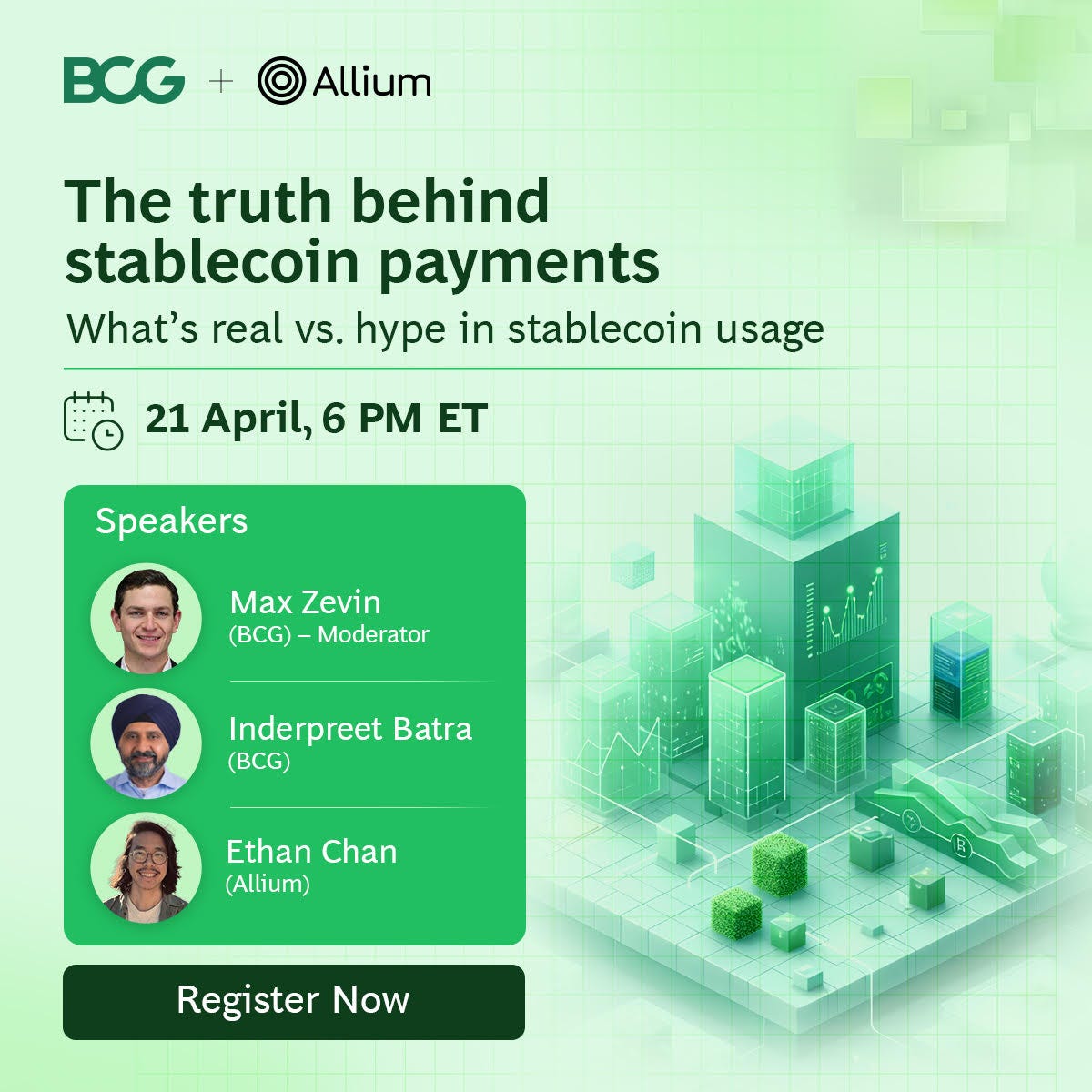
AEvent: BCG x Allium Webinar - The Truth About Stablecoin Payments
Date/Time: Tuesday, April 21 at 6pm EST
Speakers: Inderpreet Batra (BCG Global Head of Fintech & Payments), Ethan Chan (CEO, Allium), Max Zevin (BCG MD & Partner)
Topics:
What’s driving institutional interest right now, and how regulation (GENIUS Act, MiCA) is shaping the conversation
What Allium’s stablecoin data reveals: use case breakdown (B2B, C2C, cross-border), blockchain distribution, and why volume estimates vary so widely across reports
Implications for different players: banks, fintechs, PSPs, and where to focus
Where the market goes over the next 12–24 months
Register: https://bcg.zoom.us/webinar/register/WN_gm6eFezTSQC6gaNw5aLamQ
In this newsletter:
Just how “digital” is Bitcoin?
A European USD stablecoin gets a boost
Weekend: an iconic video from the ‘90s
(No Assorted Links this week, sorry, a time squeeze.)
✨Press Publish with Irina Slav ✨
Come join me for a Substack Live next Friday, April 24th, at 7am EST / 1pm CEST when I talk to energy expert Irina Slav.
One thing you need to know about Irina, other than her charm and depth: she writes. A lot. With punch and humour and flow. There’s her Irina Slav on Energy newsletter, which is how I discovered her work (and was the first Substack I paid for). Then I found out she also writes for OilPrice.com, several articles a day. And she has two other newsletters, both enchanting and on widely different topics.
So, come and join us for a chat about why she does what she does, how she manages to juggle so much, what advice she’d give anyone starting out or struggling to grow in Substack, and more.
And if you missed my Substack Live “Press Publish” session with Brady Dale yesterday, where we talked about media, newslettering, Substack, platforms in general, and a whole lot more, you can catch the replay here.

(And, yes, I said “Crypto is Macro Now podcast” in the intro, I meant newsletter – it had been a long week!)
Plus, check out the playback of the session I did with Christine Kim about her journey from big-brand research into self-publishing, how she gets so much done, what she’d do differently, and more.
Some of the topics discussed in this week’s premium dailies:
Coming up this week: inflation, forecasts, earnings
Term of the day: Mythos
Monday mood: Just how “digital” is Bitcoin?
Markets: a whiplash of a weekend
Macro: US CPI
Term of the day: quantum computer
Hong Kong stablecoins: too conservative?
Macro: why US consumer confidence matters
Term of the day: Producer Price Index
Nauru: where history meets technology
Markets: war over?
Macro: US PPI
A European USD stablecoin gets a boost
Markets: the professional investor mood
Term of the day: Beige Book
Macro: what the Beige Book is saying
Should stablecoin issuers be able to freeze accounts?
Term of the day: Hezbollah
Markets: what conflict?
Just how “digital” is Bitcoin?
Many pixels have been spilled about the performance of BTC since the war began, some of them in this newsletter: the surprising resilience, the lack of volatility, the quiet derivatives market, the vulnerability to a sharp stock market adjustment. But, to be honest, I’m not giving much thought to where the price goes in the short-term – there’s no point as war tends to mask fundamental trends with decibels of noise.
I’m much more interested in what’s next, and how that will shape and be shaped by our understanding of networks. This is changing more than most realize. While we’re distracted by explosions and commodity prices and global choke points and off-the-rails social media diplomacy, our collective perception of the digital and physical planes of the global economy has been shifting.
For most of this century, we’ve assumed the world was going digital. Finance, money, entertainment, even relationships => digital, “flat”, connected.
Those of us that rearchitected our careers and lives around this felt like we were ahead of the curve, creating the future, more forward-thinking than those stuck in analog ways.
We could argue about when the cracks in this worldview started to show. It could have been COVID, when we realized we didn’t want everything to be digital, remote, isolated. It could be the Russian invasion of Ukraine, giving most of us in the West our first bitter taste of kinetic war on our doorstep. I think the hostility of the previous US Administration to a new emerging form of digital finance played a part, lifting the veil on the imperative and the cost of centralized control. The election of Donald Trump as President of the US, both times, can be seen as a big middle finger to the “connected” layer. And now, we have the mother of all supply shocks in energy and its derivatives headed our way.
Plus, we sent people into space, and they came back safely. That’s a triumph of atoms over bits if ever I saw one, and there’s something about seeing our planet through the eyes of people floating hundreds of thousands of kilometres above it that drives home the perfect geometry of where we live.
It feels like there’s a subtle shift in the overall vibe away from digital and towards physical, away from a conviction that atoms will matter less and less, and towards a realization that they’ll matter more.
We’re seeing it in markets as well. Indices of semiconductor manufacturers have significantly outperformed those of internet services over pretty much any recent time period. Meta went all-in on the metaverse but is now rapidly scaling back. The once-hot NFT market has been quiet for years. Mythos is driving home how software is vulnerable. Now, when I hear the term “tech company”, I think of robotics before platforms.
And those who have been insisting AI will bring “abundance” are sounding less confident today as datacentre buildout runs into the wall of energy and hardware scarcity.
So, if indeed we are moving into a rediscovered appreciation for “stuff”, where does that leave the long-term outlook for Bitcoin, which is undeniably and exclusively digital?
A caveat before I sketch out why Bitcoin both is and isn’t: this is not a well-thought-out thesis yet, this is just my off-the-cuff musing. Feedback and pushback are welcome.
With that out of the way, here goes:
I think this is where Bitcoin starts to break away from the “digital finance” pack. For decades, electronic networks have fed the financialization of the global economy as new investment and leveraged products emerge faster and faster to keep up with the speed of database dollars. The need to maintain these networks led to greater centralization of control, which in turn facilitated compliance-mandated gating, exclusion and more control.
Along comes Bitcoin, a new type of network that breaks the paradigm of centralization and offers up a new type of asset that defies categorization.
But habit dies hard, especially when there are economic incentives to keep it going. And so Bitcoin became a “risk asset” or “digital gold” or whatever term helps traditional investors put it into a familiar bucket while “digital finance” gets to work doing its packaging thing.
Even those who chose to focus on Bitcoin’s unique properties stressed how it brought direct ownership and property rights (physical!) into the digital realm. The “digital” was always the dominant layer.
But what if we started to look at Bitcoin the other way around? Less as provable scarcity on a digital network, and more as digital convenience layered onto a scarce asset?
These two approaches may sound exactly the same, but they’re not: the emphasis is different in each.
If I’m right and the zeitgeist is changing, “digital” will become less dominant as a narrative, more a powerful layer of convenience than a reason for being unto itself. Here is where Bitcoin can shine relative to other “digital-first” assets that exist because of the convenience and the networked service they provide. Not only is Bitcoin the only provably scarce asset with hard property rights and no centralized control that can move on digital networks. It’s also one of the very few digital assets that does not need permission to exist but that does anyway – by “digital asset”, I mean any asset that exists digitally, on any electronic network, not just in crypto.
Most digital assets were created to do something. Bitcoin just is. It exists in that limbo between physical and digital, bringing properties of each to the other.
And in a world moving towards appreciating scarcity and protection over convenience and speed, this will come to matter more.
✨ If you enjoy these newsletters, would you mind sharing with friends and colleagues and nudging them to subscribe? I’d appreciate it! ✨

A European USD stablecoin gets a boost
This week, we got news that the first bank-issued US dollar stablecoin to be natively integrated into the MetaMask wallet… is from a European bank.
The USDCV stablecoin, issued by Société Générale’s FORGE subsidiary, will appear among a shortlist of stablecoins within the MetaMask wallet, on both the mobile and desktop apps. What’s more, reports suggest it has been given a prominent position: fourth, behind MetaMask’s own stablecoin MUSD and the industry giants USDT and USDC. It comes in way ahead of PayPal’s PYUSD, even though it is by all accounts still a small player – a market cap of $26 million, and only 245 holders.
There’s an interesting takeaway here, but first some background:
Société Générale was the first large global bank to issue a stablecoin on a public blockchain, with the launch of the euro-backed EURCV token on Ethereum back in April 2023. Since then, it has expanded to several other chains, including Solana, Stellar and the XRP Ledger, and today has a market cap of $125 million, making it the second largest euro stablecoin behind Circle’s EURC.
While initially limited to whitelisted users, in 2024 it checked all the boxes for full regulatory compliance to allow free transfer, enabling its use in DeFi applications.
In June 2025, the bank launched a US dollar sibling – USDCV – on Ethereum and Solana, with BNY Mellon as the reserve custodian. For now, this is only available outside the US.
Starting in September last year, both EURCV and USDCV were onboarded into popular DeFi apps such as Uniswap and Morpho. And now, USDCV gets a major DeFi boost with the MetaMask integration.
The boost could be significant – MetaMask has over 100 million outstanding wallets and over 30 million active monthly users.
So, why USDCV and not EURCV, which is much larger and more liquid?
The likely answer is that global DeFi users are not interested in a euro stablecoin. For an attractive positioning, it would have to be a US dollar token.
No wonder the ECB is concerned about the dollarization of the stablecoin universe.
When trading between each other, European entities are likely to prefer euro stablecoins, and these are seeing significant growth – the market cap of EURCV has jumped 65% since the beginning of the year, that of Circle’s EURC is up 15%. For context, the market cap of the ecosystem’s giant USDT is down slightly, and that of USDC is up only around 4%.
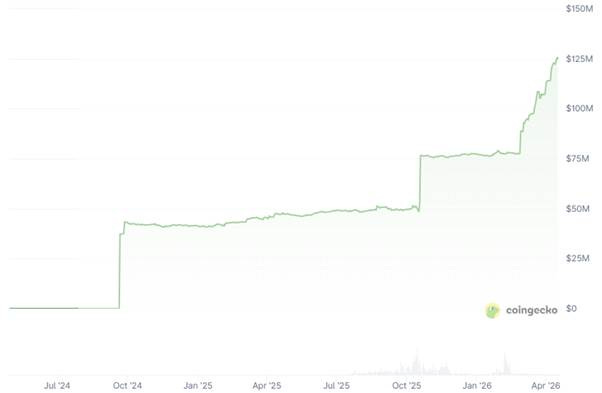
(EURCV market cap, chart via CoinGecko)
But beyond intra-Europe use, and certainly in the DeFi world, dollars are preferred. The unspoken question is what the EU will try to do in the future to tilt that equation.
HAVE A GREAT WEEKEND!
(in this section, I share stuff that has NOTHING to do with macro or crypto, ‘cos it’s the weekend and life is interesting)
After the chaos of the week, I’m in the mood for some nostalgia – and for some reason I’ve had George Michael shimmying around my brain this morning.
It’s not just the poignancy and rhythm of his music (and that voice!) that keeps his vibe fresh even today; it’s the stunning design of many of his videos.
The official video for “Freedom! ‘90” has to be one of the most iconic productions from any modern artist – I’m not saying it’s the best music video ever, but right now I’m struggling to think of one that had a bigger visual impact when it came out in 1990.
The grimy grandeur of the old apartment offsetting the newness and the impossible beauty of the models … the flames and the water … the play with light … and, perhaps most resonant to many of us at the time, the underlying message of shedding your past to create the life you want.
Almost 40 years later, it still feels timeless.
DISCLAIMER: I never give trading ideas, and NOTHING I say is investment advice! I hold some BTC, ETH and a tiny amount of some smaller tokens, but they’re all long-term holdings – I don’t trade. Also, I often use AI for research instead of Google, but never for writing.