


Hello everyone! I hope you’re all well and taking care of yourselves.
You’re reading the free weekly send of the premium daily Crypto is Macro Now, where I re-share one or two of the week’s posts and add some non-crypto and non-macro links since it’s the weekend. 🌻
In this newsletter:
No CLARITY for now – what next?
Stepping on to the slippery slope
Assorted links: City prose, envy, weird sci-fi, new words, miniatures
Weekend: TV series from the ‘80s
If you’re a premium subscriber, THANK YOU! ❤ If not, I hope you’ll consider becoming one? You’ll get ~daily updates on big-picture shifts, plus links and music because why not.
PUBLISHED IN PARTNERSHIP WITH: ✨ ALLIUM ✨
Where have stablecoins made the biggest inroads in cross-border flows? Indexed against fiat weight, stablecoin B2C runs at 5.3x in APAC, 3.5x in EMEA and 1.4x in the Americas.
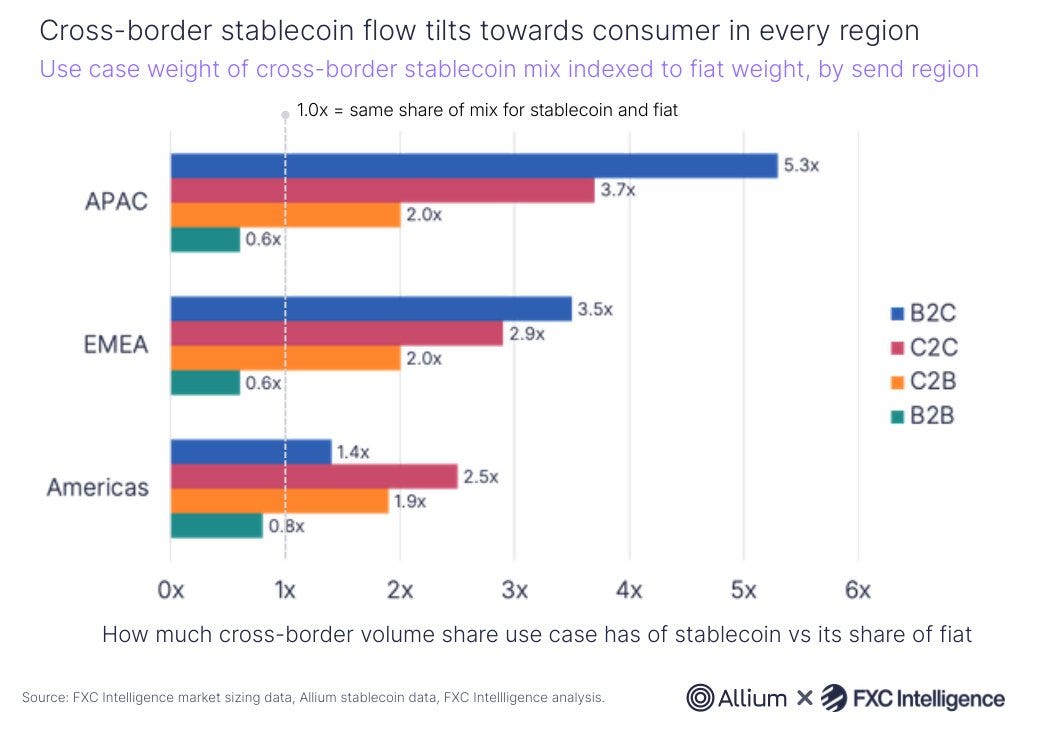
Finde out more by downloading the full report: Stablecoins in Cross-Border Payments
Get weekly onchain data and more analysis like this from the Allium Research team on Substack.

🌏 STABLECOINS AROUND THE WORLD 🌏
This week I recorded episode #2 of Stablecoins Around the World, which focuses on Brazil – so, of course I wanted to talk to Aaron Stanley.
Aaron is founder and managing director of Promenade Advisory, as well as author of the Bits and Borders newsletter on Substack and host of the corresponding podcast – a strong recommend if you’re interested in tech developments in emerging markets and other regions.
But that’s not the only reason I was thrilled to be able to talk to him about what is going on in the country in which he currently lives – to find out more, have a listen!
If you missed the inaugural episode of Stablecoins Around the World where Emily Parker and I talked about stablecoins in Japan, you can catch that here.
Some of the topics discussed in this week’s premium dailies:
Coming up this week: central banks, CLARITY, consumer data
Stepping on to the slippery slope
No CLARITY for now
The Fed whispers
Term of the day: Federal funds rate
FOMC relief amid the boredom
Here we go: the tokenization exemption
“Real” stablecoin payments volume
Recommended podcast episodes
No CLARITY for now – what next?
Well, that was disappointing. We all knew that passage of the CLARITY Act before the midterm elections was a long shot (the prediction markets had the odds at around 15%) – but it would have been clarifying to at least get a final version of the bill on which to vote.
This week, the Senate voted to not invoke cloture, which technically means the debate on the Act’s provisions continues. It does not mean the bill is dead… but the timing means passage is now unlikely. As of next week, congressional attention turns to the midterm elections. And once the dust settles on those, the Senate and the House of Representatives are likely to be controlled by the Democratic Party – Polymarket currently puts the odds of this at 60%.
This doesn’t mean there will be no crypto market infrastructure bill. Many Democrats supported CLARITY and worked hard to bridge the partisan divide. Reports just before the vote suggested that Senator Kirsten Gillibrand (D - NY) was urging other Democrats to vote in favour of invoking cloture – but in the end, she voted against. I’m not sure what happened there, but we can safely assume she is open to a reasonable framework codified in law, and she is not up for re-election until 2030. Other Democrats who had been in favour of moving the bill forward (such as Senators Alsobrooks and Gallego) also voted no. That doesn’t mean they don’t support the idea of reasonable regulation.
Indeed, the text of the bill was obviously problematic. It’s not just that all Democrats and the two independent senators voted against – even three Republican senators voted no on substance (Collins, Hawley and Moran).
It looks like the immovable obstacle was the language around officials’ personal interests in crypto ventures. This had become stricter but apparently not enough as Republicans could not get the White House to agree on a divestiture requirement. For the next attempt in a Democrat-controlled Congress, that will matter less, which could lead to a better bill – most voters can get behind the idea of preventing officials from getting rich on sectors they can influence.
The risk is that more negotiations with continued pressure from the banking lobbies and greater emphasis on centralization for the sake of safety could lead to a more restrictive bill reaching the floor, dampening development of decentralized finance. But that would not stop the US crypto industry from evolving and growing; even a relatively restrictive bill would give financial incumbents more scope to absorb crypto-related services, institutional investors greater confidence in the platforms they use, and DeFi developers greater clarity on the boundaries of what they can legally build in the US. What matters is clarity, literally.
Meanwhile, the SEC and the CFTC will continue and possibly accelerate their rule-making around the issuance and trading of crypto assets, tokenized securities and related products – this week, the ink on the cloture rejection had barely dried when we got key exemption and relief orders from both agencies.
This will be a positive driver for infrastructure development, but we should curb our expectations on both speed and scope. Both agencies are likely to face lawsuits and pushback from Congress if they are seen to overstep their remit in an attempt to change securities laws, which will slow them down. And rules are easier to unwind than laws.
Still, I am optimistic that the US will get a reasonable crypto market bill passed before the end of the Trump presidency. There is will behind crypto regulation. And a shift in political power could open previously closed doors. The work on CLARITY was not wasted, and the bill is not dead. Dormant, perhaps, but it can and probably will be resuscitated, altered and given a good meal, to better face its next ordeal.
See also:
Here we go: the tokenization exemption (Sept 2026)
What is cloture? (Aug 2026)
😎 If you’re interested in how crypto fits into the changing economic and geopolitical landscapes and you’re not already a subscriber to the dailies, I hope you’ll consider becoming one! 😎
Stepping on to the slippery slope
Of all the signals we’ve seen over the past couple of years that politics has pushed economic stability off the rails, none have shrilled louder than President Trump’s blatant attempt to buy votes.
Speaking at last week’s Republican Party convention, Trump promised all Americans a “dividend” of $5,000 each if the Republicans won both the House and the Senate.
In retrospect, the event itself should have given us a hint as to the desperation – the Republican Party has never before, at least not in the modern era, held a national rally just before the midterm elections. What’s more, it’s the first ruling party to ever do so. The Democratic Party has only held one, while in opposition in 1982 (Ronald Reagan was President), and by all accounts it was unsuccessful – they increased their comfortable majority in the House, but failed to win control of the Senate.
But even cynics among us thought that a blatant vote-buying promise would be a step too far.
We were wrong.
Of course, we know that votes are bought in every election via implicit and explicit vows to improve individual financial conditions: lower taxes, more income, better housing, free groceries and so on. And behind the bulk of government spending is a decision to paper over growing inequality with benefits, subsidies, easy credit and other forms of politically motivated financial assistance. As we have seen, even a whiff of a suggestion to remove any of those bandaids would lead to political uproar. Ever since the violent demise of DOGE, this is not even being talked about, while the US fiscal situation continues to worsen.
But there is a line between the politics-as-usual vote buying that assumes at least an attempt at economic contribution from beneficiaries, and “I’ll pay you for voting Republican”.
To be fair, that’s not exactly what Trump said, but it’s close enough.
Will it work? It’s unlikely to sway loyal votes. But those self-classifying as “Independent” are increasing in number as disaffection with both parties deepens.
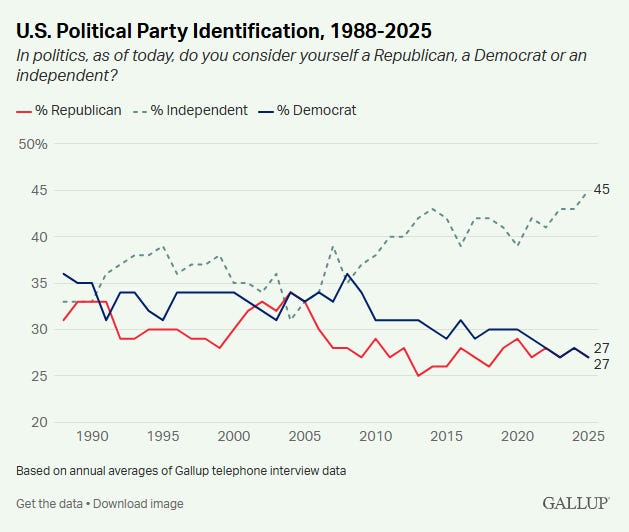
(chart via Gallup)
And we have to acknowledge that voters, especially the young, are disillusioned and so why shouldn’t they vote for some “free” money? We also can’t deny that, for way too many, $5,000 would solve some short-term cash flow problems. For those worried about tomorrow, the longer term can take care of itself.
Even for those not in short-term financial stress, why think about the longer term since there’s a 10% chance AI will kill us all anyway, right? Put differently, even those that may instinctively feel votes are a hard-won right that should not be cheapened by a payout, even those that would not normally think of voting Republican, may decide “whatever, it’s just a stupid election and we’re all screwed anyway”. It wouldn’t take much of a conspiracy theorist to wonder about the timing of the social media fuss around a looming AI apocalypse.
Of course I am not advocating for this line of thought, and I fervently hope that common sense prevails.
And Trump has promised dividends before without delivering, which might mean susceptible voters view his speech with the appropriate scepticism.
But this latest offer comes with a implied condition: a decision at the polling booth. That hits different.
It also sets up a tantalizing yet treacherous path. If it looks like the plan worked, even a little bit, the next frightened ruling party or recklessly ambitious candidate will promise more. And the next one, even more. Of course, each will give a palatable explanation of how it will be paid for. But, in the end, it will come from adding on debt.
That would be a hard sell for the bond market, especially given the likely boost to inflation.
Plus, it wouldn’t be hard to argue for a more productive use of roughly $1 trillion dollars, the estimated total cost of this escapade. For instance, there’s no way of ensuring that the payout is spent in the US, despite Trump’s assurance that it would have to be. A retail CBDC with use restrictions embedded in the code could do it, but the US doesn’t have one and nor will it, since Congress recently passed a law banning the Federal Reserve from issuing a digital currency.
And there’s the probable damage to global confidence in US democracy, which should impact investment flows.
So, it’s unlikely the promise would get the necessary Congressional approval. Hopefully enough sensible officials would understand the fiscal and political consequences and would say no, even if the promise helped win them their midterm race. After all, the Senators that take their seats in January are not up for re-election until 2032, and they will be judged according to how the US economy, markets, currency and world standing are doing then.
But the words were said, the idea was planted, and some elected officials are excitedly preparing the necessary bill.


As a standalone, this is alarming, but not nearly as much as the idea of voter payouts becoming normalized. Once that happens, the debt problem explodes. To keep the economy running, money printing accelerates, so does inflation. The net payout will seem like copper cents compared to the collective wealth destruction.
This is not a slippery slope we want to be on.
Especially because the biggest threat to democracy today isn’t an autocratic populist figure: it’s rising unemployment, and the loss of value in savings as well as fixed incomes either from runaway inflation or an economic slowdown.
And whether or not Trump’s reckless promise gets anywhere, it adds fuel to the fire of uncertainty. True, he says a lot of stuff, usually noise rather than substance and usually not worth more than a passing glance. But this one alarmed me, because it won’t be easy to put this genie back in the bottle.
Which means the debasement play is going to get even more real. Good for gold, good for Bitcoin.
But not good for democracy or the cultural fabric we increasingly take for granted.
ASSORTED LINKS
(A selection of reads I came across this week that I think are worth sharing, not about crypto nor macro. I try to choose links without a paywall, but when I feel it’s worth making an exception, I specify.)
Many of you probably already know and love Laura Marling for her music. It turns out she can also write, in lilting prose that winds through streets and lives and coffee shops, in long paragraphs that you don’t want to end, with humour that feels both biting and kind. (On Leaving London: Cool – Patterns in Repeat)
Derek Thompson and George Loewenstein unpack the compelling power of negative emotions, focusing on envy – why it takes hold, what it represents, and how to look past it. (Bad Feelings – Derek Thompson)
Most of Philip K. Dick’s novels, written in the 1960s-70s, are utterly weird – some are downright uncanny. (My Favorite Philip K. Dick Novels – The Honest Broker)
The Merriam Webster dictionary has added 1,400 new and painfully hip words, the majority of which I’m embarrassed to confess I was not familiar with. I mean: looksmaxxing, parasocial, vibe coding, letterboxing, copium, promposal, cuffing season, neckbeard, shapewear, yacht rock, Sunday scaries??? But now I can look them up in an official source! And, I’m not kidding, there is even an official entry for Rickroll. I wonder how many people will click on that one. (1,400 New Words and Definitions Added to Merriam-Webster.com)
Madison Darbyshire spent a week in Maine learning how to make miniatures, and came away not only with an appreciation for tiny little grapes, but also an insightful grasp of the pull of nostalgia, the thrill of “flow”, the empowerment of self-care and the itch of imagination applied to physical restraints. I won’t lie, I’m tempted to head off to the kitchen and try to create a scene in a matchbox. (A Small Hobby Is Having a Very Big Moment – Bloomberg, paywall)
HAVE A GREAT WEEKEND!
(in this section, I share stuff that has NOTHING to do with macro or crypto, ‘cos it’s the weekend and life is interesting)
Over the past couple of weeks, I’ve shared iconic TV series opening credits from the 1970s. There are still many more – but, whaddyasay, shall we move on to the ‘80s for a bit?
Below I share some opening credits from ‘80s TV shows, not chosen for the quality of the show (there were some great ones), but for whether or not I actually remember the music.
If there are others you feel have to be on this list, let me know!
Cheers
Miami Vice
Dynasty
Golden Girls
DISCLAIMER: I never give trading ideas, and NOTHING I say is investment advice! I hold some BTC, ETH and a tiny amount of some smaller tokens, but they’re all long-term holdings – I don’t trade. Also, I often use AI for research instead of Google, but never for writing.