


Hello everyone! I hope you’re all taking care of yourselves and coping well with whatever weather you find yourself in. Temperatures have finally dropped a bit in Madrid, thank the heavens, ‘cos this week the open window next to my desk has been feeling like an open oven door.
You’re reading the free weekly send of the premium daily Crypto is Macro Now, where I re-share a couple of the week’s posts and add some non-crypto and non-macro links since it’s the weekend. 🌻
If you’re not a subscriber to the premium daily, I do hope you’ll consider becoming one! For $12/month, you’ll get ~daily commentary on how crypto is impacting the macro landscape, and vice versa. I talk about adoption, regulation, tokenization, stablecoins, CBDCs, market infrastructure shifts and more, as well as the economy and investment narratives.
PUBLISHED IN PARTNERSHIP WITH: ✨ ALLIUM ✨
What do we mean by “onchain data”?
Every transaction on a blockchain leaves a permanent record.
The hard part is turning those raw records into something finance teams can actually use. Our latest guide breaks down what onchain data really is, why it matters, and how it becomes usable.

→ https://allium.so/blog/what-is-onchain-data-a-clear-guide-to-blockchain-data/
And get weekly onchain data and analysis like this from the Allium Research team on Substack.
In this newsletter:
South Africa’s proposed stablecoin ban
Why CLARITY’s delay hurts banks more than crypto
What is cloture?
Assorted links: Best cities, LinkedIn slop, the social constructs of menswear, Substack
Weekend: the total eclipse
Some of the topics discussed in this week’s premium dailies:
Coming up this week: US CPI + PPI
Macro: the US jobs report was not that bad
Term of the day: marginally attached
Why CLARITY’s delay hurts banks more than crypto
Term of the day: cloture
An overlooked liquidity hint?
South Africa’s proposed stablecoin ban
Hong Kong’s cautious stablecoin progress
Macro: a cloudy US CPI report
South Africa’s proposed stablecoin ban
I’ve been saying for a while now that we’ll soon see capital controls implemented on dollar stablecoins as sovereign states push back on the convenience-fuelled threat of dollarization.
It looks like the trend is starting. Last week, South Africa’s National Treasury and its central bank (SARB) published a draft proposal that would limit certain offshore transfers of crypto assets.
Going by the conditions and limitations, several of the measures in the proposal appear to specifically target the use of stablecoins by South African corporations.
For background, South Africa has had capital controls in place since the 1930s. These intensified during the apartheid era but have in recent years seen some cautious liberalization. But individuals and businesses still have limits on the amounts they can send and accept from offshore, with specific approval required for large transactions.
At first, stablecoins and other crypto assets looked like a way around these restrictions. Last year, a High Court judge ruled that crypto assets were not “currencies” and therefore could not be considered towards the cross-border total. But a couple of months ago, another High Court judge ruled the opposite, and so it was inevitable that the authorities would want to take the matter out of the Court’s hands.
The published proposal outright bans cross-border transactions in crypto assets, including stablecoins, by corporations. They would not be able to send crypto assets to offshore platforms or self-hosted wallets, nor could they receive crypto assets from offshore platforms.
Individuals would be able to make outbound and receive inbound transfers, subject to limits.
Yes, individuals would have more freedom to transact than businesses, which is an unusual approach. To close a potential work-around, the proposal includes measures to prevent individuals from acting on behalf of entities.
Another unusual feature of the proposal: the corporate ban includes local currency stablecoins. South African businesses would not be able to transfer rand stablecoins cross-border. But they can send traditional rand offshore, within established limits. This effectively categorizes a domestic rand token as a “foreign asset” because of the rails on which it moves, breaking the unspoken rule of technology neutrality.
On the surface, this makes little sense, but a speech given in South Africa last week by Dan Katz, IMF First Deputy Managing Director, sheds light on the reasoning. In his speech, Katz addressed the currency risk for emerging economies from the growing use of dollar stablecoins. Yet encouraging the use of local currency stablecoins will not stem dollarization, he argued – it could accelerate it. If local currency stablecoins become widely used, converting to a dollar stablecoin is an onchain transaction away, less friction and less control than onramping directly.
So, the South African authorities seem to have reached for the easy solution: ban it all for large, potentially control-evading transfers.
The proposal is open to public comment until the end of September. Obviously, corporations are objecting – presumably they can exert some political pressure? But capital controls have been a feature of the financial landscape for so long, they are deeply ingrained in the South African psyche. I’ll be watching to see whether the cost advantages of cross-border stablecoin transfers end up being worth fighting for, or whether – as usual – energy will instead be spent on finding workarounds.
I often get asked how I find something to write about every day for the newsletter.
My problem is more one of not having time to cover everything I consider relevant to the crypto-macro intersection. My backlog list is long.
But I’m good at surfacing the most relevant and also overlooked trends.
So, I hope you’ll subscribe. 😎
Why CLARITY’s delay hurts banks more than crypto
Is the CLARITY Act dead?
No. It’s not doing well, but it might pull through.
Below I’ll briefly summarize what happened to this key piece of financial market legislation last week, what could happen next, and what that would mean for both crypto markets and the banking industry.
What happened?
First, some background: the CLARITY Act is a bill working its tortuous way through Congress that would establish a federal framework for crypto asset markets. It’s a long one, over 600 pages, so I won’t try and summarize it here. But the key features include:
The definition of token categories
The distribution of regulatory responsibility between the SEC and the CFTC
A format for legal token fundraising from the public (known as “Regulation Crypto”)
Protection for developers from prosecution relating to use of their code
A safe harbour for certain decentralized finance activities
The right to self-custody and peer-to-peer transactions
Activity-based rewards on stablecoins
Bankruptcy treatment of digital assets
Ways banks can engage in and offer digital asset activities
The CLARITY Act is not exactly new in that it threads together crypto bills proposed with bipartisan support as far back as 2022. But it has evolved through hard-won compromise and both House and Senate votes, and is tantalizingly close to getting enough support in the Senate for passage.
Close, but not close enough – there is still much that can go wrong, and last week delivered a meaningful setback. Despite plenty of scurrying and calling and pleading, the CLARITY Act did not get a floor vote before senators took off for the August recess.
Now what?
This is a blow as momentum counts for a lot in Congress, and the CLARITY Act just lost what momentum it had.
Maybe it could get some back. Senate Majority Leader John Thune has filed cloture (see below) which could put the bill on the agenda for a vote in September.
But by then, senators will be focused on the upcoming midterm elections, with much at stake. And there are still unresolved issues such as ethics (limits on crypto activities of elected officials), illicit finance safeguards and stablecoin rewards.
Furthermore, the delayed vote means that the crypto political action groups (PACs) don’t yet know which senators will vote against and so cannot efficiently plan how to spend their considerable sums on opponents’ campaigns.
What’s more, support for CLARITY is becoming increasingly partisan, a trend that will intensify as the midterms approach. Many Democrats in Congress understand the cost of not creating a framework for financial market innovation in the US, but cannot risk being seen as supportive of the Trump family’s enrichment from crypto assets. And a recent Normington Petts poll showed that Democrat voters overwhelmingly hate crypto – almost 60% hold a “very unfavourable” view of the industry, with another ~20% opting for “somewhat unfavourable”. Crypto fared much worse than AI, datacentres and pharma companies, which is quite something.
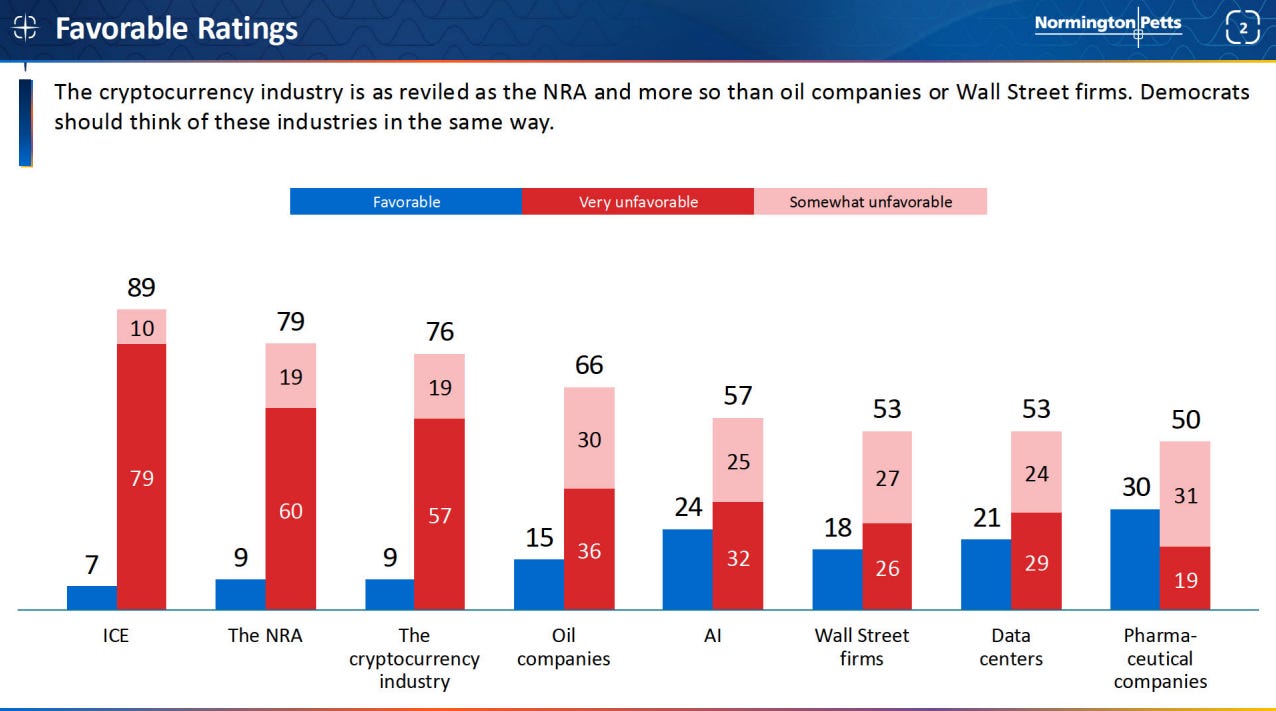
(chart via Normington Petts)
With the midterms looming, will any Democratic Party candidates want to risk votes? It’ll be in their interests to delay a CLARITY vote until after the November elections.
And even some Republican senators have indicated they will vote no unless the provision for stablecoin rewards is tightened – the bank lobbies have been hard at work flexing their long-standing relationships with Senate politicians.
The frustration among pro-crypto Republicans and industry lawyers and executives is palpable – they have been working so hard on this. But, while tempting, it’s technically not fair to point the finger at the Democrats or even at the banks, at least not exclusively. In a recent poll on X that asked who was to blame, the Democrats tied with the Trump family.
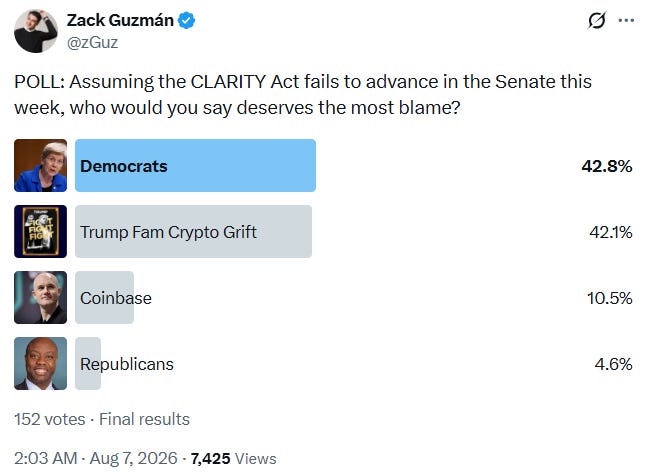
(post by @zGuz)
Unless there is meaningful movement on the ethics provisions, passage is unlikely, especially once Democrat senators are “posing for the camera” amid midterm election scrutiny. The bank lobby objections could probably be softened with further explanations as to why they’re misleading, but that will require more time and anyway is unlikely to be enough.
But a delayed vote is better than a failed vote, which would have been a much bigger blow to momentum.
Still, it’s worth looking beyond CLARITY and contemplating a scenario in which it fails in September.
The impact on crypto
The crypto industry will continue to grow whatever happens, guided by a supportive SEC and CFTC. SEC Chair Atkins had scheduled a meeting for this Friday, viewable by the public, to discuss proposing new rules for token issuance – this has been postponed due to scheduling conflicts, but we can expect it to get back on the calendar soon. The White House is hosting an event for crypto executives next Wednesday, with both Atkins and President Trump expected to attend. The very next day, the CFTC holds its first meeting of its new new Innovation Advisory Committee. The signal is that the agencies will press ahead with and perhaps even accelerate planned rulemaking for crypto and tokenized asset markets.
True, agency rules are not as permanent as law, and an Administration hostile to the crypto industry could unwind much of the progress. But this is unlikely, especially if the industry continues to grow and draws in participation from a wider range of financial institutions. Insisting that they withdraw from a market they’re making good profits on would create more problems than just letting the industry be.
A bigger concern is the probability of lawsuits brought against the agencies from groups concerned about the pace of change who argue the agencies are overstepping their remit. The courts are generally reluctant to rule against regulatory agencies, but you never know, and it would tie up resources.
The crypto market itself does not seem fussed, though: the price of ETH, which stands to benefit more than does BTC from CLARITY Act passage, has held relatively steady.
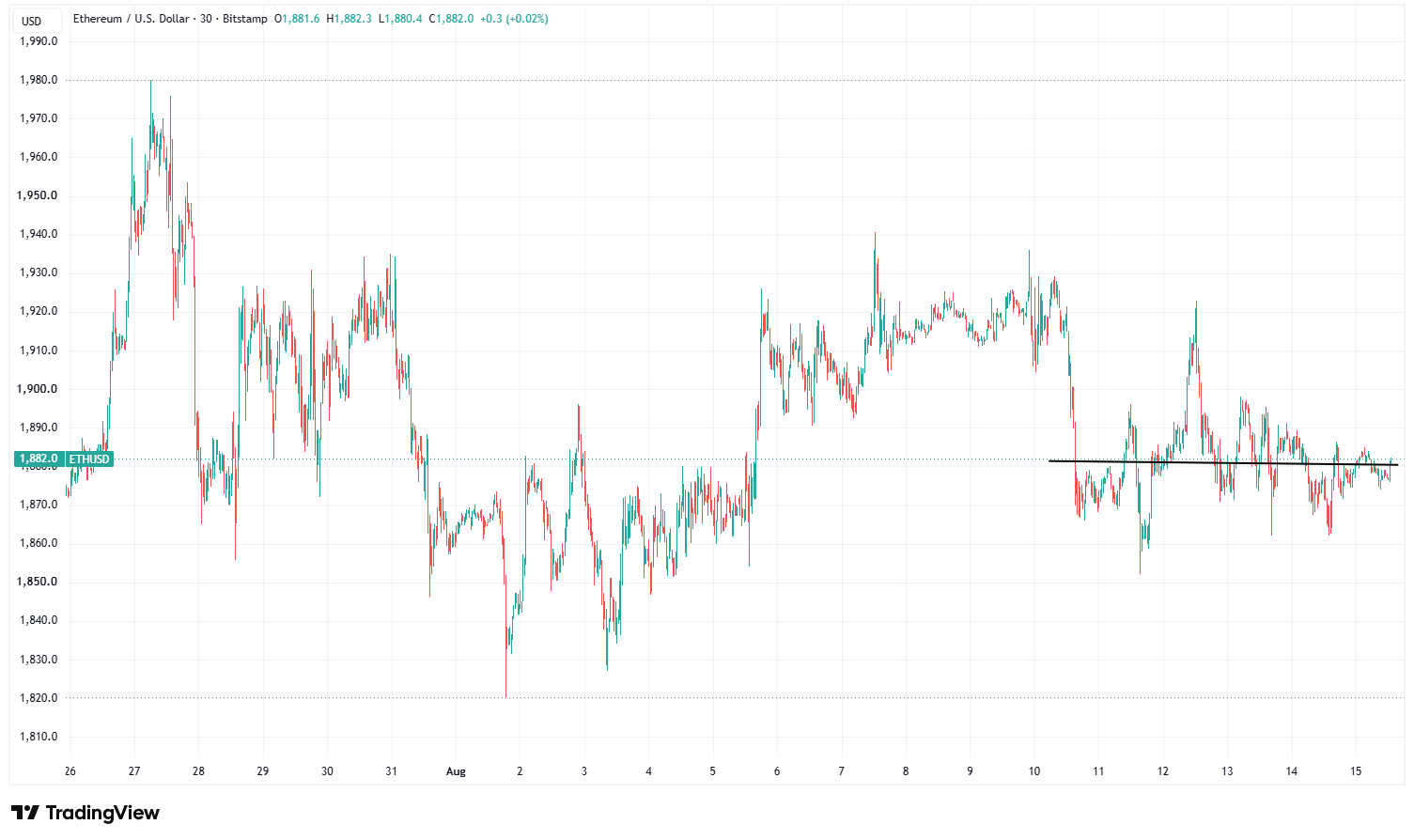
(ETH/USD chart via TradingView)
Market consensus seems to be that the bill’s failure in its current form would not deliver a meaningful blow.
The impact on banks
Beyond the implications for crypto, the potential impact of the bill’s failure on the banking industry has been largely overlooked.
Banks have done themselves no favours here – they have expended a lot of political and public opinion capital arguing against change that, in one form or another, is inevitable.
What’s more, their somewhat panicked protests of vulnerability, apart from misleading and misdirected, are not exactly going to bolster public trust in their resilience.
And many of us are poised to amp up our explanations of why most of the bank lobby arguments are just plain wrong. It would not be hard to increase public awareness of how extractive traditional banks are, how they put fighting competition ahead of client service, how alternatives are emerging despite their efforts.
We wouldn’t need to explicitly say that traditional institutions are misleading their clients and political allies – that would become obvious, further turning public opinion against them and weakening their resistance to other potentially damaging legislative proposals.
Such as one that would limit cushy credit card revenues.
On Friday of last week, Senators Lummis (R-WY) and Moreno (R-OH) – two of the more tireless advocates for CLARITY – signed on as co-sponsors of Senator Marshall’s (R-KS) Credit Card Competition Act (CCCA), joining Senators Durbin (D-IL) and Welch (D-VT) and giving it more bipartisan heft. The timing is unlikely to be a coincidence.
This is a shot across the bow: reports suggest that one of the main reasons banks didn’t object more forcefully to the GENIUS Act was the threat from Republican senators that they would push for the CCCA – Senator Marshall had attempted to attach it to the stablecoin bill, but the banking groups hit the roof and focused their energies on getting it removed.
Now it’s back, and the big banks are not going to be happy. The CCCA would direct the Federal Reserve to issue rules requiring large card issuers to enable at least two unaffiliated payment card networks on their cards – at least one network would need to not be Visa or Mastercard. Merchants could then choose the network on which to route transactions.
The target here is the high interchange fees (also known as swipe fees, typically 2-3% of a transaction) set by Visa and Mastercard and paid by merchants to the issuing banks. More competition would bring these fees down, hurting a comfortable and lucrative revenue stream.
So, in their vocal opposition to the CLARITY Act, the solidly profitable US banking industry is inviting unwanted scrutiny of their poor remuneration of deposits. An enquiring public just might get curious about where the threat to deposits is actually coming from. And the industry lobby’s unfounded accusations will hopefully weaken its efficacy going forward.
Meanwhile, charters for new banks will continue to introduce competitive business models (I wrote about this recently). This week, the Financial Times reported that Erebor, a digital-first bank backed by Anduril co-founder Palmer Luckey and other tech investors, is raising $1.5 billion at an $8 billion valuation – for a financial institution barely six months old.
In sum, crypto will be fine, whatever happens to CLARITY. The US banking industry will also be fine – the alternative scenario is just not allowed – but it will not be able to stem the assault from new companies, products and services, no matter how loudly it protests. And in opposing the modernization of financial rails and the reduction of transaction costs for clients, it has done meaningful damage to its image.
See also:
Why you should care about bank charters (Aug 2026)
What is cloture?
(There is so much jargon flowing around crypto and finance, so much “insider” language – so, most weekdays in the premium newsletter, I define a term that is often used but generally not well understood.)
Politicians can go on and on, turning debate into a marathon that can preclude actual lawmaking.
The US Senate has a solution known as “cloture” (from the French for “closure”), a procedure used to end debate on a bill and force a vote.
If a cloture motion filed by a senator is co-signed by at least 16 peers, it goes to a vote. If the motion gets support from at least 60 senators, cloture is said to be “invoked”, and the remaining time for debate is limited, usually to around 30 more hours.
Senator Thune (R-SD) filed cloture in the early hours of Saturday morning, with the vote on invoking cloture scheduled for September 15, the day after the Senate returns from recess. If it doesn’t get the necessary 60 votes (some Democrat senators would need to support the motion), then debate on the bill continues.
It’s important to note that if the motion does get enough votes for cloture to be invoked, that is not an indication CLARITY will pass as a senator could vote yes for cloture but no on the bill itself.
🌻 If you enjoy this newsletter, would you mind sharing it with friends and colleagues? I’d appreciate it! 😃
ASSORTED LINKS
(A selection of reads I came across this week that I think are worth sharing, not about crypto nor macro. I try to choose links without a paywall, but when I feel it’s worth making an exception, I specify.)
We know Substack is changing how people keep up with news and opinion, making a significant dent in the traditional media business model. But fiction publishing? It turns out that novels published on the newsletter platform are becoming a thing, with Mackenzie Scott – a successful published author who could afford to buy a publishing house if she wanted to – using it to serialize her first novel in over a decade. (MacKenzie Scott Could Have Chosen Any Publisher. Instead, She’s Releasing Her First Novel in 13 Years on Substack, Inc.)
Derek Guy writes Substack notes as if they were posts, which oddly feels more like old-school journalism in that they are less polished, no formatting. His thing is men’s fashion, and here he is explaining the social constructs behind sartorial elegance and why we need an even more liberal society for it to come back. (Derek Guy note on Substack).
I beg you to not use this tool for your LinkedIn posts because that website is already so flooded with “slop”. But it’s jaw-droppingly good. (LinkedIn Cringebot 3000)
As someone convinced that Madrid is the best city to live in, I read articles on the topic with interest. Janan Ganesh (the main reason I subscribe to the FT) has been doing his own research and, rather than share his findings, muses on the rise of non-Western challengers who are still some way from dislodging the usual, Western winners. (Which is the next No 1 city on Earth?, Financial Times – paywall)
HAVE A GREAT WEEKEND!
(in this section, I share stuff that has NOTHING to do with macro or crypto, ‘cos it’s the weekend and life is interesting)
I had read that total eclipses can make people do crazy things, so I was curious as to what it would feel like. Not for me personally, you understand, I am cool and level-headed and good at keeping emotions in check.
So I was shocked to feel tears running down my face on Wednesday evening when the temperature dropped, the light dimmed, the birds went quiet and the sun was transformed into an unrecognizable sculpture in the sky.

I’ve since pondered that moment, and I think what got me was everyone around us gazing at the heavens, together, in awe. It felt spiritual, directed not at a deity or the work of man, but at nature. At the miracle of living on a sphere hurtling through space, able to witness the fleeting alignment of two other spheres. And we were all witnessing it with each other, uniquely united in our appreciation of the beauty.
Of course, good photographers (not amateurs like me) captured some magnificent images of that night.

Ander Gillenea, via Wired

Christian Hartmann, Reuters

Wayra Ficapal, National Geographic

AJ Smadi, The Planetary Society
DISCLAIMER: I never give trading ideas, and NOTHING I say is investment advice! I hold some BTC, ETH and a tiny amount of some smaller tokens, but they’re all long-term holdings – I don’t trade. Also, I often use AI for research instead of Google, but never for writing.