


Hello everyone! I hope you’re all having a bright summer.
You’re reading the free weekly send of the premium daily Crypto is Macro Now, where I re-share a couple of the week’s posts and add some non-crypto and non-macro links since it’s the weekend. 🌼
If you’re not a subscriber to the premium daily, I do hope you’ll consider becoming one! For $12/month, you’ll get ~daily commentary on how crypto is impacting the macro landscape, and vice versa. I talk about adoption, regulation, tokenization, stablecoins, CBDCs, market infrastructure shifts and more, as well as the economy and investment narratives.
PUBLISHED IN PARTNERSHIP WITH: ✨ ALLIUM ✨
Are agentic stablecoin payments becoming a thing?
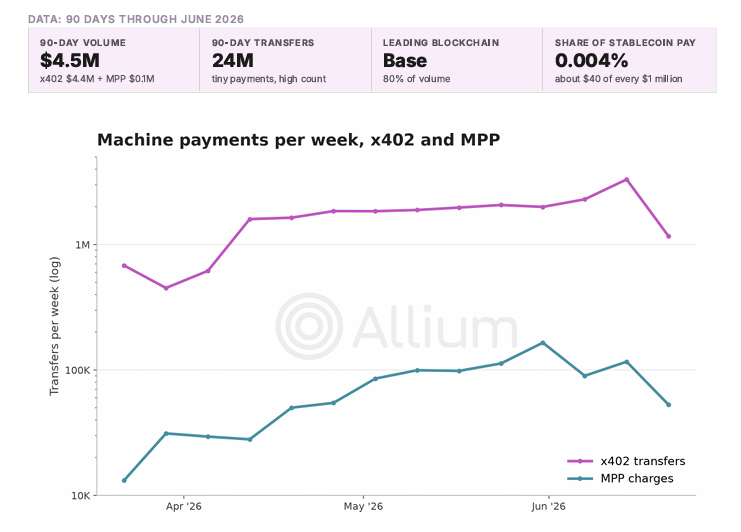
Software agents now pay each other, for data, API calls or compute – but the volume is tiny. The two main agentic rails are x402 (concentrated on the Base blockchain) and MPP (a protocol on Tempo), and about $4.5 million has moved across them over the last 90 days, in 24 million tiny payments.
→ For more, download Allium’s State of Onchain Finance report: https://allium.so/reports/state-of-onchain-finance-q2-26
In this newsletter:
The money question
The changing shape of onchain ownership
Assorted links: Football (yes, still), AI slop, the regulation reflex, sounds
Weekend: retro desktops
Some of the topics discussed in this week’s premium dailies:
Coming up this week
Monday musings: The AI tide goes out?
Term of the day: Open-weight models
The whack-a-mole of stablecoins in crime
Term of the day: FATF
Markets: BTC still quiet
China vs US: where trust matters
Term of the day: Thucydides Trap
Coming up this week: central banks, macro reads.
Monday musings: The money question
Podcast episode recommendations
Stablecoins in Africa: the overlooked story
Markets: FOMC uncertainty
Term of the day: Minsky moment
Stablecoins in Africa (2): the last mile
Term of the day: African Continental Free Trade Area (AfCFTA)
Markets: the performance and the non-message message
Term of the day: Baumol’s cost disease
The changing shape of onchain ownership
Term of the day: Transfer agent
Macro: US PCE and GDP
The money question
The essence of money is something that most of us never think about. Maybe we think about how to get more of it and why it disappears so fast – and for many, those threads are all-consuming, about survival. But peer closely and they’re really about numbers and about our actions. We need or want more, and we make plans to achieve that.
I worked in traditional finance for many years, and so I thought I understood money. It turns out that, like all of my industry peers then and today, I conflated money with numbers which went up and down according to what we and the markets did. Almost none of us stopped to think about what money is. Even during the dot-com crash, the Great Financial Crisis, the Eurozone stress, we focused on number management – we didn’t ask what this was all about.
Maybe we finger-pointed when looking for someone to blame, maybe we criticized certain decisions, maybe we pretended we’d have handled things better. But no-one in my circles questioned the underlying assumption: money is something “given” to us, a public good managed by experts, and we are expected to maximize its accumulation within the rules and let them handle the mess when things go systemically wrong.
Then I discovered Bitcoin. Back in 2014, after watching a Khan Academy video and getting goosebumps, I read the white paper. Finally, I realized how unusual and unnatural the financial system we all take for granted had become. And that I had never understood money.
Just as you can never really understand how something works until you take it apart, here – finally – was the ideal tool with which to pose the important questions: What is money? Who decides? Why does using it online feel increasingly threatening and insecure? Are humans condemned to always trade convenience for vulnerability?
Fast forward more than a decade, the cracks in the current system are getting wider, in part because of the questions and because of the new tools Satoshi’s white paper unleashed.
It’s not about whether Bitcoin is money – that’s substituting one answer for another without understanding the importance of the question itself. Nor is it about whether stablecoins will usher in a new era of monetary management.
It’s about what do we want from money, what do we need it to do? Even that question is more complex than you might think. Store of value? Unit of account? Means of payment? Do we need one asset for all? Or could we partition without confusing consumers and adding more vulnerability?
And should its creation be demand-driven? Supply-driven? Neither? Who decides?
Yet the current unease goes deeper than that. The emerging cracks, with more of us peering into them, highlight our relationship to change. Money is the bedrock of our daily choices, and so we assume it is timeless. We forget how often it has weathered disruption. From metal to paper, physical to electronic, backed to unbacked – we’ve lived through systemic shifts before, surviving and even benefitting from the new conveniences, opportunities, threats and relationships.
Today, we’re witnessing another such epoch. Money is changing – and with it, economics, politics, culture and how markets work.
Over the next few months I’m going to be writing more about what I call “The Age of Interregnums”, and about how blockchain technology is both an instigator and shaper of what’s coming. I started Crypto is Macro Now almost four years ago (!!) to explain to readers the impact of crypto on the macro landscape, and vice versa. Today, the convergence is accelerating, as is the broader disruption from other new technologies and economic structures.
The five interregnums I’m focusing on are: monetary, economic, political, social and business/markets.
Everything we thought we knew about those areas is being questioned. Old rules no longer work, and we don’t yet know what the new ones are.
To be clear, crypto is not the cause of grand dislocation – it’s a tool, in some cases a lever, but change was coming anyway. That said, the technology will be a part of the new bedrock in all five areas. That’s what I want to explain.
It will take time: I’ve given myself the target of a year to build up a body of work on the five. I’ll write about how we got here, what solutions are being developed, which ones are likely to stick, what the world might look like when things settle and how our reactions suggest a bumpy ride until then.
Of course, I’ll also continue to profile interesting use cases, geopolitical flash points, market narratives and more – nothing changes, other than I have an outline I plan to fill in. And as I do, I’ll share what I’m learning and seeing and thinking with you.
🍦 If you find this newsletter interesting, would you mind sharing it with friends and colleagues and nudging them to subscribe? I’d appreciate it! 😀

The changing shape of onchain ownership
Spare a thought for transfer agents – hardly anyone ever does, even though they are a key piece in the smooth functioning of global securities markets. (See below for a description of what they do, if you’re not familiar.)
On Wednesday, they grabbed the tokenization mic with an announcement that may seem dull on the service but is actually a big deal for the evolving market structure.
BNY has launched an onchain transfer agent service for tokenized funds (Digital Transfer Agency, or Digital TA). The service will be initially open to select clients in the US and the UK, with plans for expansion.
Why is this a big deal? In several ways:
1) BNY is one of the largest funds transfer agents in the world.
Its name has credibility and clout, which it now brings to a radically different type of marketplace technology. As far as I know, it is the first major traditional US bank to launch an onchain service for ownership records.
Below I’ll get into why this matters for markets and more, but first some more detail from the announcement:
Along with the digital transfer agent, BNY is launching BLIQUID, a blockchain-native money market fund from BNY Investments Dreyfus (the institution’s cash management and short-duration fixed income division) running on Ethereum and Solana. Ownership will move in near-real time along with the tokens, which can be transferred peer-to-peer among whitelisted wallets. There will be a daily backup to an offchain ownership record, but the official file is the onchain information.
In addition, Digital TA will handle the already-live Baillie Gifford Enhanced Yield Fund (BAGEY, the first publicly available fully native UK-regulated tokenized fund), which also runs on Ethereum and Solana.
And when BlackRock gets approval from the SEC (request filed in May) to add an onchain share class to its existing BSTBL fund, those tokens will also use the Digital TA service. The ~$6.1 billion fund started trading back in 1990 but last year changed its name to the BlackRock Select Treasury Based Liquidity Fund and updated its composition to comply with GENIUS Act requirements for stablecoin reserves.
2) The service makes tokenized funds much more efficient.
To date, ownership for most tokenized funds is recorded offchain. This is not because of regulation – last May, the SEC Division of Trading and Markets published an FAQ on digital assets which explicitly permits a registered transfer agent to use a distributed ledger as the official ownership record, assuming it complies with the requirements set out in securities law.
Rather, it has so far been down to preference, caution and, counterintuitively, convenience – rewiring systems amid patchy progress is complex, expensive and risky. And compliance departments are generally unhappy with anything that changes how investor privacy and data protection are handled. Plus, the FAQs are not official SEC rules – they set policy for now, but can be altered or withdrawn at any time, so there’s understandable hesitance in taking the plunge without some guarantee the rules won’t change.
The dual system – linking onchain movement to offchain recordkeeping – may feel more comfortable, but it limits the efficiency of tokenization, adding steps, cost and complexity.
It also limits the mobility of tokens. A transfer on the weekend, for instance, would not have legal ownership updated until Monday. This could impede the use of the token as collateral or in a lending application.
With ownership recorded onchain along with the movement, new levels of flexibility and utility are effectively unlocked.
This doesn’t necessarily confer near real-time settlement finality, as that also depends on the payment method which could be in fiat (subject to banking hours) rather than stablecoins. But it comes closer.
3) The utility feeds through to stablecoins.
There are two threads here:
One is that onchain money market funds make better reserves for stablecoins than traditional money market funds as they can meet redemption/burn requests in real time, rather than have to wait for trading hours. Of course, eventually a wave of redemptions would hit traditional markets (at least until the government starts issuing Treasury bills onchain and accepts stablecoins in payment), but they offer a potentially useful buffer that should bring some comfort to regulators concerned about market destabilization.
(Although it’s worth noting that, last week, BNY let clients know it had facilitated an out-of-hours Treasury transaction earlier this year for two stablecoin issuers – Ripple and OpenEden – and that it aims to support 24/7 settlement for both traditional and tokenized Treasuries next year.)
Another is that onchain money market funds offer convenient yield. Stablecoins don’t. But imagine you could sweep idle stablecoin balances into a money market token and out again, earning yield even for just a few hours. This could only really work with near-instant ownership transfer, else to whom does the yield accrue?
It’s not hard to see how convenient yield for stablecoins (not the same as stablecoin yield, noooo) could boost their utility and adoption.
4) It starts to change the nature of ownership.
Let’s get philosophical: what is ownership?
In purely decentralized onchain systems, it’s access. Your Bitcoin wallet, for example, gives you access to a balance that you can control, so that balance is yours. This is “bearer” ownership, much like if you have a gold bar in a shoebox in your attic, it’s yours. But if someone takes it from you, even if they aren’t supposed to, it becomes theirs because they now have access and you don’t.
In traditional finance, with everything recorded on centralized third party ledgers, ownership is a legal construct. You own the title to these shares because the transfer agent lists you as the rightful owner. No-one can just take them from you without a change in the ownership record, and there’s a central party to make sure that only happens legally.
The separation of ownership from the asset in traditional markets is convenient – there’s no danger of you misplacing your legal right. But it’s also for control – issuers must have insight into who holds their securities in order to comply with sanctions, anti-money laundering rules and the like.
You can see why this need for centralized ownership control has long been a friction point in the development of tokenized markets – delayed updates to centralized records add a layer of murkiness to who “owns” a transferred token. It could be in your wallet, but it’s not yet legally yours. This clears up, though, when ownership moves with the token.
Pressing further and assuming compliance with securities laws, moving official ownership records onchain brings some degree of “bearer” ownership to securities trading. Ok, not really – the system is still tightly controlled by the transfer agent. Tokens can only move to approved wallets, and any errors can be fixed by smart contracts. But you can see how, from a philosophical and a market structure viewpoint, this feels new.
Looking ahead, this will become even more interesting and relevant as we start to see more native onchain issuance, rather than tokens that link to traditional securities.
What’s more, if you squint, you can maybe just see how a tokenized money market fund with peer-to-peer transfer and near-instant ownership change could become accepted as payment itself – changing not only the nature of ownership, but also of money.
And you perhaps thought transfer agents were boring.
What is a transfer agent?
Someone has to keep a centralized record of who owns which shares, right? In US stock markets, that task falls to a transfer agent: an entity a company entrusts with maintaining the master list of registered shareholders and/or bondholders.
This involves more than just tracking ownership and processing changes. Transfer agents also handle corporate actions such as dividend payment and bond interest calculations (passing payment instructions on to the relevant banks), share splits, mergers, bond maturities – anything that either depends on or affects verifiable security ownership.
Other services include the distribution of proxy voting materials, annual reports and necessary tax information.
In the US, transfer agents are mandated by the Securities Exchange Act of 1934 and are regulated by the SEC, with strict operational standards.
The large-cap segment of the market is dominated by three companies: Computershare (which handles the ownership registry for almost 60% of S&P 500 shares), Equiniti (around 35% large-cap market share, bought for $4.2 billion by crypto exchange Bullish earlier this year, go figure) and Broadridge.
Note that BNY is not on the list – historically, BNY was one of the largest corporate stock transfer agents in the world, but it sold that part of its business to Computershare around 2012. It is still, however, one of the largest funds transfer agents in the US.
ASSORTED LINKS
(A selection of reads I came across this week that I think are worth sharing, not about crypto nor macro. I try to choose links without a paywall, but when I feel it’s worth making an exception, I specify.)
Quico Toro reflects on a time long, long ago when sport was sport, not a commercial behemoth – but it was also more boring. (Back When Football Was Innocent—And the World, Too, Persuasion)
“We live in a faster, sharper-edged world, slicker, much more competitive and much richer. What passed for entertainment back then bores the hell out of us today. Our society is brighter, sharper edged, the stakes are higher.”
In an attempt to stem the flood of AI slop absolutely everywhere, Substack now allows readers to ask for a Pangram scan to determine whether a post was written by AI or not. Many writers are not happy about this, calling it a “witch hunt”. I find this argument puzzling – if they think being labelled as relying on AI would hurt their cachet, why do they do it? I would have thought that if you think there’s nothing wrong with it, you won’t mind people know you do it? Isn’t using AI for writing but pretending you don’t sort of cheating? Like the Substack CEO Chris Best said: “People should know what they’re getting.” (Substackers Say New AI Detection Tool Is a ‘Witch Hunt’, 404)
A sharp and cathartic rant from John Cochrane on the stupidity of calling for AI regulation now. (AI regulation, The Grumpy Economist)
“What happened to basic economics, especially for economist signatories? To regulate, you document a market failure, and then you document the capacity of a regulatory body to address it without inviting an avalanche of cronyism and protection. You don’t “act now” before you have any idea what you’re doing.”
I did not know this existed, and am now hooked – the BBC has a library of over 30,000 different sounds, with which you can do whatever you want. My favourites are the sounds of things we don’t hear anymore: dial-up modem, Barracuda aircraft, little toy wind-up cars, newspaper printing, cash register, typewriter and I could go on… (BBC Sound Effects)
🙏 If you find Crypto is Macro Now useful, would you mind hitting the like button? ❤ I’m told it feeds the almighty algorithm.
HAVE A GREAT WEEKEND!
(in this section, I share stuff that has NOTHING to do with macro or crypto, ‘cos it’s the weekend and life is interesting)
I’m loving the “retro” aesthetic that seems to be seeping fashion and culture. Vintage clothes are everywhere, vinyl LP sales are up, I hear cassettes are coming back, and bicycles are in. Which is why I was intrigued by a video game I read about in the Financial Times called Desktop Explorer, in which the gameboard is a ‘90s computer.
You click around, open files, guess passwords, solve puzzles, play some retro video games and solve a decades-old mystery. I’m not a gamer, but am definitely into the wallpaper and the nostalgia.
DISCLAIMER: I never give trading ideas, and NOTHING I say is investment advice! I hold some BTC, ETH and a tiny amount of some smaller tokens, but they’re all long-term holdings – I don’t trade. Also, I often use AI for research instead of Google, but never for writing.