


Hello everyone! I hope you’re all well and taking care of yourselves.
You’re reading the free weekly send of the premium daily Crypto is Macro Now, where I re-share one or two of the week’s posts and add some non-crypto and non-macro links since it’s the weekend. 🌾
Production note: the free weekly will skip publication next Saturday as I’ll be travelling. For premium subscribers, I’ll also have to skip Thursday and Friday.
In this newsletter:
Why Pontes is not about CBDCs
The pretence of multicurrency platforms
Assorted links: Computism, art and language, TV ranking, biltong
Weekend: Fat Bear Week
PUBLISHED IN PARTNERSHIP WITH: ✨ ALLIUM ✨
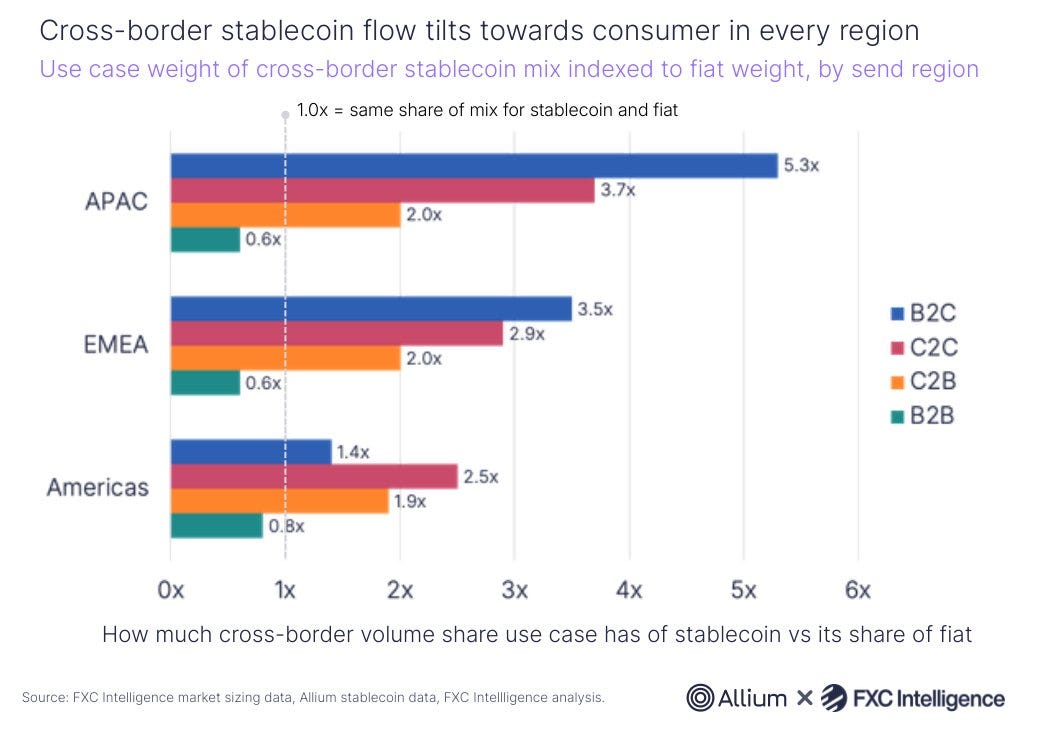
Where have stablecoins made the biggest inroads in cross-border flows? Indexed against fiat weight, stablecoin B2C runs at 5.3x in APAC, 3.5x in EMEA and 1.4x in the Americas.
Finde out more by downloading the full report: Stablecoins in Cross-Border Payments
Get weekly onchain data and more analysis like this from the Allium Research team on Substack.

🌏 STABLECOINS AROUND THE WORLD 🌏
In this series, I explore stablecoin systems outside of the US, talking to experts familiar with various geographies away from the mainstream glare. So far, I’ve recorded episodes on Japan with Emily Parker and Brazil with Aaron Stanley.
Next week: Europe! I’ll be talking to Marieke Flament, who knows more about this ecosystem than anyone I’ve ever met. You’ll find out why when the episode is released on Thursday. Meanwhile, check out her newsletter Currency of Power, which she co-authors with Nicolas Colin.

Some of the topics discussed in this week’s premium dailies:
Coming up this week: geopolitics on stage
The pretence of multicurrency platforms
Why Pontes is not about CBDCs
Markets: a new vibe
Stablecoins: central banks vs banks
The changing face of banking
Basel report: bank exposure to crypto assets
Term of the day: prudential exposure
Markets: The squeeze tightens
Macro: In the driver’s seat
The fuel for stablecoin statecraft
Term of the day: diesel
Why Pontes is not about CBDCs
This week, Europe took a big step forward on its path to tokenized markets. True to form, it did so through legacy institutions rather than by encouraging private innovation – but, to be fair, it solved a problem that had been holding the ecosystem back, and it did so with full establishment support.
The Eurosystem’s platform for tokenized asset settlement, known as Pontes, is now live.
Before I dive into its features, some definitions are in order.
The “Eurosystem” is the European Central Bank plus the national central banks of euro countries.
“TARGET Services” refers to the suite of real-time wholesale payment services managed by the Eurosystem. This launched in 1999 as group of linked national real-time gross settlement (RTGS) systems, became a single platform known as TARGET2 (short for Trans-European Automated Real-time Gross settlement Express Transfer, 2nd interation) in 2007-8, and in March 2023 was upgraded to the current multi-service structure that includes:
wholesale monetary operations (T2),
securities settlement (T2S),
instant payments (TIPS),
and unified collateral management (ECMS).
I know, there are a lot of acronyms in there.
With that out of the way, on to Pontes:
What Pontes is
Its aim is to connect tokenized markets to central bank money. One of the main drags on the development of a deep tokenized ecosystem in Europe has been the lack of a legally recognized settlement token that reflects the efficiency of distributed ledgers.
The EU’s 2014 Central Securities Depositories Regulation (CSDR) says that central securities depositories (CSDs) must settle in central bank money where practical. The EU’s T2S securities settlement platform, through which most euro-area CSD transactions travel, settles only in central bank money. (In the US, settlement flows up to central bank money rails but often goes through commercial bank money settlement steps and batching before getting there, giving American firms more flexibility in settlement services.)
Stablecoins are not yet recognized as legal settlement for tokenized securities, although the EU’s painfully slow DLT Pilot Regime is exploring how they could be incorporated.
The EU law actually says that central bank money must be used for securities settlement “where practical and available”, and one could argue that in tokenized markets it was just not available, so stablecoin settlement could be considered legal – but institutional investors would understandably rather wait for more robust regulatory assurance, depriving tokenized markets of the desired liquidity.
Pontes offers an interoperability layer (the “Eurosystem DLT”) that connects tokenized assets to central bank money in two ways:
Via a “trigger” that executes a payment in fiat money on T2.
Via the exchange of tokenized central bank money, which then settles on T2.
Either way, finality is achieved in T2, as in the traditional settlement system.
The key advantages include:
Potential connectivity between a wide range of DLT networks and official settlement rails.
Technology agnostic – authorized market participants connect via APIs.
The exchange of securities and money is simultaneous (delivery-vs-payment, or DvP) even across distinct cash and asset layers, eliminating settlement risk.
It does not require a legal re-write of settlement laws, which would take years.
However:
Pontes is for now only operational during traditional banking hours, but the ECB has hinted that these will be expanded next year.
And, as yet, it does not enable smart contract functionality, it is purely a settlement connector. That said, participants can use whatever onchain features they want on their end.
What Pontes is not
A widespread misunderstanding is that Pontes is the engine for a Eurosystem central bank digital currency (CBDC). It isn’t. It is for wholesale transactions, which separates it from the retail-facing digital euro. But central bank money is not directly issued on the ledger – Pontes creates and handles a tokenized representation of balances held on T2. It’s closer to a deposit token than a new form of central bank monetary engagement.
I’ve also seen much commentary on how Pontes kickstarts the Eurosystem move towards onchain money. Not really. It’s not about digital currency at all, that’s in the background. Pontes is about tokenized markets. The aim is to find a way to efficiently fund tokenized asset transactions while complying with settlement regulation.
Why it matters
This speaks to the larger, quieter goal: a new capital market. The EU has been working on Capital Markets Union for decades and the progress has been minimal. Why? Because EU governments don’t want to give up control of their national markets. Luxembourg, which earns over 60% of its corporate income tax revenue from the finance industry, does not want to cede supervisory power to ESMA. Germany, a bank-heavy economy, does not want to see increased capital market financing detract from interest income on loans. I could go on.
So, we may have monetary union but not capital markets union, which is frustrating for anyone who cares about liquidity. Unfortunately, this is unlikely to change given the lack of incentives to do so, and will continue to hold the EU back in terms of innovation and capital market efficiency.
It’s not just about unnecessarily thin markets sending ambitious companies to the US to list and grow, with the resulting brain and capital drain that implies.
It’s also about distribution of opportunity – if we are a united economic bloc, then issuers should have access to the same pool of investors, and savers should be able to invest in any European-issued asset without tax penalties or legal friction.
And, it’s about euro stablecoins. Without a deep, pan-European bond market, we’re unlikely to get pan-European government bonds. This will mean that stablecoin issuers don’t have access to as safe a backing instrument as those in the US – which gives US stablecoins under the GENIUS Act an advantage over those under the EU regulation MiCA. Politicians will insist that MiCA compensates for the relatively thin debt market by requiring a significant chunk of stablecoin reserves to be held in bank deposits – as if bank deposits were safer than government bonds.
I’ve often written before about how I see onchain markets as a solution. If national interests insist on holding on to the current fragmented system, a new type of market supported by European authorities could perhaps satisfy the need for a pan-European structure.
In a speech last month, ECB Executive Board Member Piero Cipollone pretty much confirmed this is a key part of the plan:
“If we design and build an integrated European market for tokenised assets from the outset, the digital finance transformation will allow us to leapfrog the fragmentation of existing legacy systems.” (my emphasis)
Pontes is a big step forward to bringing institutional liquidity to the tokenized asset ecosystem. Tokenized central bank money is not the goal here, onchain settlement for a pan-European marketplace is. Put differently, Pontes is not about money – it is about assets, trading, savings, investment and the creation of wealth.
See also:
Reform vs change (Aug 2026)
EU tokenization and wholesale CBDC (Mar 2026)
Tokenization: Building frustration (Apr 2026)
The EU DLT Pilot Regime: let’s move faster (Feb 2026)
The pretence of multicurrency platforms
The recent BRICS Summit held in New Delhi did not, despite the declared ambition of Indian officials, produce a commitment to launch a group payment platform. Rather, the post-Summit Declaration rather tamely acknowledged work done so far by the BRICS Payment Task Force on studying the interoperability of national systems and the potential for local currency settlement – and it encouraged continued discussion “while respecting national priorities and acknowledging that there is no one-size-fits-all approach”. The overall vibe is one of “we have no consensus on the need nor the format”.
This is hardly a surprise. The BRICS is made up of such a diverse array of financial cultures and priorities that agreement feels elusive at best – and the larger the group gets, the less likely consensus becomes. For many, the situation is not urgent enough to overcome mutual distrust. And without broad interest, the effort and cost of the development will be hard to justify.
Even narrow collective platforms struggle. The mBridge platform, a CBDC-connector developed by the central banks of China, Hong Kong, Thailand, and the UAE under the umbrella of the innovation lab of the Bank of International Settlements (BIS). A small group, a limited scope, and even then, rumours of governance difficulties have been circulating for a while.
In June 2024, Saudi Arabia joined the project as it reached Minimum Viable Product (MVP) stage. A few months later, the BIS withdrew.
Last Sunday, the Financial Times reported that Saudi Arabia had exited the mBridge project. The headlines spread rapidly across mainstream media and social feeds, amping it up as a geopolitical signal. This was irresponsibly misleading (and further proof that fact-checking is a thing of the past): in May 2025, Saudi Arabia executed a proof-of-concept on the platform and then stopped participating. Over a year ago.
What’s more, it’s unlikely the decision had anything to do with US pressure – Saudi joined late, tested the plumbing, and probably realized there was no clear advantage beyond bragging rights. Not long after the mBridge test, the kingdom entered into a security pact with Pakistan, sending the message the US no longer has sway in its strategic decisions. Bottom line, Saudi Arabia backed out because it doesn’t need mBridge.
Why not? For one, it’s not desperately looking for alternative digital rails, unlike some jurisdictions. Most of its trade is invoiced in dollars, and it is unlikely to find itself on the receiving end of a dollar blockade. The riyal is pegged to the dollar, and the bulk of its reserves are in dollars. True, China is Saudi Arabia’s largest trading partner, and some invoice settlement is in yuan – but not enough to develop an alternative system. And, unlike the UAE, the kingdom has no clear CBDC strategy.
Meanwhile, mBridge has continued to grow – recent additions to the list of participants include Macau and Mongolia, and a South China Morning Post report in July said commercial launch was imminent.
But for now, the only active CBDC on mBridge is the digital yuan.
This raises an obvious question: are multicurrency platforms the answer to trade settlement? The BRICS nations seem to think not. And mBridge is so far behaving more like a digital yuan connector than a joint governance project.
But China already has one: the Cross-border e-CNY Transfer Services (CBETS) platform. Merging various e-CNY pilots, it launched as a rebranded entity in June with 26 direct participants. These were mainly Chinese institutions, but with direct operations in Hong Kong, Macau, Laos, Thailand, Singapore, Qatar and Brazil. Local banks in these countries can connect with CBETS participants to get access to e-CNY supply, transfers and settlement.
Or, they can apply to connect to China’s CIPS yuan payments platform. Last year, it started incorporating direct participants headquartered in foreign countries, starting with the UAE, Thailand, Singapore and Kyrgyzstan. South Africa’s Standard Bank, the largest financial institution in Africa with operations in 21 countries, is a direct member. The expansion continued in 2026, with additions from Angola, Mongolia and – earlier this month – Türkiye, Georgia, Malaysia, Rwanda, Uzbekistan and the Maldives. In August, Deutsche Bank became the first non-Chinese bank in Europe to be designated an RMB clearing bank, upgrading its direct CIPS connection (via its Chinese subsidiary) into an official European regional hub.
With so many global banks joining the fiat Chinese currency cross-border platform, and with China’s e-CNY platform expanding, you’re probably wondering why mBridge exists.
The thing is, for a multi-currency CBDC platform to be effective, it needs multiple currency CBDCs. That is much, much harder to orchestrate than just spinning up a token representing central bank money (itself legally and operationally complex). The underlying issue is the same friction that fragments today’s currency map: concentrated demand, influenced by infrastructure and liquidity. Everyone wants dollars, few want to hold on to the Vietnamese dong or the Guinean Franc. A faster, more flexible ringgit is not going to boost global demand for the ringgit.
And while blockchains can execute fast, low-cost, disintermediated currency swaps, there needs to be supporting liquidity which may not be economical, especially in an environment of high or climbing interest rates.
So, the promised utopia of multi-currency digital platforms settling global trade at the speed of light while reducing reliance on the dollar and delivering savings to the Global South is probably not going to materialize. Put differently, multi-currency efforts will soon become single- or dual-currency platforms, no different (but more expensive) than bilateral agreements. It feels like just yesterday when all the top global governance organizations were touting their plans for a “universal ledger” (for our convenience, nothing to do with wanting to control the infrastructure, of course not). They’ve been unsurprisingly quiet on that topic for a while now.
That doesn’t mean we won’t soon find ourselves in a multi-CBDC world. But the “multi” will have scaled back to a concentrated few. After all, the main advantages of a wholesale CBDC are 1) cheaper cross-border settlements when there is demand for the currency in the first place, and 2) more efficient settlement with same-currency tokenized assets, a domestic market decision. Few nations are still focusing on wholesale CBDCs for cross-border reasons. Those with ambitious tokenization plans will see wholesale CBDCs as a domestic settlement tool.
This suggests that we will see continued fragmentation of the global payments landscape, but a concentration around the dollar, the yuan and the euro. Not ideal for those with trust issues, but diversification of payment rails and settlement currencies brings its own resilience, even if the currency used is not yours.
In sum, Saudi Arabia’s decision last year to withdraw from mBridge has little to do with sovereign allegiances and more to do with the impracticality of a multicurrency settlement platform, even one powered by a fast-settlement technology. We will probably eventually see mBridge absorbed into China’s CBETS e-CNY network as it expands further.
Meanwhile, the BRICS nations will continue to fret about dollar dependence, but will react by stitching together even more bilateral connections – some may be CBDC-related, most will probably be links between more traditional fast-payment technologies.
The overall vibe is that the drive to reduce the costs of international commerce, such an obvious priority just a few years ago, will give way to a focus on shoring up domestic payment systems, liquidity mechanisms and securities markets, as the global gaze turns inward.
See also:
China vs US: where trust matters (July 2026)
mBridge gets complicated (Oct 2024)
A CBDC alternative to SWIFT? (Nov 2023)
ASSORTED LINKS
(A selection of reads I came across this week that I think are worth sharing, not about crypto nor macro. I try to choose links without a paywall, but when I feel it’s worth making an exception, I specify.)
A piercing portrait by Sam Dresser of the ideology of “computism”, which holds that the world can be datafied, replicated, standardized. Who controls that data and what is done with it? What does it mean to be human in the age of machines? What is “taste”? Can code replicate instinct? A moving read, not your typical “tech is bad” rant, more an exploration of our relationship with and the role of design. (Who Will Taste the Cherries? – Aeon)
“When users outsource agency to the interface – allowing their kitchen, for example, to cook for them while they run errands – the interface begins to take on qualities of a subject while the user moves closer to a data-generating object.”
T. J. Clark delivers a fascinating exploration of the origins of art, its place in the development of “language” and the tension between linear and spatial. (Night Visitors – The London Review of Books)
I literally gasped. The Economist ran an article on biltong, a flavoured, dried beef that hails from South Africa and has for decades been my favourite snack in the entire world. One of the highlights of my London trips (behind seeing beloved family) is stocking up as I have yet to find a source here in Spain. My mother was South African and would make her own when we lived in countries where it was not readily available – I haven’t gone that far yet as we have two dogs who would probably go crazy at the sight and smell of slabs of meat hanging to dry in the kitchen. But I have thought about it. Only now, according to the article, it is becoming a global phenomenon, so maybe I won’t have to? (Biltong is going global - like South Africans – The Economist, paywall but should be a gift link)
The New York Times polled show people and the public on their favourite TV series of the 21st century. In the top 20 there are several I totally agree with and many I have not yet seen – I have a lot of viewing to catch up on. (The 100 Best TV Shows of the 21st century – New York Times, paywall but should be a gift link)
HAVE A GREAT WEEKEND!
(in this section, I share stuff that has NOTHING to do with macro or crypto, ‘cos it’s the weekend and life is interesting)
It’s that time of year again! I am, of course, talking about Fat Bear Week. Every year as hibernation season approaches, Katmai National Park in Alaska opens voting on which of their bears should get crowned champion of plumpness and might. And voting is now open, until September 29 at 9pmET.
This year, the US Department of the Interior is getting involved (because bears matter) – it helpfully shared a list of vocabulary we will need to know.


On to the voting. First, meet Chunk, winner for 2025:

(image via Forbes)
And going by the voting so far (we’re two rounds in), Bear 132 and her cubs are in the lead:

(image via explore.org)
I am devastated Marshmallow got eliminated from the running:

(image via explore.org)
But Bucky is in with a chance – go, Bucky!

(image via explore.org)
Seriously, there are worse ways to spend 15 minutes – you can vote here.
DISCLAIMER: I never give trading ideas, and NOTHING I say is investment advice! I hold some BTC, ETH and a tiny amount of some smaller tokens, but they’re all long-term holdings – I don’t trade. Also, I often use AI for research instead of Google, but never for writing.