


You’re reading the free weekly send of the premium daily Crypto is Macro Now, where I re-share one or two of the week’s posts and add some non-crypto and non-macro links since it’s the weekend. 🌼
If you’re a premium subscriber, thank you so much! ❤
If not, do consider becoming one – for the cost of a weekly cup of coffee, you’ll get more regular commentary that filters the noise on crypto’s place in monetary and geopolitical realignment.
In this newsletter:
The IMF path to tokenization
Newslettering after four years
Weekend: magnificent dog photography
PUBLISHED IN PARTNERSHIP WITH: ✨ ALLIUM ✨
Allium’s State of Stablecoins and Payments Q3 2026 report measures stablecoin supply, adjusted volume, payments, agentic payments and card spend through September 30, 2026, with commentary from 17 industry contributors.
Download the report here: https://www.allium.so/reports/state-of-stablecoins-and-payments-q3-2026
And get weekly onchain data and more analysis like this from the Allium Research team on Substack.

Some of the topics discussed in the recent premium dailies:
Coming up this week: lots of high-level global meetings, US inflation
How relevant are consumer surveys?
The IMF path to tokenization
Macro: US CPI
GRAB BAG ISSUE: Agentic payments, stablecoins and the price of intermediation
commentary on pieces by Jordi Visser, Citrini Research and David Marcus
Markets: about turn?
Stablecoin payments: the numbers
Newslettering after four years
The IMF path to tokenization
Earlier this week, the IMF released its semi-annual Global Financial Stability Report discussing the major trends impacting the world economy. Whatever you may think of the IMF, this report carries weight as a “health check” that aims to identify crises before they blow up, with a focus on financial-sector implications of macro policies and structural developments.
For the first time, the latest report carries an entire chapter on tokenization.
It’s actually pretty good – thought-provoking, balanced and quite well written, with items of interest for both the uninitiated and those already deep in the industry. There is a sprinkling of good charts, and a smattering of “boxes” with related deep dives (I do like reports with boxes, perhaps something to do with the by-the-way choice of distractions).
Below, I’ll highlight one of the more interesting observations from the report, one that tends to be overlooked by market participants but that weaves together the various threads covered.
But first, a summary of key metrics:
A snapshot
At the end of July, tokenized real world assets excluding repo stood at around $65 billion, with the bulk of that in tokenized fixed income (corporate credit, asset-backed credit, and money market fund).
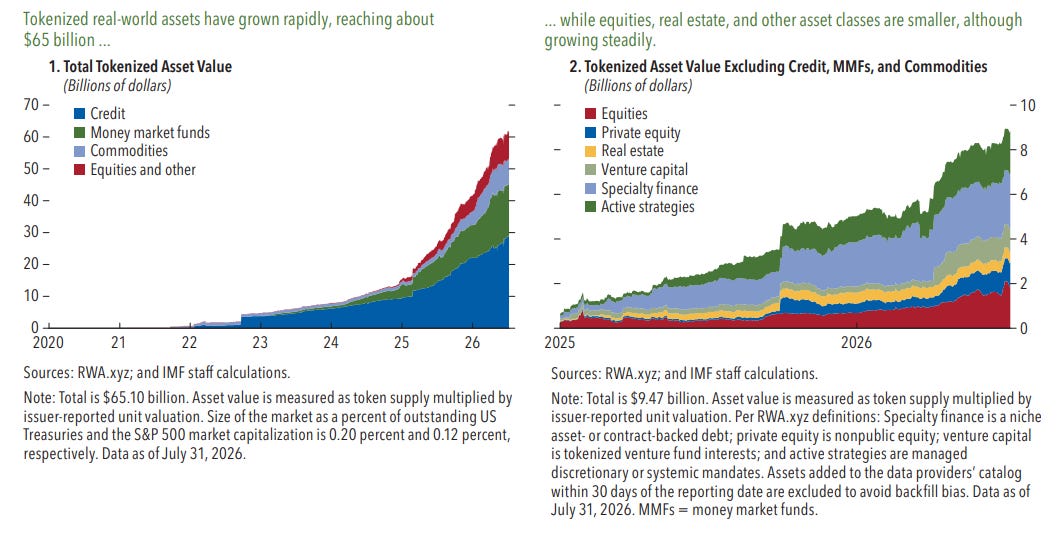
(all charts from the IMF Global Financial Stability Report, October 2026)
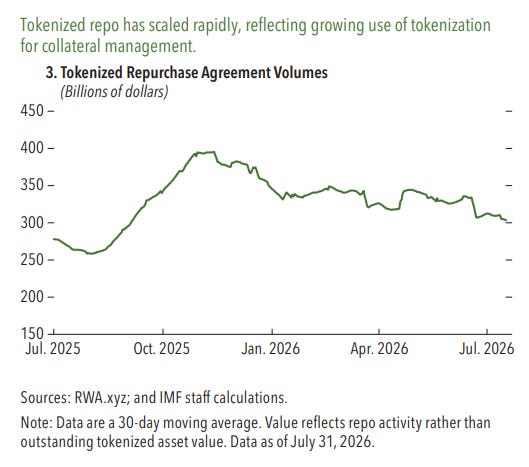
Tokenized repo is not included in that total as it is more about flows than issuance – yet its average daily volumes have for the past year been over $300 billion, an indication that collateral management is one of the most compelling use cases in today’s market.
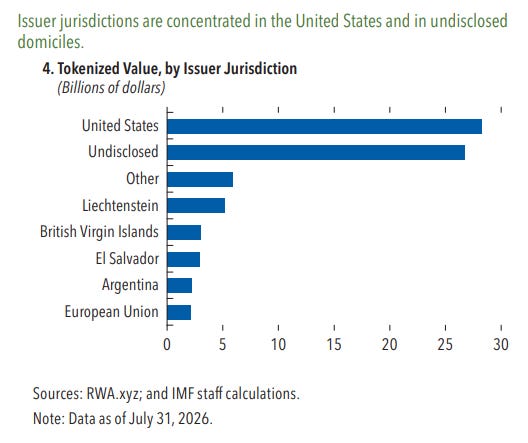
Unsurprisingly, most tokenization currently takes place in the US – but check out the sizeable volume with unknown origin, a blow to those who insist onchain assets are transparent.
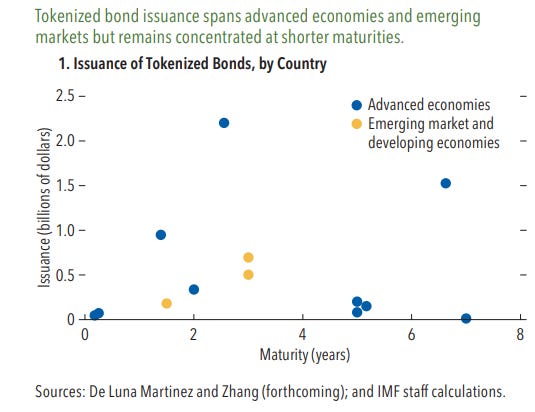
Bonds issued on-chain tend to have short maturities, which makes sense given the relative youth of the technology and the “still testing” approach from large issuers.
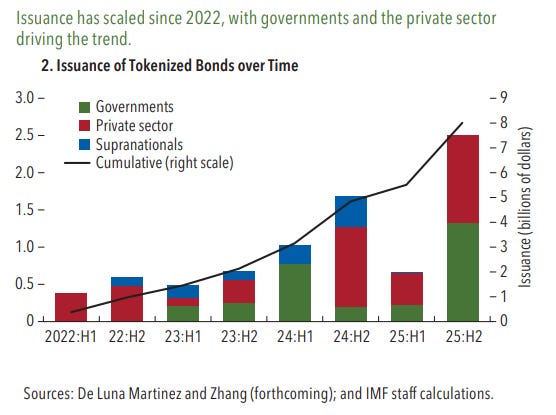
Also interesting is the growing participation from governments (in green below).
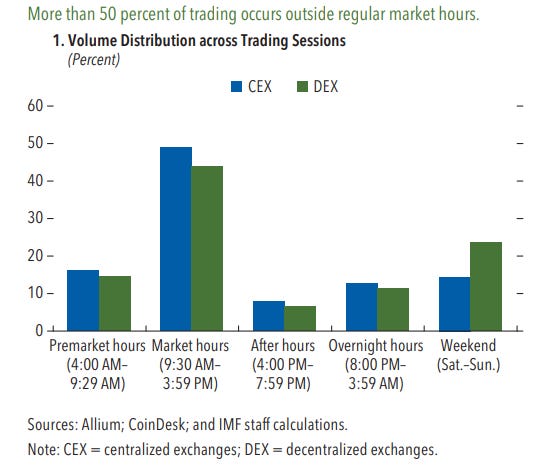
In tokenized equities, it’s notable that around 50% of trading takes place outside typical market hours, suggesting that the always-on nature of onchain markets is a strong draw.
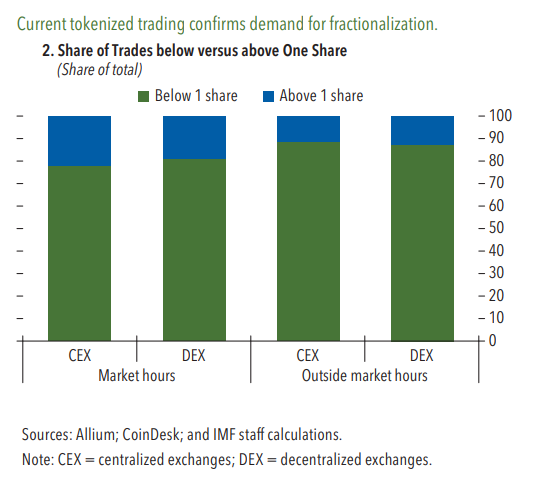
Also, I was surprised by the demand for fractionalization (which reduces investment barriers) – most trades are of less than one share.
Adoption
For a report that aims to identify systemic risks, the chapter on tokenization is surprisingly optimistic, even while taking an original approach to the diagnosis of vulnerabilities.
To start with, the authors point out that the systemic risks are low given the industry’s small size. But they stress recent growth, outline the advantages (current and potential), and suggest remedies for the barriers.
The report makes the usually overlooked point that the pace of adoption is not about the underlying technology – we know that works. It’s about the incentives facing market participants. For now, these are still relatively thin.
Tokenization does offer obvious benefits:
Financial claims can be issued, transferred, serviced and settled on shared digital infrastructure, rather than through multiple intermediaries and separate ledgers.
Programmable transfer rules can automate aspects of transaction execution.
Smart contracts can automate certain clearing arrangements, facilitating more reliable and efficient delivery-versus-payment transactions while reducing settlement risk.
Native programmability enables the flexible and efficient combination of assets across protocols and applications.
More precise transaction timing can support liquidity management.
Removing the need for multiple intermediaries can improve automation and lower issuance as well as transaction costs.
Integrated ledgers and common standards can dramatically enhance the speed and efficiency of payments.
Real-time reporting can improve the transparency of holdings and facilitate corporate actions.
However, there are still considerable barriers to adoption:
Regulatory clarity and legal certainty is improving, but gaps remain, and there is as yet no global framework. What rights does the token inherit from the underlying asset, and how enforceable are these? Are onchain transfers legally binding, and if so, at what point? What is the legal status of smart contracts and ledger entries? How are different legal regimes reconciled in cross-border transactions?
Fragmentation is keeping liquidity thin. Activity takes place across fragmented networks, which can trap liquidity and reduce market depth, discouraging the large investors that could bring in more liquidity. Greater interoperability is a solution, but introduces additional risk.
Trust tends to be deeply embedded in settlement workflows. Large traditional investors are used to settling in trusted central bank money – relying on private settlement assets such as stablecoins introduces new risks that many may feel uncomfortable with. But insisting on a cash leg for tokenized markets removes the same-ledger efficiency, at least until more jurisdictions issue wholesale CBDCs.
What’s more, the report notes that many of the benefits are not exclusive to onchain markets, weakening the incentives for adoption – compressed settlement cycles and 24/7 trading, for instance, can be achieved on existing rails, as can programmability and nearly real-time monitoring.
But, unlike updated services on traditional rails, tokenized markets can act as a catalyst for market modernization while offering unique shared-ledger benefits such as composability, efficiency and cross-network transparency.
Outlook
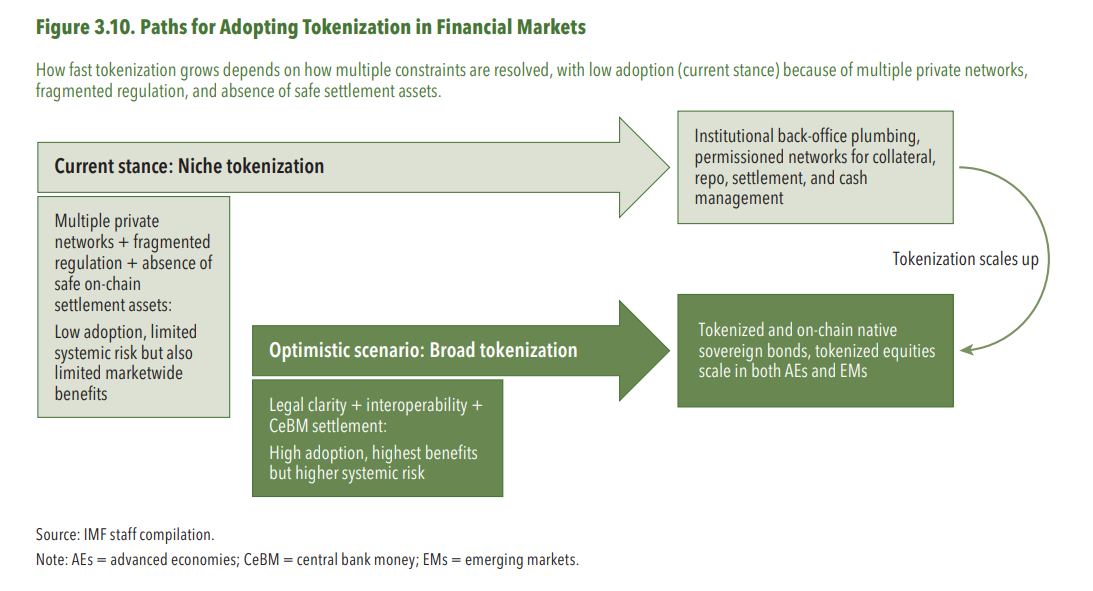
The current trajectory, according to the authors, points to limited scaling and adoption with localized efficiencies and volumes concentrated in specific use cases.
As these barriers get lowered, however, network effects could kickstart non-linear growth, giving scale to the potential efficiency and liquidity benefits.
Here is where the risks could become material.
The report focuses not so much on specific technology or issuance risks, as on how tokenization can reshape the channels through which shocks can be transmitted. Operational and infrastructure vulnerabilities are understandably of greater concern when it comes to relatively young technologies. When markets are more connected, these become more important still. In a fragmented system they can be contained – in a connected system, that becomes much more complicated.
It may even be impossible given how fast onchain assets can move. Greater asset mobility in connected markets could accelerate the contagion of liquidity runs and fire sales.
But the authors stress that there are tradeoffs. The benefits could outweigh the heightened risk, especially if jurisdictions collaborate in implementing mitigating measures.
An entire page in the chapter is dedicated to exploring how tokenization could change market structure. Most FMIs and service providers today are vertically integrated, operating asset and trading services as well as the infrastructure on which those services run. Tokenization could allow for a degree of “unbundling”, with functions offered independently of the rails, encouraging more competition.
A final thing that stood out is that stablecoins are hardly mentioned, other than in passing when talking about trusted settlement assets. Personally, I appreciate the limited scope of the chapter’s focus – it’s not as if the IMF hasn’t published risk assessments of stablecoins before.
In sum, the chapter came across as an unexpectedly constructive look at the potential impact of tokenization. A larger takeaway, though, is in the assumption that onchain assets are now a feature of finance. They could remain a niche if the adoption barriers are not dealt with – but the authors laid out a series of policy prescriptions to lower them.

🌟Thanks so much for reading! Do you know anyone else who feels crypto is playing a meaningful role in global shifts, and is not yet a subscriber?
Newslettering after four years
As part of this newsletter’s fourth birthday commemoration (which I’m still finding hard to believe), I promised to share some thoughts on how I do what I do, and how that has changed over the years. I’m hoping this will be helpful to anyone else struggling with the weight of content production in an increasingly crowded environment – and that it will give you wonderful readers some insight into what my days are like, and why I feel so lucky.
Below, I’ll answer the questions I get asked most often. There will obviously be much that I leave out, not deliberately but in the interests of time – feel free to reach out on Substack Chat if there’s something you’re wondering about that I haven’t addressed. If I get enough interesting questions there, I’ll do a part 2.
How do you find something to write about every day?
This is easily the most-asked question, and the only answer I have is that my recurring problem is one of time and energy constraints, not topics to focus on. There is SO MUCH going on, most of it is so interesting, and I’m fascinated by how it all fits into the bigger picture of changing relationships and expectations. In sum, there’s so much more to write about than I can possibly get to, which is a frustration I’ve learned to deal with.
How do you choose what to write about?
Usually, on Sundays, I’ll map out what I want to get to during the following week. Often things happen (significant developments, a new report, etc.) to rearrange my plan, but at least this way I feel more in control of the content flow.
My criteria for choosing what gets my (and your) attention is:
Does this topic shed light on crypto’s evolving role in the changing global landscape, or does it help to highlight shifting market narratives? Can I do a good job explaining why it matters?
Almost every day I come across things I want to write about but have to skip, given time constraints – I’ll put them on my Topic List, which is intimidatingly long and getting longer.
Why do you publish so often?
I’ve often thought about dropping the frequency of publication – the newsletters have been getting longer, and you are all no doubt too busy to read them every day. Plus, more time to do research would lead to deeper and possibly more useful pieces.
But, I’ll be honest, I actually enjoy the daily deadline. There’s a thrill in hitting publish, followed by the relief-fuelled joy of heading to the kitchen to make lunch and take a break. A feeling of accomplishment. And, it keeps me from going too deep into any one topic when there’s so much I want to pay attention to. The daily deadline keeps me productive and focused.
That said, publishing every day is exhausting, and as I get older, I find I don’t have the energy I used to. Still, I’m going to stick to my rhythm for now, only with perhaps more frequent days off here and there.
Why don’t you do more video/audio?
That’s a question I wrestle with often. In the early days, I tried doing an audio version of the podcast and embedding the recording in the email before sending it out – but that meant publishing really late, and reading out loud what I had already written felt like an unproductive use of my time. I am toying with the idea of trying again, simplifying my mic setup and figuring out how to get an AI to do the editing for me.
As for video, it comes down to time management – for the 2-3 hours it would take me to prepare a script, set up the lighting, record, edit, distribute, I could be doing a lot of reading, learning and writing, which I enjoy much more. And would people really rather watch/listen to me than read? I’m realizing that, yes, there are some who would, and so exploring how to do this efficiently is near the top of my To Do list.
I am getting better at video interviews – check out my Stablecoins Around the World series if you haven’t yet seen it. And I do enjoy talking to people, so when this series ends, I have an idea for another one.
How has the newsletter changed over four years?
I’d like to think it’s gotten more relevant for understanding the changing world, in that my focus has sharpened as my thesis has evolved. In the early days, it was much more market-focused, a lot more commentary on price movements and investor signals, as back then that was what I was mainly known for, and what I figured readers wanted more of.
But my interest in crypto has always been the big-picture global impact, and I’ve loved the freedom I have now to focus on filling in some of the pieces in the changing puzzle. I feel I can add more value there as not enough of us are working in the crypto/macro intersection, whereas there are so many people doing crypto market commentary.
I think the newsletter has gotten better at content packaging with time – better lead-ins and titling, more links to previous relevant pieces.
I used to do more news-style summaries, monthly round-ups of developments in stablecoins, CBDCs, regulation and tokenization. I stopped because I found sticking to a regular schedule on that became impossible with so much other stuff to focus on. Let me know if you miss it (I know I do) and I’ll find a way to bring it back.
The posts have gotten a lot longer – perhaps because my research is getting deeper, or because there’s more happening, or maybe I’m just getting too wrapped up in words. Shorter feels more useful. I’m going to have a think about how to get a better balance.
How is it going?
I’m happy with how the number of free subscriptions is growing – this is now over 7,100, up 10% on the year, with new ones joining the list every day.
The number of paying subscribers has dropped by quite a bit, I’m down 17% over the past 12 months. That upset me at first, until I realized that pretty much all Substack newsletter writers were seeing the same thing to some degree (other than the superstars, I assume). The better Substack does in attracting new names, the worse we do individually as the available spend pie does not grow proportionally – there’s only so much we can spend on newsletters, right? Especially when we’re also maintaining our subscriptions to traditional media.
I’m extremely fortunate to have wonderful sponsors in Allium – their support gives me a good cushion to absorb a drop in paying subscribers, while my growth in free subscribers gives them more exposure.
And, I love what I do – truly – and I was never in it for the money anyway. So I stopped stressing about the revenue. But, not going to lie, it would make me so happy to see the paid number start to tick up again. Suggestions welcome!
Like this newsletter ❤ if you care about changing marketplaces.

HAVE A GREAT WEEKEND!
(in this section, I share stuff that has NOTHING to do with macro or crypto, ‘cos it’s the weekend and life is interesting)
It’s been a while since I shared beautiful images with you, and what better occasion to rectify that than the reveal of the winners of the Dog Photography Awards 2026.
Without further ado, here are some of my favourites, chosen for feeling rather than composition or technique:

photo by Nika Kuplenk Golobic

photo by Elena Marchi

photo by Gavriella Leon

photo by Eco Lorka
DISCLAIMER: I never give trading ideas, and NOTHING I say is investment advice! I hold some BTC, ETH and a tiny amount of some smaller tokens, but they’re all long-term holdings – I don’t trade. Also, I often use AI for research instead of Google, but never for writing.