


Hello everyone! I hope you’re all well, taking care of yourselves, and enjoying the last weekend before September gets into full post-Labor Day swing. 🌻
In this newsletter:
Why the next crypto cycle will feel very different
Assorted links: AI predictions, detecting slop, geologists and the meaning of camp
Weekend: TV series from the ‘70s
You’re reading the free weekly send of the premium daily Crypto is Macro Now, where I re-share one or two of the week’s posts and add some non-crypto and non-macro links since it’s the weekend. 🌼
PUBLISHED IN PARTNERSHIP WITH: ✨ ALLIUM ✨
A tokenized treasury fund earns its yield from the same short-term government paper as a money market fund. Settlement, transferability and who can hold it at which hour are what change. Smaller than the marketing suggests, larger than the sceptics allow.
Allium Research explains how they work: https://allium.so/blog/tokenized-treasuries-how-they-work-and-why-they-matter/
Get weekly onchain data and more analysis like this from the Allium Research team on Substack.
Some of the topics discussed in this week’s premium dailies:
Coming up this week: central banks, inflation data
Monday musings: why the next cycle will feel very different
Some notable Bitcoin think-pieces
Markets: now we’re talkin’
Network incentives, digital euro design and bank mendacity
What is co-badging?
Podcast episode recommendations (they’re back!)
Coming up this week: US jobs, geopolitics
Reform vs change
Markets: by “hike” I mean…
Term of the day: Shanghai Cooperation Organization
Can financial institutions use public blockchains?
Markets: hopeful resilience
Shapes in the fog
Term of the day: penny warrants
Russia’s CBDC launches
Macro: what should we be focusing on?
Why the next crypto cycle will feel very different
It’s sad to see people go. Over the past few months, I’ve lost count of the number of crypto contacts I’ve spoken to that have said they’re just tired of the industry. You’ve probably heard this from some friends and acquaintances also: frustration, disappointment, even disgust.
I’ve been dwelling on why, when arguably the industry has been successful.
Bitcoin has been powering itself for 18 years, with no technical hiccups in well over a decade. Its token is held by retail savers around the globe as well as by the occupants of some of the highest elected offices. Legacy institutions in the world’s largest financial markets have set up crypto trading desks and launched digital asset investment products. US financial regulators are drafting rules for more secure crypto market participation, and there may soon be approval (maybe, hopefully) on a Congressional law. No-one thinks the crypto ecosystem will disappear, and only a regressive few think it will fade into irrelevance. And there are enough meaningful battles ahead to maintain emotional engagement.
And yet, the mood has been bleak. It’s picking up a bit along with the price, but even so, the vibe among old-timers is largely one of “meh” or even “blech”.
Looking into what’s behind this despite achievements is a humbling exercise that says a lot about where the industry is in its development stage, while highlighting many of the features that still make it a fascinating space to watch.
Below, I’ll share my theories with you, and what they imply for the coming cycle. I have to stress that I, personally, am not at all disillusioned with the industry, and I acknowledge that everyone brings their own set of expectations to the table – here I have tried to understand why others are.
Asset prices
The bleak mood is, of course, partly about price. Crypto assets are in an extended slump, typical of the cycles that many of us thought were over. BTC, for instance, is still 35% below its October 2025 high, and many other tokens have done much worse. What’s more, BTC has been bouncing along within a narrow band for what feels like ages – the tedium has been enough to dent even the most resilient conviction.
The past couple of weeks have returned a glimmer of optimism that sentiment is turning – but only a glimmer, as we’ve seen many false bounces before.
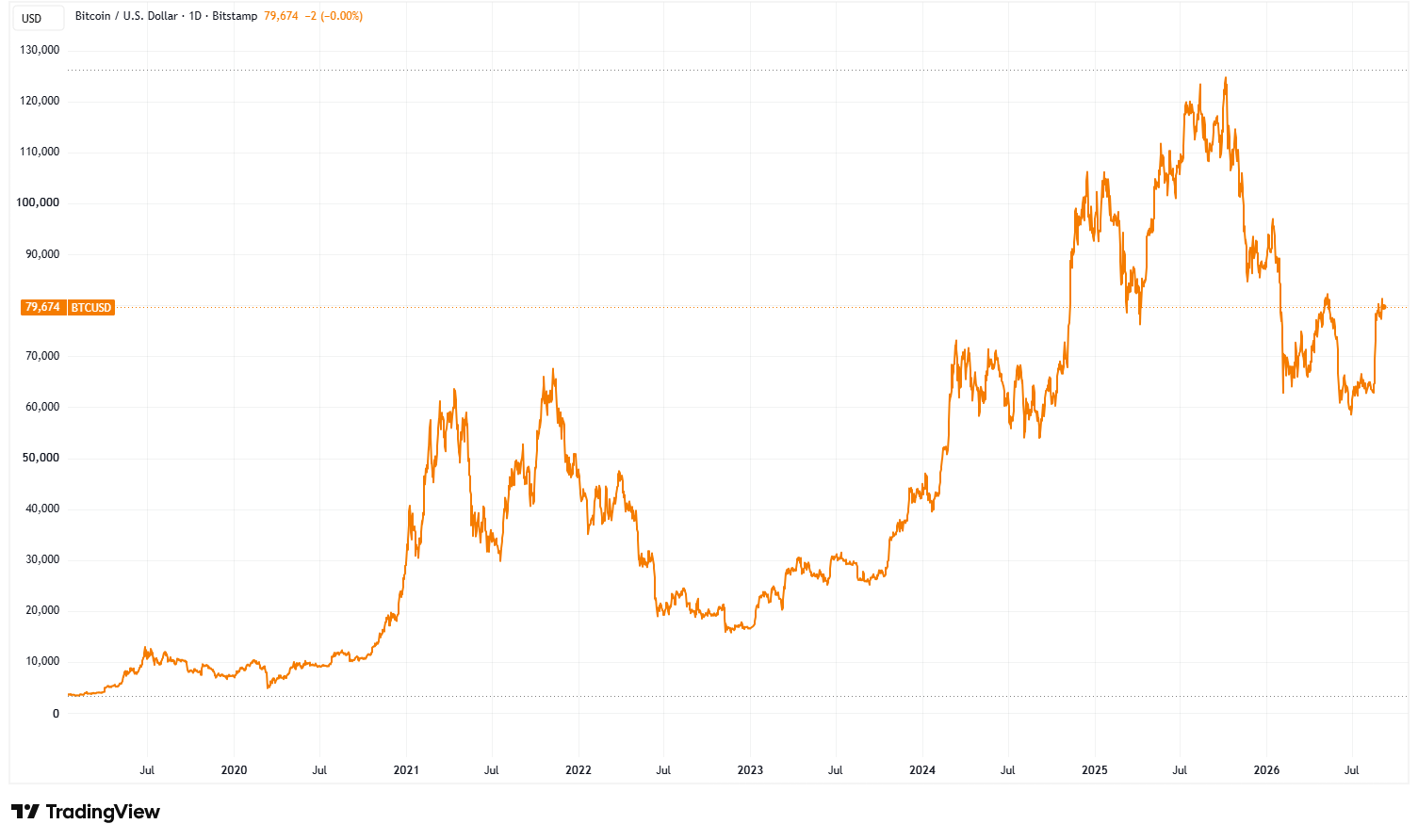
(chart via TradingView)
Shrinking industry
While revenues at many of the crypto majors have been growing and some exciting funding rounds have been closed, the industry as a whole feels smaller.
This may sound counterintuitive as we hear a lot about real progress in tokenization, stablecoin adoption, infrastructure development, data services and more.
We don’t hear about the number of businesses winding down, or not getting funded.
According to Tracxn, 486 new startups have emerged in the “blockchain technology” category in 2026 so far, compared to more than 2,000 in 2024 and almost 10,000 in 2021. In the narrower “web3” category, the number dwindles to 35 vs almost 7,000 in 2021.
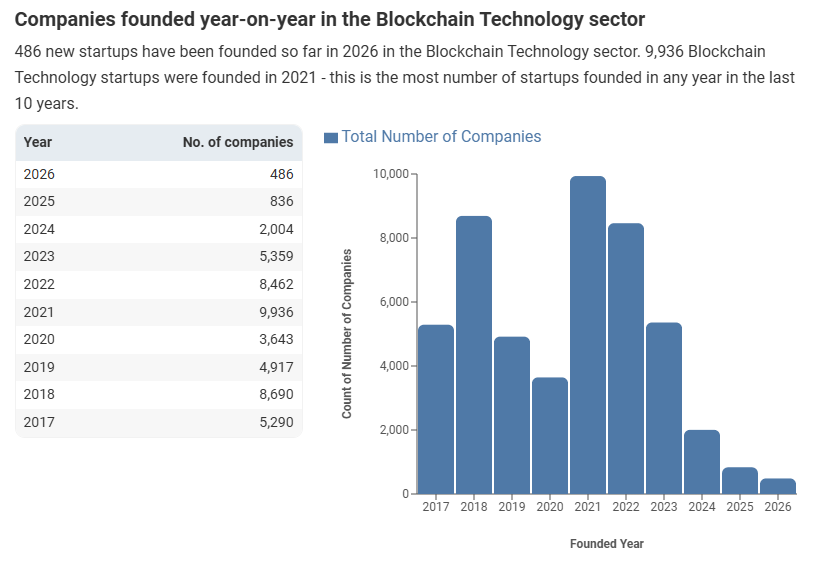
(chart by Tracxn)
According to cryptorank (via The Defiant), 651 firms participated in crypto rounds in Q2, less than a quarter the number writing checks in the same period four years ago.
And while there are active pockets of hiring with many firms growing teams, we’ve seen waves of layoffs making headlines. Many more have flown under the radar.
Asset prices are part of the problem; so is the migration of funding to AI, robotics and other sparklier areas.
No longer frontier
There’s also the migration of talent. Many visionary builders and developers joined the crypto industry early on because it was a frontier technology with blue sky potential to transform, if not quite the foundations of society, at least the functioning of money, markets and commerce.
According to Electric Capital, the number of those actively working on crypto networks and applications has been falling since last May, and is back to 2023 levels.
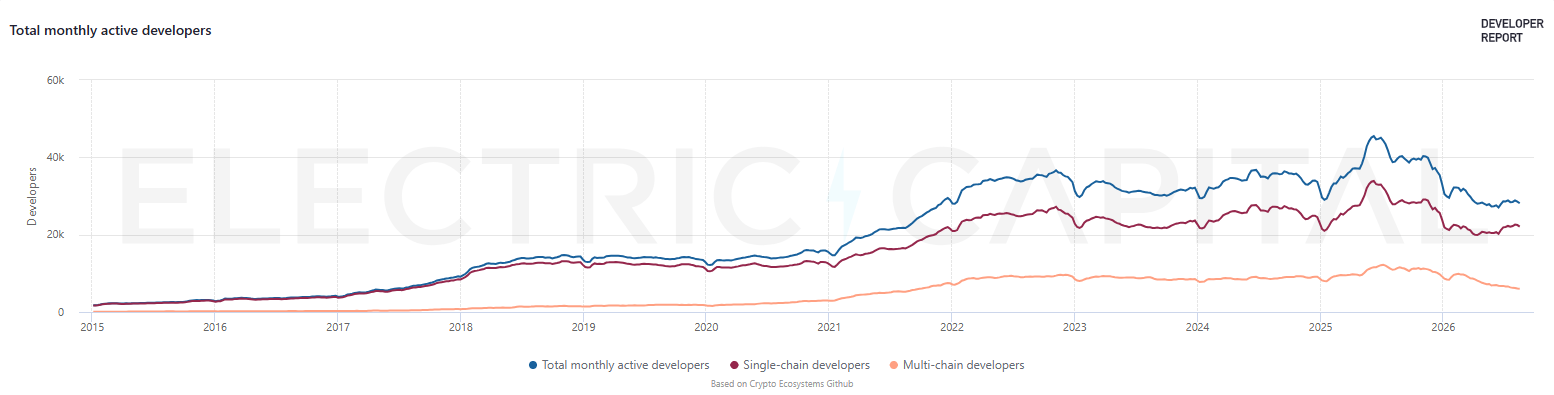
(chart via Electric Capital)
Arguably, the allure of frontier has moved on: AI, robotics, healthtech and other sectors are more attractive today for the type of funding and brains that want to work on the “new”. More than 18 years in, crypto has lost its “newness”.
Lost aura
It has also lost its ideological glow.
Several years after Sam Bankman-Fried, Do Kwon and others made crypto embarrassing, we are still struggling with what I call the “ick factor”. The Trump family institutionalizing the sector’s reputation for grift is not helping.
Today’s digital asset optimism seems to be coming from tokenization, from replicating traditional markets on new rails, a far cry from the ideology of breaking centralized shackles that fired the early years. Gone are the days when we were the cool rebels threatening the establishment.
For many, there’s the disappointment of seeing several of their heroic Bitcoin visionaries embracing the financial engineering of digital asset treasuries, using centralized structures to make more money and (unsuccessfully) try to boost Bitcoin’s price.
Even the promised opportunity of decentralized finance seems to have retreated. It still works and its potential is still strong, but excitement about its open access and lean set-up has largely morphed into a concern for KYC and authorization – understandable given the need for regulatory acceptance, but nevertheless a step away from the early motivation. And overall, interest has weakened. The market value of tokens locked in smart contracts on DeFi apps is back down to where it was in late 2024.
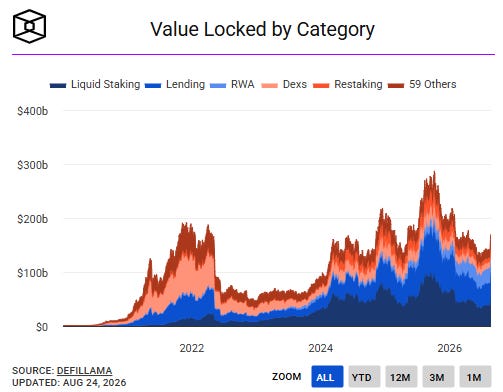
(chart via The Block Data)
No laughs
Finally, where has the fun gone? Not long ago, even the more financially sober among us could laugh at some of the memecoins, feel something for certain NFTs, chuckle at the DOGE price. Not long ago, crypto had a crazy side that made it culturally relevant, with the lack of fundamentals for some assets part of the iconoclastic point. These days, hardly anyone seems to care about the potential for fun.
What next?
Again, the above theories are not about my engagement with the crypto industry – I am as fascinated and more convinced than ever of its meaningful role in the evolving landscape. They’re also probably not about yours – you have your reasons for being a subscriber to this newsletter (thank you!!!!). Rather, the above is my attempt to understand why so many who have invested so much of their time and talent in this space are so glum or have already moved on.
In sum, it’s about the crypto industry leaving the childhood of games, parties, indulgence and an idealistic lens. It’s about crypto growing up and entering the adulthood of responsibility, boardrooms, playing within rules and monitoring the profit/loss. This matters a lot for the next cycle.
The thing about maturing is, you can’t undo it, no matter how many Lego sets you buy or kitesurfing vacations you take. Growing up is a one-way door.
Surely not, you say, surely we can get the original spark back?
Well, let’s look more closely at that.
Prices, yes, they will overall do well, and we have some exciting days ahead. Of course, they can go lower in the meantime – but the bear market in crypto is coming to an end.
But crypto is not all about prices.
True, they should help improve both funding and hiring, which will boost overall sentiment. Continued success in changing market structures around the world will stoke more conviction that what we’re doing is important. Spreading adoption of crypto assets as alternative savings and of blockchain rails as alternative financial access will encourage those of us that see the technology as a tool for resilience.
All that is good.
But the ideological spark of the early years is gone. The world has changed, and so have we. We’ve seen what we’ve seen, we know what we’ve learnt, and the industry has grown up.
This is also good. It feels more real – harder, perhaps, but more tangible. Our understanding of the potential has both narrowed and deepened. Those that are still here truly want to be.
It may feel more sober, but that’s also healthier. Growing up means losing some of the magic of youth, but it also brings longer-lasting opportunities. We may be devastated to learn the tooth fairy doesn’t really exist, but now we can buy our own ice cream. Perhaps it’s harder to become an astronaut or a lead ballet dancer than we thought, but we have a clearer idea of what our role in the world can be.
The next crypto cycle will be different, in part because we’ve changed but also because the newcomers will have very different profiles to those who drove the last bull run. Less ideology, less vindication, hopefully less crowing arrogance. But, probably, a lot more money to invest.
And, this time, crypto and digital assets will have earned a permanent, less speculative seat at the big league’s table.
📣 If you’re interested in how crypto fits into the changing macro and geopolitical landscape, I hope you’ll consider becoming a premium subscriber - for the cost of a weekly cup of coffee, you could be getting so much more out of these newsletters! And, you’d make my day. 😊
ASSORTED LINKS
(A selection of reads I came across this week that I think are worth sharing, not about crypto nor macro. I try to choose links without a paywall, but when I feel it’s worth making an exception, I specify.)
Ted Gioia’s AI predictions are not pretty. In that, he’s not alone, but the key signal here is that he is not a tech builder or VC investor – he’s best known for his depth in music and culture more broadly, so he can be considered an “outsider”. Which means he represents a cohort that does not have a vested interest in convincing us everything will be wonderful. There are some uplifting notes, however, especially around the increasing use of analogue devices and the embrace of real life experience. (10 Brutally Honest Predictions on the Future of AI – The Honest Broker)
Derek Thomson interviews Pangram founder Max Spero on why the spread of AI content on our screens matters, just how bad is it, how Pangram works, what could disrupt it, and more. (We Can’t Let AI Writing Take Over the Internet – Derek Thompson)
A fascinating report on the increasingly important role of geologists in combatting the impact of climate change, what post-flood investigations involve, why landslides are becoming more frequent, the particular challenge of the Himalayas, and more. (Nepal’s Catastrophic Flood Heralds a New Age of Disasters – Bloomberg, paywall)
Robert Armstrong of the Financial Times does a lot more than comment on markets. He’s also pretty sharp on fashion. Here, he writes about camp, authenticity, values and Dolly Parton, while delivering crisp observations on human nature. (Notes on campy clothing (and Dolly Parton) – Financial Times, paywall)
“Everything from decor to advertising, the spirit of the age is knowingness, acting out things we do not fully identify with.”
HAVE A GREAT WEEKEND!
(in this section, I share stuff that has NOTHING to do with macro or crypto, ‘cos it’s the weekend and life is interesting)
Nostalgia seems to be in, not that it was ever out. I’m seeing it in fashion, movie styles, music, and I’ve even been hankering to watch some of the old TV series I grew up with. I’m not joking, the other day I happily sat through a clip from The Partridge Family.
In that spirit, today I’m going to share some of my favourite open credit music scores from the ‘70s, chosen more for the music than the series itself. There are so many that I will almost certainly do a part 2 at some point, and do please let me know your favourites.
Happy Days
Hawaii Five-0
The Muppet Show
Kojak
DISCLAIMER: I never give trading ideas, and NOTHING I say is investment advice! I hold some BTC, ETH and a tiny amount of some smaller tokens, but they’re all long-term holdings – I don’t trade. Also, I often use AI for research instead of Google, but never for writing.