


Well, that’s the first month of 2026 in the bag. And what a crazy month it’s been. I looked over what I was writing about in January in 2025 (will share thoughts on that next week) and, yes, this past one was on a different level. Bring on February. Gulp.

You’re reading the free weekly edition of Crypto is Macro Now, where I re-share one or two posts from the week.
✨
If you’re not a subscriber to the premium dailies, I hope you’ll consider becoming one! You’ll get access to market commentary as well as adoption insight and industry trends. Plus, links and music recommendations ‘cos why not…
✨
My op-ed in American Banker this week (paywall!) suggests that branded stablecoins are kinda like loyalty points, and are poised to usher in a further breaking down of traditional “money” definitions. “Stablecoins could boost the utility of customer loyalty programs”.
Earlier this week, I was a guest on Scott Melker’s live The Wolf of All Streets show which was, as always with Scott, a lot of fun. You can see the playback here.
And a podcast recording I did with the AllInCrypto team last week is now out – you can see/listen to that here.
PUBLISHED IN PARTNERSHIP WITH: ✨ALLIUM✨
As traditional finance and crypto converge, trusted data is the missing infrastructure layer. Allium provides this data foundation for teams like Visa, Stripe and Grayscale.
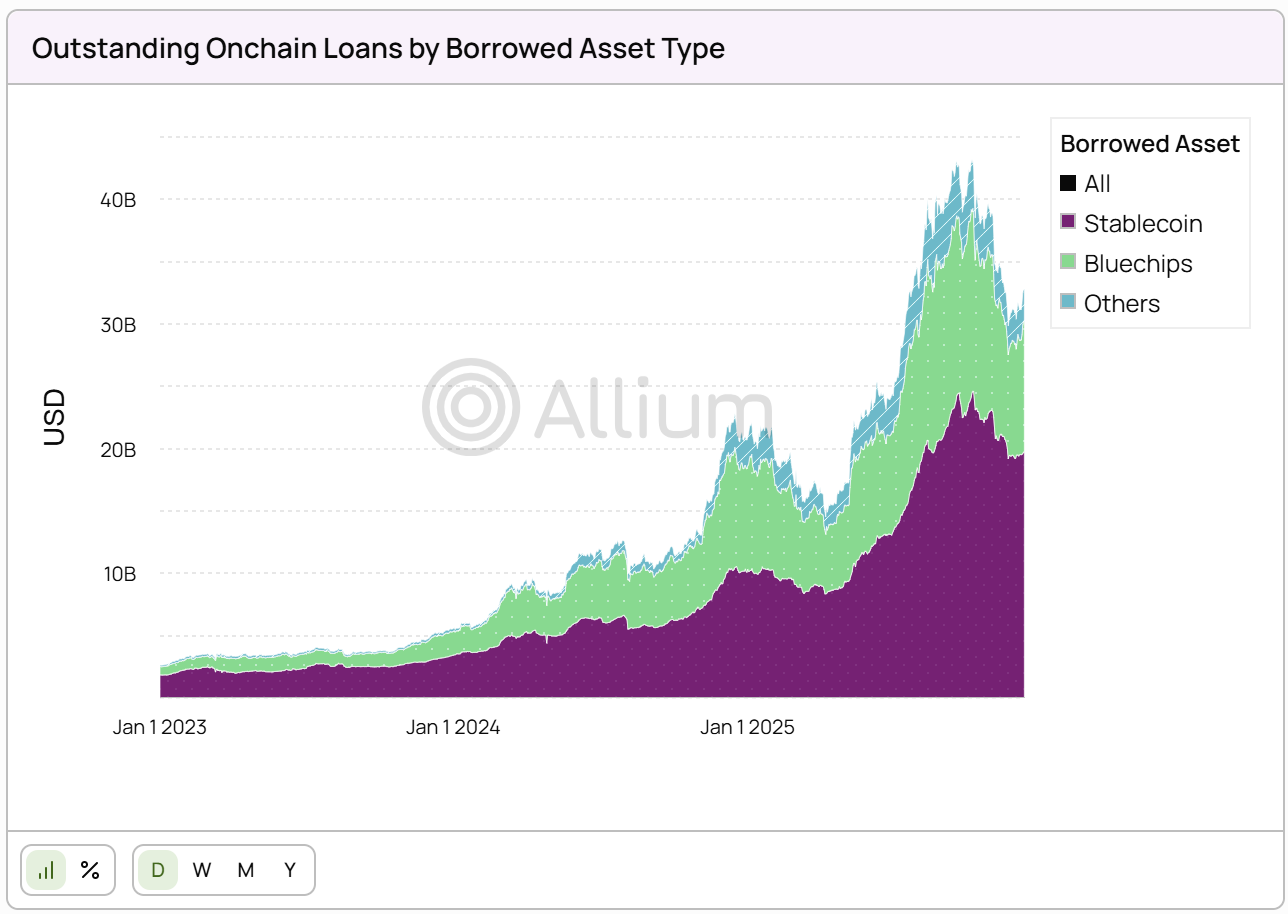
Our latest whitepaper published with Visa, Stablecoins Beyond Payments: The Onchain Lending Opportunity, examines how banks can access emerging credit markets. Looking at the data, outstanding onchain loans reached over $40Bn this year, with stablecoins making up more than half of borrowed assets.
If you’re producing institutional crypto research or analytics, start with trusted data. Explore a live demo.
In this newsletter:
Stablecoin roundup:
new issuances the past month, infrastructure development, adoption anecdotes, some surprising stories, and more
Assorted links: an alternative democracy, politics as entertainment, false cognitive limitations, the AntiChrist, airport books
Weekend: Society of Photographers Awards
💃 If you speak Spanish and are interested in a less frequent, shorter update on developments on stablecoins and tokenization, you can subscribe to Cripto es Macro here. 🎁
Some of the topics discussed in this week’s premium dailies:
Coming up this week: FOMC, US activity, digital euro
Markets: something’s off
Gold and the dollar
BTC and political drama
Macro: US consumer sentiment
NYSE vs Nasdaq on tokenization design
Broken momentum
Markets: earnings vs rates
The dollar’s drop: part of the plan
Markets: BTC still asleep
Tether: USAT touchdown
Tokenization: the new race
A “no comment” FOMC
Markets: the reaction and the action
Stablecoin roundup:
big moves from the past month in stablecoin issuance, infrastructure development, deposit tokens and adoption
So it’s Kevin Warsh
Markets: whoa
Stablecoin roundup
We’ve hit the end of the month so, as promised, I’m restarting the monthly look-backs at key developments in certain segments of the crypto-macro overlap. First up is – of course – stablecoins, with tokenization, CBDCs and regulation on their way. My aim is to extract the moves that matter from the daily noise, and to sketch out development trends and overlooked narratives.
Here goes:
New stablecoins in January
Wyoming: FRNT
(This has to be one of the wildest stories of the month.)
Launched last August, Wyoming’s state-backed stablecoin FRNT is now available to the public.
This is a standout issuance for many reasons, both structural and political.
The token has official backing and compelling use cases – paying state contractors via traditional methods, for example, can take weeks, while FRNT should in theory compress that to minutes. Public payroll could become cheaper to distribute, tax refunds could arrive faster, and so on.
But despite that, takeup is not guaranteed.
Apart from the usual user suspicion of any change involving money, and the likely reluctance to change habits, there is considerable onboarding friction. Initially FRNT will only be available for purchase on Kraken, so users will have to open accounts. Also, Kraken will sell FRNT only on the Solana blockchain. A partnership between the state and crypto card issuer Rain will allow holders to spend FRNT anywhere Visa is accepted – but on the Avalanche blockchain. Holders can switch their FRNT from Solana to Avalanche (and Ethereum, Base, Arbitrum, Optimism, and Polygon) via the Stargate app, which I presume means they’d need to open an account there, too.
Why would they want to do that?
Here’s where it could get interesting. The GENIUS Act bans issuing banks and non-banks from paying yield. Wyoming argues that it is not covered by this ban as it is, essentially, a sovereign issuer. This means it could distribute interest. It has no intention to do so just yet, though. For now, any interest earned on reserves will help fund the state’s school system.
But, hang on, if it’s a sovereign issuer, doesn’t that make FRNT a sort of CBDC? Representative Tom Emmer thinks it does, and his vehement opposition is reportedly one of the reasons public access was so delayed. But there is no central bank issuer here, digital money is not “created”, and FRNT is backed by US treasuries – not at all like a CBDC.
Could the US Administration stop Wyoming from paying interest on FRNT? I’m not a lawyer (nor am I American), but from what I gather, states have to comply with laws passed by Congress, but not with Executive Orders, which are binding on federal agencies but not states. But, of course, a lot of pressure could be applied to comply, and it gets especially fuzzy when an EO is an interpretation of an existing law.
Confused yet? The grey areas are so interesting.
Tether: USAT
The other big issuance of the month was from Tether, which launched its dollar token USAT, available to US-based institutions. I wrote about this earlier this week so won’t go on much more, other than to add that USAT could end up encouraging more use of USDT offshore as the US regulatory approval of USAT confers a shine of respectability on USDT. They are two separate assets operating in different jurisdictions, but perception matters.
See also:
Tether: USAT touchdown (Jan 2026)
Fidelity: FIDD
Long rumoured to be in the works, earlier this week Fidelity Investments confirmed the launch of its stablecoin in coming weeks. The Fidelity Digital Dollar (FIDD) will be issued on Ethereum by the asset manager’s national trust bank, for which it got provisional authorization last month. FIDD will be available on participating exchanges, but here’s a twist: the national trust bank’s retail and institutional clients will be able to buy and redeem FIDD on one of Fidelity’s digital assets platforms (it has three: Fidelity Digital Assets, Fidelity Crypto, and Fidelity Crypto for Wealth Managers platforms). This is unusual, normally redemption is limited to a few authorized participants, with most stablecoin users buying and selling stablecoins on exchanges.
Also, according to the statement, FIDD will be freely transferrable to any Ethereum address – I’m not sure how compliance will work here, details to come, I expect.
This issuance is interesting in that it is the first large asset manager to issue a US dollar stablecoin. It has a massive network of potential users, and a trusted brand. But pickup might be slow as the use of stablecoins for payments is still nascent, the main use by far is still trading, and I expect only a very small percentage of Fidelity customers are active in DeFi and crypto markets. Those that are will need a strong reason to switch from their current stablecoin of choice.
Universal Digital: USDU
The United Arab Emirates has its first regulated dollar-backed stablecoin. Issued by Universal Digital, USDU is registered with the region’s central bank as a Foreign Payment Token, which means it can be used by institutional and professional clients (including foreign entities) for settlement of trades on UAE crypto exchanges. This may sound limited, but given the region’s growing crypto activity, the token is likely to pick up meaningful volume, especially as professional traders switch from using unregistered stablecoins (USDT, USDC and others) to the central bank-authorized USDU. The token should also benefit from compliant, bank-approved onramps and integration into the financial system, although the regulation stipulates it can’t be used for domestic or cross-border payments.
Tokenized deposit moves in January
The biggest news in tokenized deposits over the past month is BNY’s launch of its tokenized asset service. Back in October, the bank revealed it was exploring the idea as a way to scale instant cross-border payments. Earlier this month, it announced that the service is now operational, and the initial list of users includes Intercontinental Exchange (owner of the NYSE), Citadel Securities, DRW Holdings, Baillie Gifford, Circle and Ripple’s prime brokerage arm Ripple Prime. We can expect more to follow.
Lloyd’s Bank executed the UK’s first tokenized deposit transaction, settling a tokenized gilt trade on the Canton Network.
Speaking of Canton, JPMorgan announced plans to expand its JPM Coin deposit token to the network in a “phased rollout”, broadening its potential utility beyond the Base ecosystem.
The most innovative move of the month, however, came from an unexpected source: the London Stock Exchange Group (LSEG) launched the Digital Settlement House, designed to act as a connector between different payment systems, both onchain and traditional. The platform includes a service called DiSH Cash, which converts commercial bank money held by members of the platform into blockchain tokens that can then be transferred 24/7 for the settlement of FX and digital asset trades. So, technically this is a deposit token service, as the issued tokens are backed by bank deposits, and can only move between platform members. But it’s also not, as in LSEG is not a depositary institution.
See also:
LSEG launches tokenization platform (Sept 2025)
Stablecoin infrastructure moves to watch
In a $5.15 billion transaction, major US bank Capital One acquired fintech platform Brex, which offers checking accounts, corporate cards, treasury management and other financial services with a focus on streamlining, transparency and data aggregation. In September of last year, Brex started offering stablecoin payments, allowing businesses to send and receive USDC directly from their accounts. Watch this space, I guess.
Polygon Labs, the development team behind the Polygon blockchain network, announced the acquisition of crypto payments company Coinme and crypto infrastructure provider Sequence for more than $250 million. These acquisitions no doubt will help flesh out the team’s vision, detailed earlier in the month, for the “Open Money Stack” which aims to power faster, more reliable global payments. In coming months, we can expect to see new stablecoin apps emerge on Polygon and possibly new infrastructure layers.
Video sharing platform Rumble has launched an embedded non-custodial wallet (you have control, not the platform) to allow viewers to tip creators using stablecoins. Rumble is backed by Tether, so this is an innovative way to both broaden USDT adoption and experiment with funding models for decentralized media.
Abu Dhabi’s ADI Foundation is partnering with M-Pesa to extend the use of dirham stablecoins throughout Africa. I wrote a lot about this last week, nothing to add here – but it is a fascinating story that is ultimately about much more than stablecoins, worth keeping an eye on.
See also:
Tether, Rumble and AI (Oct 2025)
Tether and Rumble: what’s really going on? (Jan 2025)
Some quick stablecoin adoption notes
Blockchain forensics firm Elliptic reports that Iran’s central bank has around $507 million in USDT, and that it has been using the token to prop up the plummeting rial (not very successfully, I’d argue?).
Separately, a report from TRM Labs suggests that Iran’s Islamic Revolutionary Guard Corps (IRGC) moved roughly $1 billion over the past couple of years, through two cryptocurrency exchanges registered in the UK (Zedcex and Zedxion, never heard of them but I guess that’s the point).
What’s more, the FT reported that Iran’s Ministry of Defence Export Centre last year started offering to accept stablecoins as settlement for purchases of weapons.
The address labelling is relevant given that earlier this month Tether froze $182 million in USDT tied to five Venezuelan addresses.
And last week, Bloomberg reported that A7A5, a ruble-backed stablecoin issued last January by a firm in Belarus, reached aggregate trading volumes of over $100 billion, largely acting as a bridge between rubles and USDT. The EU issued sanctions on the token in November, and it appears that volumes have dropped and that no significant issuance has taken place since July – so, maybe sanctions on a token work?
On a more mundane level, electronic brokerage giant Interactive Brokers now allows clients to fund accounts with stablecoins, although these are automatically converted into dollars.
See also:
Sanctions on a stablecoin (Oct 2025)
The dark side of crypto (June 2025)
ASSORTED LINKS
(A selection of reads I came across this week that I think are worth sharing, not always about crypto or macro. I try to choose links without a paywall, but when I feel it’s worth making an exception, I specify.)
What if democracy could be run differently? Like, very differently? This piece by Quico Toro is a must-read: thought-provoking, well-written, great storytelling, it dares to throw radically new ideas into a pool we know is murky and messed up, and in so doing, gets us to question long-held assumptions. (The Venetian Option, One Percent Brighter)
Kyla Scanlon writes about how the Consumer Republic became the Shareholder Republic which led to the Great Moderation and then the Great Financial Crisis and now we’re heading into the Great Entertainment, where politics is scripted for the small screen and the appearance of success matters more than the real thing. Scoreboards, memes and a false reliance on nostalgia are now the main levers of political communication, but eventually reality catches up with rhetoric. (The Great Entertainment, Kyla’s Newsletter)
Rather than join us in our collective recoil from Peter Thiel’s recent ramblings about the Antichrist, Joe Lonsdale dives in and rephrases it as a warning about existential threats. These are not necessarily plagues, monsters emerging from the sea nor religious prophecies, but more likely systems that we ourselves choose out of fear. Perhaps even more thought-provoking, which is saying something, is Joe’s uncomfortable nudge that we should question why we’re not interested, given Thiel’s intellectual pedigree. Have we become so co-opted by “acceptable thought” that we assume, without research, that any ideas outside it are just bonkers? (Taking Thiel Seriously on the Antichrist, Joe Lonsdale)
This piece by Sinéad O’Sullivan may seem wonky, but it’s actually an exploration of cognitive limits, as in, how smart are we, and how smart can we get? We’re taught a certain way of thinking, but that doesn’t work for everyone – still, we’re graded on that often irrelevant standard. Thinking “harder” does not necessarily lead to better understanding – but thinking differently could. (How To Become a Mathematical Genius, But This Time It’s Different)
John Oxley offers a resonant Public Service Announcement about airport bookshops. We assume they’re selling knowledge, but really they’re designed and stocked to convince you that this book (whatever self-improvement thesis is in fashion at the time), which you will of course have time to read now that you’re getting on a plane, will result in a more successful and less stressed you. Intellectual shortcuts with snappy covers and social credibility lead to Airport Book Brain, which unfortunately seems to explain much of today’s culture and politics. (Airport Book Brain, Joxley Writes)
✨ If you find this newsletter at all useful, would you mind sharing it with friends and colleagues and nudging them to subscribe? I’d appreciate it! 😃
HAVE A GREAT WEEKEND!
(in this section, I share stuff that has NOTHING to do with macro or crypto, ‘cos it’s the weekend and life is interesting)
It’s been a while since I gushed about photography, about how an image can transport us to new worlds while helping us to better appreciate the one we’re in, about how flat takes on dimensions and about how imagination connects to the eyes in bewildering ways. Mercifully, I now have a good excuse to, as The Society of Photographers has unveiled its 2025 winners. So many amazing images – here are a few of my favourites:




DISCLAIMER: I never give trading ideas, and NOTHING I say is investment advice! I hold some BTC, ETH and a tiny amount of some smaller tokens, but they’re all long-term holdings – I don’t trade. Also, I often use AI for research instead of Google, but never for writing.