


Hello everyone! I hope you’re all taking care of yourself, getting some fresh air, touching grass, drinking lots of liquids (of the healthy kind)… this past week was one of the craziest in recent memory, and that’s saying something. 🍂
You’re reading the free weekly send of the premium daily Crypto is Macro Now, where I re-share one or two of the week’s posts and add some non-crypto and non-macro links since it’s the weekend. 🌼
If you’re a premium subscriber, thank you so much!! ❤
If not, do consider becoming one – for the cost of a weekly cup of coffee, you’ll get more regular commentary that filters the noise on crypto’s place in monetary and geopolitical realignment.
In this newsletter:
The deeper lesson in electoral waves
Paraguay’s banking crisis
Weekend: Waitin’ on the World
PUBLISHED IN PARTNERSHIP WITH: ✨ ALLIUM ✨
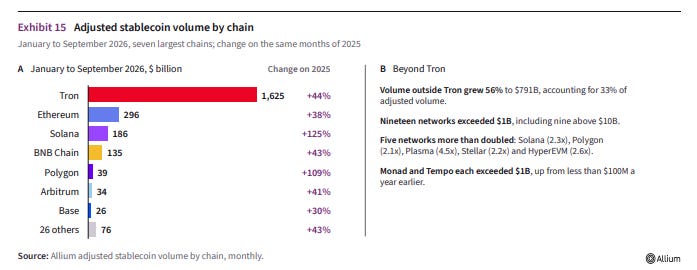
Adjusted stablecoin volume (removing non-economic activity) grew across all seven leading networks in the 9m to Sept 30 2026. While Tron still dominates with around 67%, its adjusted stablecoin volume grew 44% vs the 56% seen elsewhere.
Download Allium’s State of Stablecoins and Payments Q3 2026.
And get weekly onchain data and more analysis like this from the Allium Research team on Substack.
🌏 STABLECOINS AROUND THE WORLD 🌏
Assuming all goes to plan, there’s a new episode of Stablecoins Around the World dropping next week – for this one, I head south. More details to come!
Previous episodes:
Stablecoins in the UK with Rhys Bidder
Stablecoins in the EU with Marieke Flament
Stablecoins in Switzerland with Ian Simpson
Stablecoins in Brazil with Aaron Stanley
Stablecoins in Japan with Emily Parker
Some of the topics discussed in the recent premium dailies:
Coming up this week: elections, US jobs, big conferences
Binance: the resilience and the aftermath
Midterms prep: the races to watch and why, the timing, the potential market impact
The bigger lesson in electoral waves
The market reaction
Hong Kong: tokenized firsts in an evolving market
TMMFs and secondary trading: a blurring of boundaries
Ensemble: when boundaries expand and layers become more porous
RedCoin: hard boundaries changing shape
A new type of emerging market
Markets: a jug of ice water
Paraguay’s banking crisis
The deeper lesson in electoral waves
Well, that was quite something.
As I wrote yesterday, it was not clear as voting started that the Democrats would take control of the US Senate… but boy, did they ever. And they swept the House, doing better than even the most optimistic projections. And they won some key governorships. And, and, and…
The most resonant takeaway is the stunning rebuke of President Trump – inflation, the war, the aggressive support for data centres, the re-districting manipulation, the sense that the “common touch” that won him the election had been replaced by an obsession with reflecting pools and ballrooms.
It’s impossible to list here all the seismic shifts that redrew the US political map, but the ones that most stand out include:
The Democrats needed 218 House seats to control the majority – tallies are still coming in, but they’re already up to 228.
They needed to flip four Republican senate seats to reach 51 – so far, they have flipped seven, pushing the total up to 54, and there are still a couple of states yet to report.
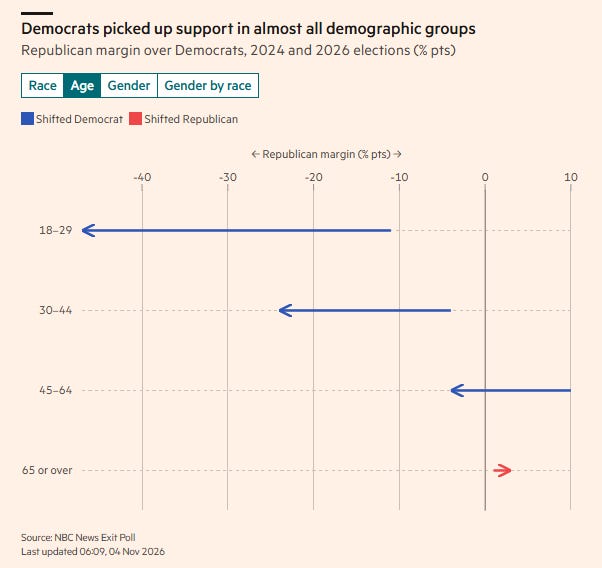
According to the FT, almost three quarters (72%) of 18- to 29-year-olds voted Democrat, up from just over half (54%) two years ago.
(chart via the Financial Times)
Texas has its first Democratic senator since the late 1980s – James Talarico is only 37 years old.
Gina Hinojosa becomes the first Democrat governor of Texas since 1991, and its first Hispanic governor ever.
Pastor Adam Hamilton becomes the first Kansas Democrat elected to the Senate since 1932.
With the win of paediatrician Annie Andrews, South Carolina will have its first Democrat senator since 1998.
Maine’s Republican senator for the past 30 years, Susan Collins, lost to Democrat Troy Jackson.
Both Iowa and North Carolina elected their first Democrat senators – Roy Cooper and Josh Turek – in 18 years.
The Republican House candidates lost in all the Florida districts the Republicans had re-drawn in order to boost their chances of winning.
There are so many more eye-opening anecdotes from last night… but enough wallowing in the drama.
In question now is what happens in Iran. Trump has said there are no immediate plans to strike, but he said the opposite a few days ago so who knows. The message that this war is resoundingly unpopular has been delivered, and there have been no military or strategic signs yet, eight months in, that it is winnable. Accepting that sooner rather than later could limit the damage to the Republican Party as attention turns to the 2028 election.
Flexing his renowned social media instinct, Iran’s Speaker of the Parliament took the opportunity to suggest that Trump was not serving the American people, and to remind them of the cost of escalation.

As for Netanyahu, it’s possible that Trump blames him for getting the US into the war in the first place. Yesterday – note the timing – Trump said that aid to Israel would end at the end of the year. It’s possible that by then Netanyahu is no longer Israel’s leader as the recent elections have not yet produced a clear winner, and his prospects just dimmed.
Also in question is the trade map – will beleaguered partners continue negotiations in good faith, or will they try to draw things out in the hopes the current momentum continues until 2028?
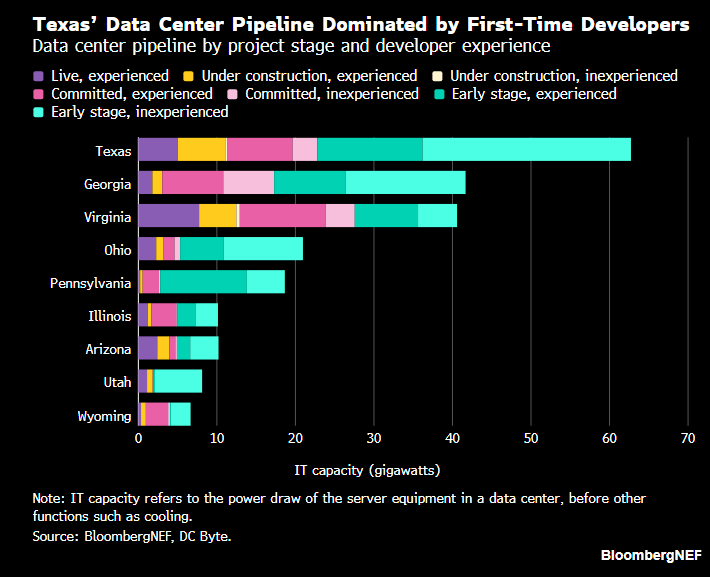
And the outlook for data centres ran into a reckoning. Among the crowd of things to vote on last night were 45 local ballots to on data centre construction: of the 34 fully counted by 6am ET this morning, 33 voted to restrict.
What’s more, the Democratic sweep in Texas is economically significant, given the state’s lead in planned data centre construction. One of the campaign promises of incoming governor Gina Hinojosa was an immediate moratorium on data centre permitting in the state.
(chart via @AnnaEconomist)
In Georgia, one of the fastest-growing data centre hubs, incoming Democratic governor Keisha Lance Bottoms has promised a temporary state-wide pause.
In Ohio, also one of the key US data centre hubs, incoming Democratic governor Amy Acton has promised a conditional freeze on new permits until requirements on union labour, environmental standards, community benefit agreements, costs and transparency are met.
None of this will bring data centre expansion to a halt – but it will add to the ongoing slowdown of planned growth, and should send analysts back to the drawing board on their earnings forecasts and studies of credit worthiness.
There’s a much bigger takeaway from yesterday’s results, however, that feels overlooked, both in the US and elsewhere. Peering past the post-election noise of popping champagne corks and angry pointing of fingers, we glimpse a fundamental feature of American life: the escape valve that is democracy, the opportunity it gives for peaceful change when a country wants it. The system worked yesterday, just as it has done every two years going back a very long time. This is one big lesson from the recent drama that I hope the whole world comes to appreciate just a little bit more: democracy is always under threat, from forces both obvious and invisible. And it is rarely perfect and should never be without challenge. But it works, and is worth fighting for.
If you enjoy these newsletters, would you consider sharing with friends and colleagues and nudging them to subscribe? I’d appreaciate it!

Paraguay’s banking crisis
Paraguay is not known for being a crypto “hot spot” – but that might soon change.
This week, one of its largest banks imploded, revealing weak controls and signs of outright fraud. Only, this bank has political connections, and its troubles have led to the swift impeachment and arrest of the country’s president and the resignation of the head of its central bank.
Some background:
In the early hours of Tuesday morning, when most citizens were asleep, Paraguay’s central bank announced the closure of Ueno Bank, one of Paraguay’s largest financial institutions and sponsor of the national soccer team at this year’s World Cup.
The official intervention came after months of rumblings about the bank’s substantial lending to businesses tied to its parent company. Later that day, police raided the mansion of the Miguel Vázquez, chairman of the bank’s controlling shareholder and one of Paraguay’s richest men – he is now in jail. Carlos Carvallo, head of the country’s central bank, resigned.
It gets messier. Carvallo used to be Ueno Bank’s CEO. He was appointed to lead the central bank by President Santiago Peña, who until last year was a shareholder in Ueno Bank’s parent company.
What’s more, Peña sharply increased government deposits with the lender. And allegations are circulating that his connections encouraged oversight of the bank to be more relaxed than for other institutions.
Peña resigned on Thursday, but that did not stop the lower chamber of the government from unanimously voting to impeach him. The Senate followed suit yesterday, which removes some of his legal protections. Paraguay’s public prosecutor has said it will launch a criminal investigation. And President Trump loses a key ally in the region. Deputy Secretary of State Chris Landau was in Paraguay last month, heaping praise on Peña and his governance.
The bank’s closure has left its 2.9 million clients – almost half the country’s adult population – unable to withdraw money, and the anger has spilled over onto the streets. Violent demonstrations over the past couple of days have been met with tear gas and water cannons.
Of course, the crypto community is out there with the “Bitcoin fixes this!” message. It doesn’t, really – Bitcoin can work as money when people agree it does, but most merchants and consumers are not there yet. What Bitcoin can offer is an alternative savings vehicle to those offered by opaque banks, and peace of mind in crises such as these.
Some reports breathlessly highlight how the price of one USDT in guaraní terms has surged, as if this was an indicator of higher stablecoin demand rather than just plain old currency fluctuations (one USDT costs more in local currency terms because the guaraní has dropped relative to the dollar).
I mean, demand will probably see an uptick as depositors in other as-yet unaffected banks are concerned that their institutions are also vulnerable, and they would rather transfer wealth to a crypto wallet. But I doubt the flow is enough to trigger a stablecoin price deviation, as the reports imply.
We are likely to see a pickup in crypto interest, however. Unfortunately, crises like these remind us all of the personal and societal cost of bank failures, and how vulnerabilities can go undetected until it’s too late.

HAVE A GREAT WEEKEND!
(in this section, I share stuff that has NOTHING to do with macro or crypto, ‘cos it’s the weekend and life is interesting)
I’ve often written here about the power of music to move. And I often share samples from photography competitions, because of their power to inspire. Sometimes, adding sound and visuals creates a new type of impact – it can give more power to a song, more meaning to what you’re seeing.
That’s how I feel about the below video. A good song, but not one I’d listen to, transfixed, were it not for the performance patched together from artists around the world. It’s reminiscent of the patchwork pieces artists would stitch together during the pandemic, when isolation made it impossible to gather for concerts or shows – I loved those, it felt like a deeper glimpse of what it means to collaborate on a performance.
I’m thrilled to see the idea is still around.
Perfomance for Change gives it a different twist: bring together different styles and backgrounds, and weave them into a song with a message. The below version is temptingly chaotic and visually scattered, but you can hear the common thread.
When you think about it, that’s the world in a song – different people, scenes, instruments, vocal styles, wanting to connect. Differences, held together by the common thread of humanity.
If you find this newsletter at all worthwhile, would you mind hitting the like button? ❤
DISCLAIMER: I never give trading ideas, and NOTHING I say is investment advice! I hold some BTC, ETH and a tiny amount of some smaller tokens, but they’re all long-term holdings – I don’t trade. Also, I often use AI for research instead of Google, but never for writing.