


Hi everyone! I hope you’re hanging in there and staying sane through the newsflow craziness…
You’re reading the free weekly Crypto is Macro Now, where I re-share a couple of the week’s premium posts as well as some non-crypto and non-macro links of interest.
💮 If you’re not a subscriber to the premium dailies, I hope you’ll consider becoming one? You’ll get access to market commentary as well as adoption insight and industry trends. Plus, links and music recommendations ‘cos why not… 💮
Production note: It’s Easter next week, so I’ll be taking a few days off and will miss publication of next Saturday’s weekly. Not gonna lie, looking forward to a break.
PUBLISHED IN PARTNERSHIP WITH: ✨ ALLIUM ✨
As traditional finance and crypto converge, trusted data is the missing infrastructure layer. Allium provides this data foundation for teams like Visa, Stripe and Grayscale.
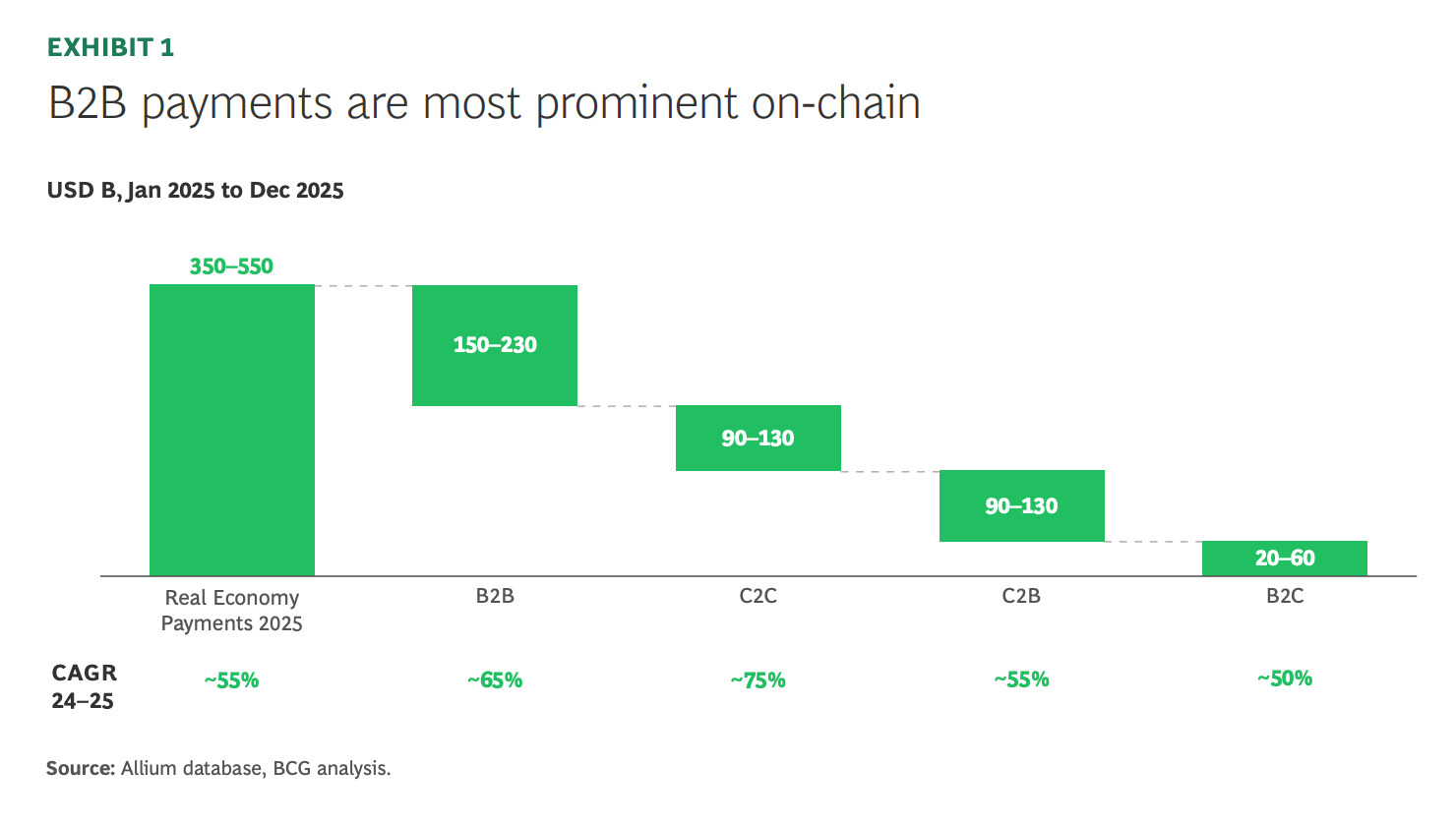
The latest whitepaper published with BCG, Stablecoin Payments: The Truth Behind the Numbers, examines how stablecoins are being used in the real economy today. The analysis estimates $350–550B in on-chain payments in 2025, led by $150–230B in B2B activity, with consumer flows contributing another $200–320B.
If you’re producing institutional crypto research or analytics, start with trusted data. Explore a live demo.
In this newsletter:
Trade fragmentation and digital currencies
Why audits are not boring
Assorted links: Belief capitalism, self-publishing, chill breaks, dinner parties and blockbusters.
Weekend: Blossom time!

✨ Use the discount code MACRO for 20% off!
Some of the topics discussed in this week’s premium dailies:
Coming up this week: economic health checks, G7 meeting, Japan inflation
Monday mood: It’s the reactions, not the reality
Market manipulation
Markets: getting weirder
The new map
Expanding the digital yuan
Stablecoin yield compromise?
Macro: about those rate cuts
A new stablecoin dashboard
Global fund managers: not so cheerful anymore
Why audits are not boring
Markets: new signals
Macro: the global health-check looks ugly
Trade fragmentation and digital currencies
Markets: getting more comfortable with volatility
Tokenized equities: the hype vs the potential
Markets: scepticism sets in
Trade fragmentation and digital currencies
When we say the tectonic plates of geopolitics are shifting, the metaphor has two implications, both different but nevertheless appropriate.
Over aeons, continental drift can move entire land masses across oceans, so smoothly the inhabitants barely notice the gradual climate change.
Or, tectonic plates can crash into each other, creating fire and brimstone and new mountains.
This split metaphor applies aptly to currency trends, specifically to the “dedollarization” many have been mumbling about – there’s the slow drift, and there’s the sharp shocks.
The seeds of the slow shift were sown in the unwinding of Bretton Woods II. To ensure global demand for its now-free-floating currency, the US negotiated with Saudi Arabia the pricing of their oil in dollars in exchange for maintaining security in the Middle East. Other Gulf countries followed and other commodities chose dollar pricing for FX convenience, which rapidly made the US currency the most liquid while US economic growth supported its value relative to others.
In the early 2000s, the world started to notice that the climate felt a bit different: the plates had been shifting. With strong growth in Asian economies and the discovery of American shale, the US was no longer the largest customer of Gulf oil. The emergence of new military powers further weakened the dollar-security relationship in the region, as Gulf states became closer to Pakistan, Russia and others, and the diversification of protectors as well as a greater drive for self-sufficiency accelerated as Saudi Arabia’s relationship with the US deteriorated under President Biden.
Against that background of slow drift, the past few years have brought some notable tectonic plate collisions in the global currency balance. There’s never just one particular starting point for a chain of events, but a strong candidate is the West’s reaction to the Russian invasion of Ukraine: seize Russian reserves held in European and US banks, use sanctions to isolate its financial system, and deny it access to international payments where possible.
Nations around the world were jolted out of their complacent assumption that the US would never weaponize the entire global dollar-based network.
Fast forward to the Iran war, which throws into sharp question the original deal of Middle East security in exchange for oil sales based in dollars, and you have yet another catalyst for a rewiring of trade rails.
Earlier this week, Deustche Bank published a report on the impact of the Iran war on dollar hegemony that is worth a read.
It notes that there are two main forces chipping away at the regional hegemony of the petrodollar, a key factor in global dollar demand.
One is to do with trading relationships. Over the past couple of decades, as I mentioned above, Middle East oil exports have been swinging away from the US and towards Asia.
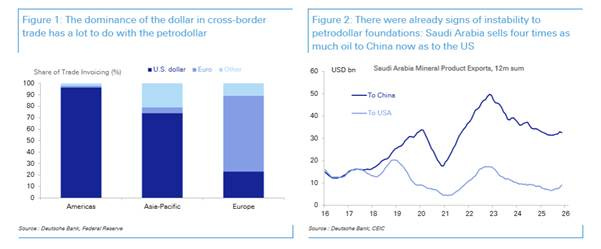
(chart via Deutsche Bank)
And reports that Iran is allowing some ships through the Strait of Hormuz if the oil is paid for in yuan highlight that it’s no longer diplomacy or security guarantees that ensure the smooth passage of oil; it’s now down to bilateral agreements which do not need dollar clearing. Iran has promised that, even after hostilities cease, the management of Hormuz will never be the same. It’s also unlikely that either Russia or Iran will ever go back to fully trusting US banks or payment rails.
The other key force the Deutsche Bank report highlights is the shift away from fossil fuels. This has been underway for decades due to concerns about climate change, but is likely to accelerate given renewed concerns about energy security. Not all nations are blessed with sufficient hydrocarbons in the ground; many will have to invest heavily in nuclear and other renewable grids.
This weakens the global dollar demand anchor provided by Middle East energy, and opens the door to new relationships and new payment pathways.
Strangely, the Deutsche Bank team only make one passing reference to the role that digital currencies are likely to play in this shift; they point out that Saudi Arabia is a member of CBDC platform mBridge, along with China, Hong Kong, Thailand and the UAE. But they don’t go further than that, even though a key plank of dedollarization is the underlying plumbing. Using traditional payment rails for global commerce generally implies touching the US-controlled SWIFT messaging system and relying on FX conversion that will often have a dollar leg. The mBridge platform is just one of the emerging alternatives that bypass those potential chokepoints.
Others include:
Saudi Arabia started exploring a digital rial back in 2019;
Russia is moving towards a phased national rollout of its wholesale CBDC in September;
India is due to propose a BRICS CBDC platform later this year;
China has “steady development” of the e-CNY as one of its goals in its latest Five Year Plan;
Europe is making strides on its wholesale and retail version, publicly declaring the goal of reducing dependence on US rails;
Reports surfaced earlier this week that the Reserve Bank of India (RBI) is talking to 4-5 central banks about cross-border CBDC transaction rails for both wholesale and retail use.
I could go on, and probably will in coming weeks, especially as CBDC and national stablecoin frameworks emerge – this is one of the reasons I started this newsletter three-and-a-half years ago. Hong Kong is due to announce its first authorized local stablecoins any day now, further cementing its role as the mainland’s financial and digital sandbox as well as a gateway to global financial markets.
The globalization efficiency of the past few decades is evolving into a more fragmented, bilateral trade map. Blockchain rails are one of the tools building this new world. Not only do they bring a layer of digital efficiency to bilateral trade resistant to third-party interference; but they also set a base for the development of new types of marketplaces for the exchange of tokenized assets, potentially deepening local liquidity and opportunity.
In sum, building payments plumbing resilience is a key step in the rewiring of global trade; it also sets the stage for growth in a more decentralized global market infrastructure and liquidity distribution.
✨ If you find this newsletter useful, would you mind sharing it with friends and colleagues and nudging them to subscribe? I’d appreciate it! 😃
Why audits are not boring
The news that Tether has hired KMPG, one of the “Big Four” accounting firms to perform an audit is much more than the boring administrative process it may seem. It plants a big flagpole for the entire industry, it signals stablecoin maturity and it fires the starting gun on big-name US stablecoin competition.
First, some details: according to Tether’s statement released earlier this week, the firm has engaged a Big Four auditor to complete the stablecoin issuer’s first full independent financial statement audit. Considering Tether’s vast network of subsidiaries, business lines, investments and asset types, that is going to be a mammoth task.
Of particular interest is Tether’s reserves, as not only are they a key component of user confidence, but also because over the years there have been, shall we say, “issues” with their reliability. That a big blue-chip name is taking on this challenge is a testament to just how far Tether has come in terms of institutional-grade respectability. It’s also a boost of confidence in the whole industry – if Tether can do it, so can others.
One of the reasons audits for reserves are so scarce is that the big names have traditionally not wanted to be associated with the “renegade” and (what did Gensler call it?) “non-compliant” crypto industry. Plus, for many, the requirements were still too vague: how do you value digital assets?
What’s more, auditors generally sign off on accounts being prepared faithfully according to established standards – until recently, there were none for digital assets.
Some big accounting firms would work with crypto companies but only if their names were kept out of any public statements - presumably they felt their association with “crypto” would make their other clients nervous. With deepening legitimacy of digital assets, the institutional embrace of stablecoins and a growing number of high-profile IPOs, that has obviously changed. Circle, for instance, uses Deloitte for its financial statement audits – but its reserves are still verified via attestation.
This has been the industry standard. Attestations are snapshots at a specific point in time that say “yep, the reserves are there”. Of course, they don’t vouch for the reserves being there the day after, nor that the issuer has robust management systems in place.
Now, it’s not totally clear, but Tether’s wording suggests that their auditor will also audit the reserves – the statement says that “audit firms conducted a comprehensive assessment of Tether’s systems, internal controls, and financial reporting”.
This highlights the key difference between an attestation and an audit – the latter doesn’t care about the snapshot as much as it cares about the processes and pipes: is this account used to only hold reserves? Who has access, who has oversight? How are issuance and redemptions handled? Does the company comply with KYC/AML regulations?
If, indeed, Tether is going full audit on the reserves, that’s a huge step for the world’s largest stablecoin issuer, and will go a long way towards reassuring global regulators that the firm’s patchy financial history is in the past (and I could write much about how, back then, finding any bank willing to service a crypto firm was an uphill struggle).
It’s also a threat to Circle, the world’s second-largest stablecoin issuer, which is seen as the “safe, regulated” US-based option. Tether launched USAT for the US-based market in January, it has powerful friends on Capitol Hill, plus an extensive global network and a broad portfolio of businesses to boost potential distribution. And now, it is working on reaching Circle’s level of institutional acceptance.
Presumably, Tether’s audit will also give it more robust systems certifications. System and Organization Controls (SOC) reports are issued by independent auditors to provide assurance as to internal controls – SOC 1 focuses on financial reporting; SOC 2 on non-financial aspects such as data storage, operational uptime, processing integrity, etc.; Type 1 reflects processes at a point in time; Type 2, more complete, validates processes over a period of time, usually 12 months.
Tether completed a SOC 2 Type 1 in 2024, and mentioned that work on a Type 2 was underway, but we have not yet seen confirmation of that. For its business, a SOC 2 Type 2 is the gold standard of institutional reassurance – Circle got its SOC 2 Type 2 in 2024, so while Tether is rapidly gaining ground, there is still some catch-up to do.
Still, the Tether audit news is a bigger deal than it may at first seem - it wipes away cobwebs of the past, it signals institutional stablecoin trust, it sets an example for the whole industry, and it plants a large competitor in Circle’s territory.
ASSORTED LINKS
(A selection of reads I came across this week that I think are worth sharing, not always about crypto or macro. I try to choose links without a paywall, but when I feel it’s worth making an exception, I specify.)
Kyla Scanlon introduces the concept of “belief capitalism”, in which narratives drive investment, and suggests that it is an extension of our desire for control over outcomes – our beliefs are up to us, whereas pesky fundamentals aren’t. She then puts that already explosive package on the toxic ladder of financial nihilism and how that plays on social disconnect, and sketches out how all this explains the success of “quick fixes”. A smart and original circling of headline trends that goes a long way towards making sense of the widespread confusion and unease, and that convincingly warns we are in the “distract with spectacle” phase of politics – us mere individuals are not the only ones that want control. (The Ozempicization of the Economy, Kyla’s Newsletter)
Part entrepreneurship, part the drive to create – the history of self-publishing is long and illustrious, launching the careers of writers such as Proust, Whitman, Tennyson and many others. Substack “democratizes” the concept by making self-publishing affordable – Ted Gioia would like to see it facilitate the production of books as well. (Montaigne and the Origins of Substack, The Honest Broker)
As someone who grew up in a household of frequent glamourous dinner parties and who has hosted a few herself (when I was younger and had the energy), Jemima Kelly’s report on her attempt to recreate the experience was thoroughly enjoyable. Dinner parties are about theatre and extravagance and choreography; they’re about bringing people together and lubricating spicy conversation with alcohol and great food, artfully presented. They’re exhausting, but fun, and Jemima’s right, it’s a pity the custom is dying out. (Can Jemima Kelly recreate Martha Stewart’s mythic midnight dinner party?, Financial Times – paywall)
This is perhaps not the best time to start dreaming of a far-away holiday, given looming fuel shortages and travel chaos. And anyway, spring is emerging in my city and it’s just breathtaking. But I must be feeling more frazzled than usual as this report from Bloomberg on “quiet” nature retreats in the Finnish wilderness had me almost weeping with longing. (The Arctic Getaway That Did Wellness Before Wellness Was a Thing, Bloomberg – paywall)
I’m off to see Project Hail Mary with family this afternoon, first time I’m actually going to the cinema (as opposed to waiting for the streamed version) in, oooo, I don’t remember how long. Author Andy Weir spoke to the NYT Book Review podcast about the book and the film and some other works, with anecdotes and confessions and more. (Andy Weir on Writing the Hit Book Behind the Movie ‘Project Hail Mary’, The Book Review – podcast episode)
If you find Crypto is Macro Now at all useful, would you mind hitting the like button down below? ❤ I’m told it feeds the almighty algorithm.
HAVE A GREAT WEEKEND!
(in this section, I share stuff that has NOTHING to do with macro or crypto, ‘cos it’s the weekend and life is interesting)
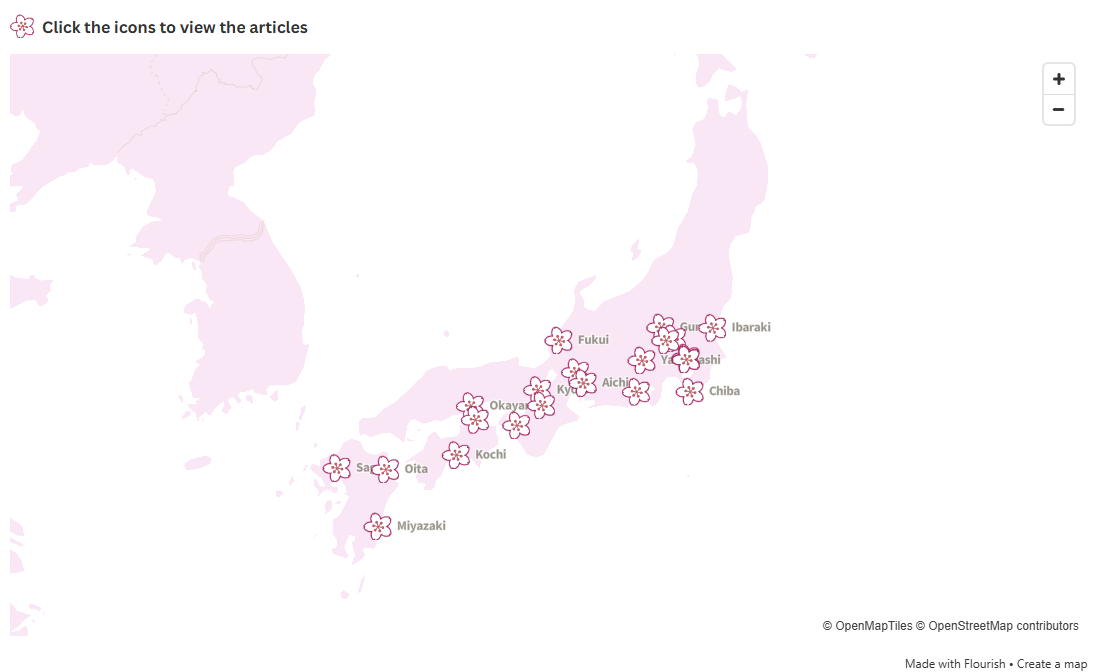
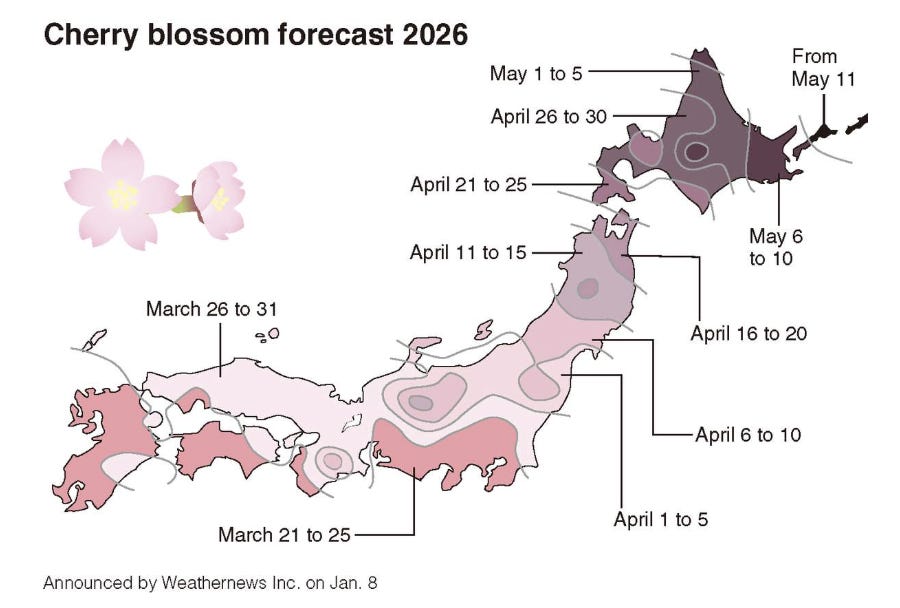
Cherry blossoms are one of the most poignant reminders of how fleeting and yet how soul-restoring pure beauty can be. In a lovely reminder of the value in its appreciation, the Japan News has an interactive map of where Japan’s cherry trees are blossoming right now, with links to articles about the flowering, updated as the season moves north. Refreshing simplicity.
(Screengrabs from The Japan News)

DISCLAIMER: I never give trading ideas, and NOTHING I say is investment advice! I hold some BTC, ETH and a tiny amount of some smaller tokens, but they’re all long-term holdings – I don’t trade. Also, I often use AI for research instead of Google, but never for writing.