


Hello everyone! I hope you’re all well and taking care of yourselves.
You’re reading the free weekly send of the premium daily Crypto is Macro Now, where I re-share one or two of the week’s posts and add some non-crypto and non-macro links since it’s the weekend. 🌼
This week, I was invited onto Bloomberg’s Crypto show – a smart team, such good questions. You can catch that here (I’m on in the last segment).
And I went on Scott Melker’s The Wolf of All Streets show to talk about macro and crypto and the SEC and stablecoins and more. Scott is always so easy to talk to. You can catch the recording here.
In this newsletter:
Who controls the money innovation narrative?
Assorted links: Deep questions, dinner party, phone-less travel, microphones
Weekend: Bond music
PUBLISHED IN PARTNERSHIP WITH: ✨ ALLIUM ✨
Most of the move in prediction market odds for a Democrat win in the Senate midterms came in two weeks: the week after US crude topped $90/bbl following strikes on Iran, and the week to Sept 17, when Democrats took the lead.
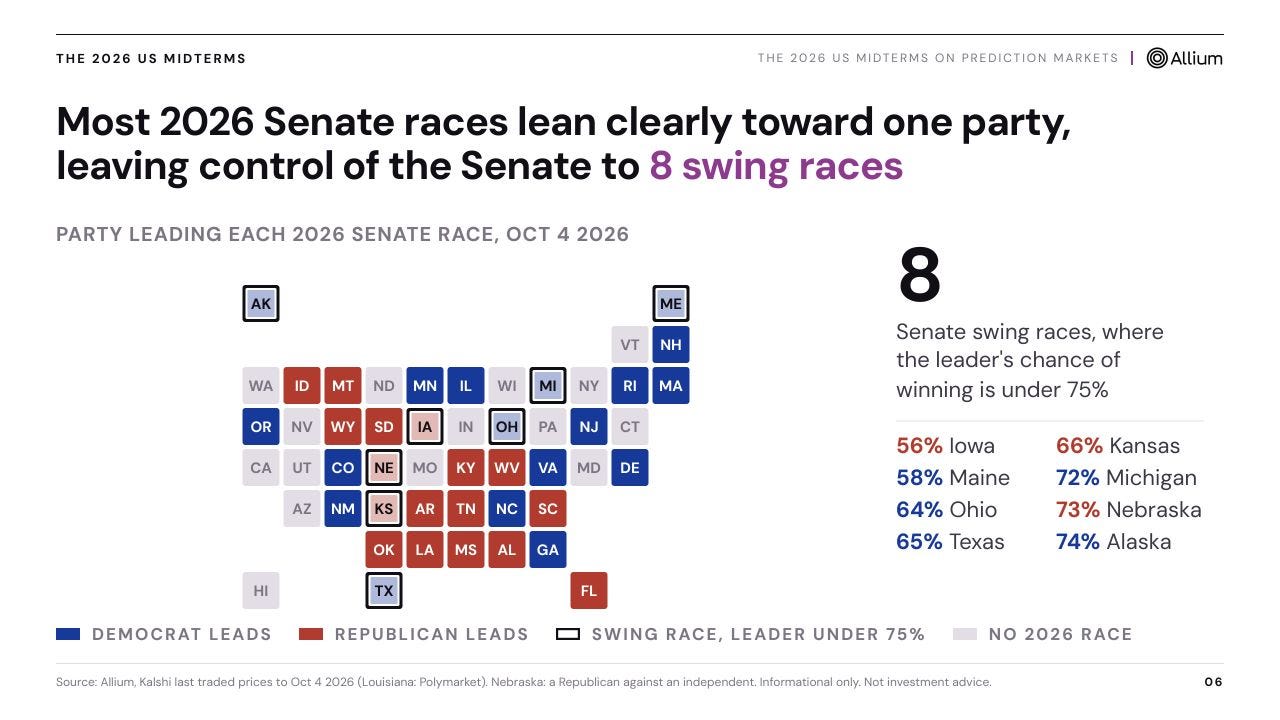
Full report: Prediction markets and a live read on the US midterms
Get weekly onchain data and analysis from the Allium Research team on Substack.
🌏 STABLECOINS AROUND THE WORLD 🌏
Since the last weekly, I’ve published episodes on:
Stablecoins in the EU with Marieke Flament, and
Stablecoins in Switzerland with Ian Simpson.
If you missed the recordings on Japan and Brazil, you can catch them here.
The next episode will be in a couple of weeks, and I’m leaving the chosen jurisdiction as a surprise, he he. 😊
I finally have distribution going on Spotify – I need to look into how to get an AI agent to handle all this for me, it’s finicky. Now working on YouTube uploads.

Some of the topics discussed in the recent premium dailies:
Coming up this week: lots of macro data
Who controls the money innovation narrative?
Global crypto: it’s not about the price
Term of the day: logarithmic scale
Stablecoins Around the World Ep. 3: the European Union
Highlights from the episode
EU stablecoin regulation
Main euro stablecoins
Coming up this week: quiet on the macro front
Macro: A self-fulfilling tension?
BTC: surprising resilience
BTC resilience: why, how and what next?
Video: Stablecoins in Switzerland
Notes from the episode
Stablecoin regulation in Switzerland
Regulatory timeline
A look-back: October 2022
Who controls the money innovation narrative?
One of the deepest lessons the crypto industry has taught me over the 12 years I’ve been swimming in these waters is that we have to question assumptions, however obvious they may seem. I used to work in traditional finance and I assumed I knew what money is – Bitcoin showed me that I didn’t. I’ve always thought that people will choose freedom over restrictions when offered – that was naïve. And I’ve trusted that efficiency-boosting innovation will transform creaky legacy structures – the jury’s still out on that.
This is front-of-mind these days because the now-parallel race between stablecoins and tokenized deposits is picking up.
What are we talking about?
For those of you new here (hello!), some basic definitions:
Stablecoins are tokens representing fiat currency on public blockchains – they hold their peg via 1:1 reserves held in safe, liquid assets denominated in the same currency.
Tokenized deposits are tokens representing fiat currency held in bank deposits, that can move on the bank’s distributed ledger. (I’ve written before about how they should be called deposit tokens rather than tokenized deposits, but here I’m going to respect the now-common form, grumbling as I do so.)
The differences between the two are legion. It’s not just that tokenized deposits are issued by banks and stay within banks, while stablecoins can be issued by non-bank authorized issuers and can move pretty much anywhere. It’s not just that tokenized deposits have, for now, limited functionality while stablecoins can fit into innovative applications active today as well as those that have yet to be invented. It’s not just that one has a legacy hue while the other wears the colours of disruption.
It’s also that tokenized deposits are traditional money on a new rail, while stablecoins are a new type of money – essentially tokenized assets that can substitute for fiat in onchain transactions. Tokenized deposits don’t change our idea of what money is; stablecoins do. (If you’re interested in more philosophy on this, and just how radical stablecoins’ use as money is, here’s what I wrote on the topic a couple of years ago.)
Why now?
The A vs B discourse is getting more interesting. A couple of weeks ago, Caitlin Long – founder and CEO of Custodia Bank, and a long-time advocate of decentralized networks (she was one of the first high-profile traditional finance people to embrace Bitcoin back in the day) – said on a panel at a Federal Reserve event that she thought tokenized deposits would eventually beat stablecoins in terms of volume and velocity.
She backs up her claim with reasonable arguments that I’ll get to in a second, but first, here’s why this surprised many of us. Caitlin is what we call a “crypto OG”, where OG stands for “original gangster” and is an affectionate term for those who have been in this industry since the early days, with consistent conviction. She is known for her courage, integrity and the battles she has fought against entrenched interests at considerable personal cost. Her firm is currently suing the Federal Reserve over the denial of its master account application – and yet she was invited to speak at its recent Philadelphia event, a sign of how much she is respected even by her supposed antagonist.
Put differently, her words carry weight because we can assume she has not been “bought” by the banks – I know I said earlier we should always question assumptions, but this one holds up.
Only, hang on, the company she founded, the one suing the Federal Reserve, is a bank.
But it’s not your typical bank. Custodia (founded in 2020 as Avanti) holds a Wyoming special purpose depository institution (SPDI) license – the legislation for which Caitlin was instrumental in passing – which means it can hold deposits but cannot lend. This new banking model, plus Custodia’s plans to offer crypto custody, appear to be the main reasons behind the Fed master account denial. But it takes a blinkered vision to hold up as a structural weakness Custodia’s lack of FDIC deposit insurance when that facility’s purpose is to replenish deposits that aren’t there because they have been lent out – if there’s no lending, there’s no need to replenish, and yet the Fed seems to regard that as a disadvantage rather than an advantage. Anyways… Custodia argues that the Fed applying subjective discretion to master account access should be seen as resistance to change and goes against the Congressional mandate.
Jumping forward, in June Custodia and Texas-based Vantage bank released the white paper outlining the design and functionality of the Hazel Network, an Ethereum-based platform that enables banks to issue Avit tokens backed by bank deposits. When used within the network, they reconcile as tokenized deposits, but they can also be sent outside the network, whereupon they automatically convert into stablecoins, which turn back into deposit tokens when they return.
In sum, Custodia has one foot in the traditional banking world and another in the stablecoin ecosystem – much like Caitlin hails from traditional finance but hopes to leverage new technology to modernize old structures. Change with, rather than against.
So, why does she think deposit tokens will beat stablecoins on eventual volume and velocity?
Size matters
Because traditional banking adopting new rails has a faster path to broad acceptance. Note that I didn’t say fast, but everything is relative, and banks not only have trillions of dollars waiting to be tokenized, with access to a deep pool of liquidity across the system, but they are also already networked via a vast web of back office connections.
What’s more, deposit tokens start off with consolidated regulatory clarity, whereas stablecoins still have question marks over property claims and redemption rights, even post-GENIUS. Institutions tend to prefer clarity over question marks.
And, she points out that banks are unlikely to ever embrace stablecoins as that would fund their own disintermediation. But most will end up involved in tokenized asset marketplaces, which will need onchain dollar settlement.
She’s not saying that stablecoins don’t have a valuable use or that they will disappear – she is pro-stablecoin. But she recognizes that deposit tokens start off with a considerable advantage, especially at the institutional market layer. So, her company created a platform to bridge the two token types.
The pace
Of course, stablecoins have been around for much longer than deposit tokens. For most of that time, they were not regulated and so became associated with criminal activity, a perception the ecosystem still struggles to shed today. The relative freedom, though, enabled them to power new forms of financial activity, reach savers who could not normally access dollars, and startle banks into considering updates to their creaking tech stack and complacent payments service. Furthermore, the pressure from US banks to suppress stablecoin utility now that they have come into the legal fold tells us that they are alarmed at the threat of disruption.
But stablecoin market cap growth has largely stalled, due mainly to a quiet crypto asset market.
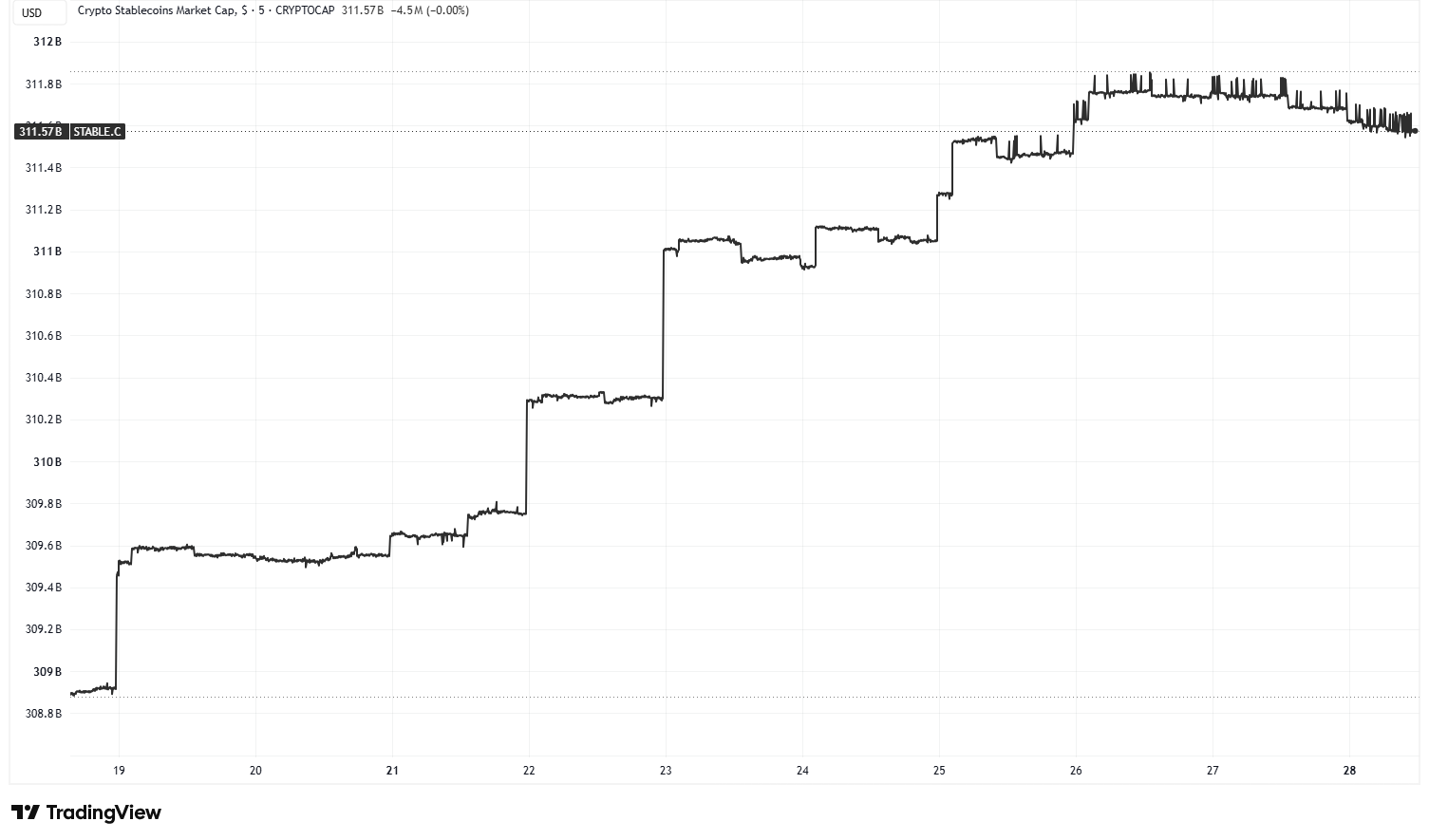
(chart via TradingView)
Meanwhile, recent headlines reveal that tokenized deposit development is picking up the pace. Over the past month alone, we’ve seen the following milestones:
Canada’s six largest banks announced a joint tokenized deposit initiative, barely a week after the country’s main banking regulator confirmed that tokenized deposits carry the same legal protections and obligations as traditional deposits.
Norway’s largest financial services group DNB and the Commercial Bank of Dubai have joined the German- Commercial Bank Money Token (CBMT) sandbox, initiated in 2021 by the German Banking Industry Committee to develop and test a cross-bank deposit token network. This brings the number of participating big-name global banks up to eight.
The Great British Tokenized Deposit initiative (yes, it’s really called that) – coordinated by industry body UK Finance with participation from Barclays, HSBC UK, Lloyds Banking Group, NatWest, Santander, Monzo and Nationwide – completed its first live customer transactions, using tokenized money to move funds between themselves.
The Clearing House – a US banking association founded in 1853, currently operator of the core US payment infrastructure – has chosen UK technology company Quant (also behind the Great British Tokenized Deposit initiative) to build its planned tokenized deposit network.
BNP Paribas and ABN Amro – two of Europe’s largest banks – joined the sandbox of the Commercial Bank Money Token initiative, confirming its expansion beyond German financial institutions.
Financial giants Citi (US) and DBS (Singapore) completed a weekend tokenized cross-border payment on SWIFT’s digital ledger.
Cari – a US tokenized deposit network servicing regional and community banks, with more than 30 institutions on board – raised $32.5 million in the first tranche of its initial funding round, entirely from banks.
And these are just the ones I saw, there are probably more.
The shift in rhythm does not confirm that tokenized deposits will “win” in terms of size. And I’m whole-heartedly rooting for stablecoins, as settling for regulated convenience may be practical but it limits potential. Tokenized deposits will bring enhanced efficiency and functionality to bank services, which is good – but it’s not a particularly exciting transformation.
Stablecoins, on the other hand, change how we think about money – it doesn’t just have to be a concept banks control, it can evolve into what we collectively want it to be. And the increased weaponization of access to bank money tells us that the concept has to change in order to remain resilient and useful.
Through my big-picture geopolitical lens, I don’t see tokenized deposits winning out. In the hyper-financialized US, perhaps. But on a global scale, innovation becomes a weapon unto itself, at a time when complacency has made giants weak and open-source tools fuel courage for those on the sidelines.
Either way, this race is not about which type of asset wins – it’s about who gets to control the marketplaces of tomorrow. Is it the incumbent banks, or is it the innovators? I’ll argue that there’s room for both, and we’re already seeing some convergence. And, of course, eventually the innovators become the incumbents, and a new cycle starts. Until then, we get to witness a narrative battle for the essence of money, carried out in code and rule sets and alliances and permissions.
See also:
How can deposit tokens be made more liquid? (July 2026)
How tokenized deposits could compete with stablecoins (June 2026)
Stablecoins, banks and innovation (May 2026)
Stablecoin rewards and bank deceit (Mar 2026)
The geopolitics of stablecoin demand (Nov 2025)
Stablecoins vs tokenized deposits: the philosophical conundrum (Sept 2024)

🌻 If you’re already a premium subscriber, THANK YOU! ❤
If not, I hope you’ll consider becoming one - you’ll get access to (almost) daily insight into how crypto fits into the changing geopolitical, monetary and financial landscapes. And, you’d make my day. 😊
ASSORTED LINKS
(A selection of reads I came across this week that I think are worth sharing, not about crypto nor macro. I try to choose links without a paywall, but when I feel it’s worth making an exception, I specify.)
Sigh. I’ve realized that I, too, don’t invite people around to dinner anymore. Pre-pandemic, it was a regular occurrence in our house. I love cooking, I have a big kitchen, I have fun friends. What I ran out of is energy, which is related to the time I spend in front of my computer. Gotta have a think about that. Anyways, Derek Thompson shares some jaw-dropping charts on how Americans entertain less at home these days, even though they spend more time at home. Reasons: 1) logistical stress, 2) other fun things to do at home, 3) shrinking social networks. (You Are No Longer Invited to Dinner – Derek Thompson)
Most of us don’t think about microphones at all, other than the occasional frustration in setting one up for a recording (that pesky cable…). This review by David Trotter of “Microphone” by Ralph Jones reminds us that we should, given their role in not just our messaging to the world, but also the world listening in on us. Sound is such an enveloping feature of life, and I am just now realizing how little I know about how it is captured, and how that has changed over the years. (A Fly’s Footfall – The London Review of Books)
For most of us, being dropped into an unfamiliar city without our smartphone navigator would probably trigger a panic attack, or at the very least spike anxiety to hand-wavy levels. But it used to be the norm, and people managed fine. Many even enjoyed the adventure of getting lost, it was part of the magic of travel. Thu-Huong Ha, writing for Bloomberg, tried to spend an entire weekend in Singapore with only a dumb phone, and found out first hand how hard it is to take a plane, coordinate with friends and order food without smart scanners, instant messaging and online forms. But he managed. (48 Hours in the City of the Future With No Smartphone – Bloomberg, paywall)
I mean, where to even start… This piece opens with questions about our chin – why do we have them, when most species don’t, not even earlier humans, and what evolutionary use to they serve? And that’s just the warm-up. It goes on to list deep questions submitted from 100 scientists, such as:
How many dimensions does it take to describe the formation and evolution of our universe?
What is curiosity?
Can environmental sustainability be achieved under capitalism?
Will we ever understand consciousness in a way that could apply to nonliving entities?
Why does the immune system in some people, and not others, control cancers and viruses?
How do humans create genuinely new concepts — not just random variations or recombinations of old ideas?
How did the building blocks of life, like proteins and nucleic acid, first organize into a living cell?
How does the human brain construct meaning from language, when so much of what we understand is not expressed in the words?
I could go on, the list is fascinating. (100 Unanswered Questions About Ourselves, Our World and Our Universe – The New York Times, paywall)
HAVE A GREAT WEEKEND!
(in this section, I share stuff that has NOTHING to do with macro or crypto, ‘cos it’s the weekend and life is interesting)
I’ll get back to the wallowing-in-nostalgia sharing of ‘80s TV show opening tunes, but the drama in bond markets has got me re-listening to my James Bond favourites. There are so many great songs assigned to the films, it’s hard to choose a short-list, but here are my top four:
Another Way to Die – Alicia Keys and Jack White
No Time to Die – Billie Eilish
Skyfall – Adele
Nobody Does It Better – Carly Simon
DISCLAIMER: I never give trading ideas, and NOTHING I say is investment advice! I hold some BTC, ETH and a tiny amount of some smaller tokens, but they’re all long-term holdings – I don’t trade. Also, I often use AI for research instead of Google, but never for writing.