


Hello everyone! I hope you’re all doing well, enjoying a smooth slide into autumn. 🍂
You’re reading the free weekly send of the premium daily Crypto is Macro Now, where I re-share one or two of the week’s posts and add some non-crypto and non-macro links since it’s the weekend.
If you’re a premium subscriber, THANK YOU so much! ❤
If not, do consider becoming one – for the cost of a weekly cup of coffee, you’ll get more regular commentary that filters the noise on crypto’s place in monetary and geopolitical realignment.
In this newsletter:
What is money? And why should we care?
Gold and the art of alchemy
Weekend: Nobody Speak
PUBLISHED IN PARTNERSHIP WITH: ✨ ALLIUM ✨
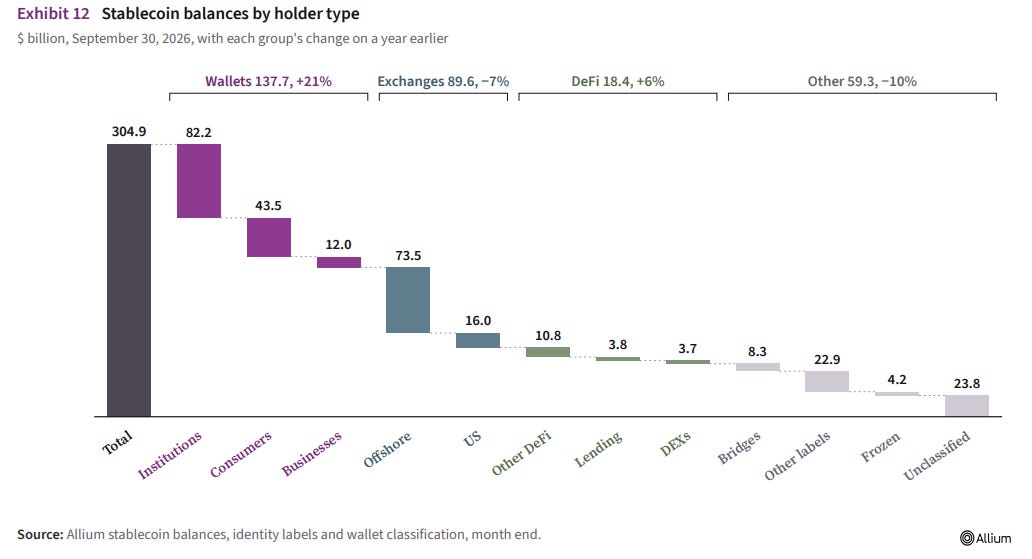
The amount of stablecoins held on exchanges at the end of September 2026 dropped by 7% year-on-year, while that held in wallets jumped by more than 20%, to 45% of the total circulating supply.
Download Allium’s State of Stablecoins and Payments Q3 2026.
And get weekly onchain data and more analysis like this from the Allium Research team on Substack.
🌏 STABLECOINS AROUND THE WORLD 🌏
Continuing the tour, this week I published an episode on Stablecoins in the UK, featuring Rhys Bidder – you can catch that here.
Previous episodes:
Stablecoins in the EU with Marieke Flament
Stablecoins in Switzerland with Ian Simpson
Stablecoins in Brazil with Aaron Stanley
Stablecoins in Japan with Emily Parker

Some of the topics discussed in the recent premium dailies:
Coming up this week: not much macro, but a lot of tech-money meetings
Euro strains and barricades
What is money? And why should we care?
The money hierarchy
The alternatives
Bitcoin: narratives and volatility
Some good reads
Video: Stablecoins in the UK
Notes on the episode:
Who regulates stablecoins in the UK?
What are the rules?
More on the BoE backstop
Markets: Treasuries are not a “safe haven”
Gold and the art of alchemy
What is money? And why should we care?
I mentioned last week that I had a stack of papers to summarize for you – this morning, I finally opened the first one, and it ended up being SO much deeper and more interesting than I expected.
It’s the kind of paper that’s worth reading more than once, even if you disagree with the premise, for the new paths it carves in how to view the global monetary system and the relationships it relies on.
Written by Iñaki Aldasoro of the BIS Monetary and Economic Department, the paper’s title is “Money and the architecture of trust”. It takes a run at the conventional definition of money, and in so doing, highlights the evolution and societal role of both the incumbent monetary system, and those which hope to disrupt it.
The main premise is that money is not a thing, nor is it a technology: it is a system. Back in my more naïve new-money days, I suggested that anything could be money if we decide it is – but now I realize that scalable acceptance requires trust which requires structure which requires time and testing. Not a thing, a system. But what Iñaki sees as a definition, I see as a perimeter – more on why below.
The money hierarchy
Iñaki makes the key point that the concept of money relies on the assumption that what is accepted as such today, will be accepted as such tomorrow (else, what can I do with the money I receive today if I can’t use it tomorrow?). For this, it does not matter what form the money takes; what matters is the system of assurances around it.
But this is not a static system – it is constantly wrestling with four main tensions, and the balances at any given point in time affect how the system behaves.
Let’s look at them in turn, and then at what they imply for stablecoins, Bitcoin and gold.
Money vs credit
For many monetary theorists, money is credit in that it embodies a future transaction, it is essentially an IOU, someone’s liability: the act of payment converts one obligation into another of a different type.
Iñaki goes deeper, separating the two concepts: money is settlement, credit is a promise. Both exist at movable points in a hierarchy that has grown up around them.
When trust is high and credit ample, the distinction fades into the background and the hierarchy becomes more fluid. But when trust breaks, the ability to settle is worth much more than promises, and the ultimate settlement asset becomes that which rests at the top of the structure: money issued by the central bank.
But today’s payment rails flow at lower hierarchy levels, making them more credit-like than money-like. When we make a payment via our bank, it isn’t money that is changing hands – it’s balances on a ledger that reflects offset claims. After all, if trust in the system were to break, our bank would probably not be able to make digital payments on our behalf. Cash (= central bank money in physical form) would be king.
Elasticity vs discipline
Credit is elastic in that it can be expanded. But its expansion is constrained by the availability of money, which represents discipline. Eventually, a promise will have to be satisfied with money, which will depend on either its availability, or the supply of more credit which only delays the reckoning.
When a system is in expansion, the layers of credit are treated as interchangeable, and a promise to pay is as good as payment. This weakens the importance of final settlement and also the discipline it imposes. In a contraction, this goes into reverse, and the “moneyness” hierarchy matters a lot.
Private vs public
At the top of the hierarchy of money and credit sits the central bank, the ultimate backstop to monetary value and the guardian of par.
We often hear about the Federal Reserve’s dual mandate of price stability and full employment – but an even more significant mandate is to maintain trust in the system. It does so by enabling private initiatives to power monetary expansion via bank loans, money market funds, non-bank financing, etc., while supporting this economic growth with trust in the ultimate settlement asset: central bank money.
Iñaki makes the fascinating point that enduring trust in new forms of money – Eurodollars, money market funds, possibly stablecoins – is only won through crisis and rescue by the central bank. This is never guaranteed and usually comes with conditions (if it were free and always assured, it would be meaningless): but it is essential for absorption into the money system.
Essentially, trust in the central bank backstop is what enables crises to be unwound, not just from the necessary assumption that any dollar is worth a dollar (par), but also from the institution’s ability to supply settlement assets when needed.
This liquidity creation is key. When it comes to settling debts, convention emphasizes solvency, or net worth, which relies on accounting and is more abstract than practical. What really matters is liquidity, which means a payment can be made, whether the payer is solvent or not. And in times of contraction, central bank liquidity becomes the ultimate trusted settlement asset.
Domestic and global money
The hierarchy of money does not stop at a nation’s borders – there is a global hierarchy, too. At its top sits the dollar, the world’s premier reserve currency. Then comes the currencies of other major economies who typically have standing swap lines with the US Federal Reserve. Then the currencies of emerging economies who have to contend with more limited facilities. Then developing economies, with even more constrained access to the global system.
Yes, this looks very much like the domestic hierarchy outlined above, with currencies moving from less robust up to the pinnacle, the dollar, whose issuer decides who has access to ready liquidity from the ultimate settlement asset (echoing central bank validation of privately issued monetary assets lower down in the domestic hierarchy).
The alternatives
Right, so money is not a thing nor a technology, it is a system, and that system has a hierarchy that is sometimes rigid, sometimes more flexible, but always has central bank-issued settlement assets at the top. Cash, or its digital equivalent, is king – but all the other layers oil the wheels of civilization because of trust. It works because a web of institutions do what they must to ensure we believe it works.
Only, there seems to be growing interest in assets that don’t need the same complex trust machine. Let’s look at those.
Gold
Where does gold fit into Iñaki’s framework? Bottom line, it doesn’t. Gold cannot be used to pay for things, and nothing is priced in gold. Its value arises from the fact that it is no-one’s liability. Trust in the “system” of guarantees is not needed, there is no backstop.
Iñaki’s stance is that this isn’t an advantage, it’s an exit. The implication is that is not good for society.
Money, he argues, embodies a social compact. A climbing price of gold suggests that confidence in that social compact and its backstop is starting to wobble.
“Gold, in this sense, is not a monetary alternative, but a monetary protest.”
My initial reaction to that sentence was that they are the same thing, but on reflection, Iñaki nails the distinction – an alternative has more utility than a protest. His point is that gold is a shiny lump, it can never be used for payment because it lacks the credit system that supports liquidity. A counterargument could point to the layers of liquidity emerging around tokenized gold (I’ll be writing more about this in coming weeks) – but this replaces one system with another. A new, emergent hierarchy, if you will.
My preferred pushback is that gold doesn’t need to be money – it just needs to hold its value relative to money better than other goods.
Bitcoin
Bitcoin, Iñaki argues, is similar in that it “aspires to be money without the architecture that makes money work”.
The main problem, apparently, is that there is no tap that can be turned on (elasticity of credit) when expansion is warranted, and off (supply constraints) when an economic slowdown is called for. On that, he’s correct.
However, as with gold, here he is assuming that Bitcoin needs to be “money”. True, the tokens are referred to as such in the white paper, but Satoshi was relying on a different definition of money than Iñaki’s “system”. And those that insist Bitcoin will replace all the world’s fiat are mercifully quiet these days.
Another point Iñaki makes on why Bitcoin can never be money, which can extend to other crypto assets, is that you can’t unbundle payments from the underlying system. If money settles payments, he argues, you can’t have one without the other. This comes at the question of why payments have to be based on credit without actually answering it – and it falls into the logistical trap of assuming that “if A then B” means “if B then A”. Money is settlement; but settlement doesn’t have to be in money. The discharge of an obligation (= settlement) can be in Bitcoin, gold or carrot cake if the counterparty is ok with that.
We can agree that Bitcoin is outside the system and therefore can never fulfil the society’s need for credit, liquidity and scalable settlement assets. But that doesn’t mean it can’t be used for payments. And, like gold, nor does it need to be to have value.
Stablecoins
Stablecoins, on the other hand, occupy a different position in the “system”. While often touted as an “alternative” (often by those who overuse the word “revolutionary”), what they really are is a new representation of establishment money. Iñaki argues that they occupy the same space as gold and Bitcoin in that, being fully backed, they also want to squeeze credit out of the monetary system – with less credit, less trust is needed. But here, also, he puts the logic blocks in the wrong order.
Unlike gold and Bitcoin, stablecoins don’t have value because of distrust in the system. Rather, the promise of full backing is more an offset to the fear of new technologies than an intrinsic value proposition. It’s been a long time since I heard proponents rely on the argument that stablecoins are “safer” than dollars – the selling point is that they are a better payments technology, with some innovative programmability features.
Wrapping up
In sum, this was a fascinating look at the hierarchy of trust in today’s monetary landscape. Iñaki understands money better than anyone outside a very small group. He writes well. And he does show a high level of familiarity with the onchain world.
But in any critique, we do have to take into account the lens through which the writer sees the world. Iñaki is the Principal Economist for the Monetary and Economic Department at the BIS, the central bank’s central bank, where he has worked for the past 10 years. Before that, he worked and consulted for key systemic institutions. This implies both expertise and inherent preference.
After all, the BIS has never been a fan of Bitcoin, and only came around to giving stablecoins a more equitable academic treatment once they realized the industry was growing fast without their support.
The goal of the paper, I assume, was to contrast the scalability, flexibility, utility and resilience to shocks with both long-standing as well as emerging alternatives. After all, we wouldn’t want people thinking the growth of interest in alternatives was a sign of weakening trust in the system, now would we?
And Iñaki does make some excellent points about inflated crypto promises and hyped solutions to problems that aren’t problems. (“Inherent preference” is often much more egregious coming from the crypto side.)
Iñaki is right in that Bitcoin and gold are not “money” in the traditional sense, but nor do they need to be. He’s also right in that stablecoins do not escape the hierarchy of the traditional system – but nor do they want to, their measure of success will be how well they integrate into it.
Bottom line, it is fair – healthy, even – to be sceptical, especially of an industry known for its unrealistic promises. But it is risky to assume institutions and systems based on trust will always be resilient. Once upon a time we assumed a well-constructed giant ship would always sail. We didn’t account for hidden icebergs.
Gold and the art of alchemy
Earlier this week, San Francisco-based energy technology startup Marathon Fusion announced that it had successfully turned mercury into gold.
A couple of years ago, I was explaining to a friend why I though Bitcoin was a better hedge against monetary mayhem than gold, as we know there will only ever be 21,000,000 but we don’t know how much gold there will be – not just from increasingly sophisticated and affordable mining methods, but also because it would one day be possible to make gold by rearranging atoms. My friend scoffed and refused to believe that science would ever get there, so I am feeling somewhat vindicated – but, before any of us do any gloating at all, we should be aware of some mitigating details.
Of course, claims of alchemy have rung through the ages, promising riches to all who could front some development funds. Is Marathon Fusion’s scientific result as fake as all of those, or did they succeed where thousands have failed?
I’m not a physicist, but it looks real. Before you sell all your gold holdings, however, there are nuances to the announcement.
The startup’s goal is to develop fusion power plants that can then produce a range of isotopes for nuclear medicine at greater scale than conventional methods. A mightily worthwhile goal, but an expensive one.
Unless you can make gold in the process to help offset the cost.
It turns out that is possible. Fuse hydrogen, deuterium and tritium and you kick out a neutron moving so fast it can knock another neutron loose from a mercury-198 atom. This then becomes mercury-197, which over a few days will decay into stable gold. (I’m simplifying here, and leaning heavily on Grok and Gemini.)
Only, because of its atomic change, the resulting substance is radioactive, and will need to be stored for roughly 10-17 years before it can be handled.
And, for now, it’s not an economically viable proposition as the fusion neutron could be used more profitably for other products – as mentioned above, the goal is medical isotopes, much more valuable than gold. Even using the neutron for generating electricity will create about the same value as using it to create gold.
Also, the demonstration was small-scale, and we don’t know much about the yield, efficiency, etc.
But still, it’s a fascinating breakthrough. One day, the process could generate enough gold as a by-product to improve the financing outlook – but that would need larger machines which are many years away yet.
Bottom line, the impact on the gold market is negligible, at least for the next few decades. A much bigger deal is the potential impact on medicine – cheaper cancer diagnostics and therapies will not only improve quality of life and life expectancy for millions, they will improve economic growth by enabling more people to contribute for longer. Hats off to the Marathon Fusion team for getting this far.
So, if this week’s dip in the gold price is at all because of supply fears, it’s likely to correct once the story becomes better understood.

HAVE A GREAT WEEKEND!
(in this section, I share stuff that has NOTHING to do with macro or crypto, ‘cos it’s the weekend and life is interesting)
This song/video from DJ Shadow and Run the Jewels is not exactly new – it was released in 2016 (hard to believe that was 10 years ago!!) – but it feels new, and lamentably appropriate for our times.
If you find this newsletter at all worthwhile, would you mind hitting the like ❤button?
DISCLAIMER: I never give trading ideas, and NOTHING I say is investment advice! I hold some BTC, ETH and a tiny amount of some smaller tokens, but they’re all long-term holdings – I don’t trade. Also, I often use AI for research instead of Google, but never for writing.