


Hey everyone! I hope you’re all doing well and taking care of yourselves – December is always manic, but there’s so much to enjoy, so do conserve your stamina.
🎀
My latest op-ed for American Banker (Here’s what is really behind all these stablecoin ‘risk’ reports – paywall, sorry) suggests that global institutions aren’t as worried about “risk” as they are eager to plant their risk-preventing stakes in the ground.
🎀
On Wednesday, I had a great chat with Maggie Lake on her show The Market House – if you’re not a subscriber to her Substack channel, it’s a strong recommend, not just for the economic and market insight she delivers every other day, but also for her humanity.
PUBLISHED IN PARTNERSHIP WITH: ✨ALLIUM✨
As traditional finance and crypto converge, trusted data is the missing infrastructure layer. Allium provides this data foundation for teams like Visa, Stripe and Grayscale.
Our latest whitepaper published with Visa, Stablecoins Beyond Payments: The Onchain Lending Opportunity, examines how banks can access emerging credit markets, as stablecoin lending volumes reached over $50bn in August 2025.

If you’re producing institutional crypto research or analytics, start with trusted data. Explore a live demo.
In this newsletter:
The CFTC opens big crypto doors
Hashkey and China’s crypto “clampdown”
India: a CBDC-friendly stablecoin
Assorted links: themes, frustrations, ideological capture, history books and high-seas adventure.
Weekend: books of 2025
If you’re not a subscriber to the premium dailies, I hope you’ll consider becoming one? You’ll get access to market commentary as well as adoption insight and industry trends. Plus, links and music recommendations ‘cos why not…
🎀 If you speak Spanish and are interested in a less frequent, shorter update on developments in the crypto-macro intersection, you can subscribe to Cripto es Macro here. 🎀
Some of the topics discussed in this week’s premium dailies:
Coming up this week: FOMC, economic data
The global shift and why it matters for crypto
Markets: a notable divergence
Macro: yawn
The CFTC opens big crypto doors
Hashkey and China’s crypto “clampdown”
Markets: steepening and YCC
Macro: consumer blues
India: a CBDC-friendly stablecoin
Digital euro: legislative positioning
Macro: JOLTS
Markets: not the Fed you know
The FOMC’s overlooked message
Markets: So, what next?
Markets: crypto liquidity
Macro: soft wage inflation
The CFTC opens big crypto doors
You have to hand it to Caroline Pham. She is currently Acting Chairman of the US Commodity Futures Trading Commission (CFTC), and has been the only remaining sitting Commissioner since September. Yet, despite announcing her intention to leave as far back as May, she has managed to get a lot done, as we are seeing in a flurry of announcements over the past couple of weeks. This is no mean feat – any official announcement from a government agency only comes after an unimaginable amount of pushing and pulling. And while she no doubt has a competent staff, she pulled this off as the sole Commissioner.
In late November, she put out a call for crypto CEOs to form part of an innovation council. The interest in industry input is especially relevant given the enhanced oversight role for the agency proposed in the crypto regulation bills currently working their way through Congress.
Then, last week, Pham confirmed that spot crypto assets can now trade on CFTC-registered derivatives exchanges. Binomial is first out of the gate to actually do so with trading expected to start this week, but we can be pretty sure others, including the CME, won’t be far behind.
This is a big deal:
1) It puts spot crypto and their futures contracts on the same platform. This makes it much more efficient to either hold and hedge, or play the basis trade (once it becomes attractive again). For instance, reports have been circulating that the CME is looking into listing spot crypto – if/when it does, this would further open up the market as most US asset managers and many international ones have accounts at the exchange, and would seamlessly be able to take advantage of this efficiency, potentially bringing in new macro funds to the crypto market.
2) The move offers all investors, not just institutions, a better crypto trading experience – reasonable leverage, more transparent order books, cleaner routing, and the reassurance of oversight.
3) It sends a signal to all that federal regulators are greenlighting crypto market participation. This is astonishing for an asset group that just a few years ago was both fringe and radioactive for regulated institutions.
4) It also sets an intriguing stage for Coinbase to combine spot and derivatives, potentially boosting the volumes for both – so far, Coinbase’s spot crypto exchange has had to rely on state-by-state money transmitter licenses for authorization. Going forward, it will be able to self-certify crypto assets for trading with federal oversight, while creating new products and strategies for platform users. This will be especially relevant for scale when it launches Deribit in the US – Coinbase bought the crypto market’s largest options exchange for $2.9 billion earlier this year.
And then earlier this week, Pham announced a pilot program for BTC, ETH and USDC to be used as collateral in derivatives markets. The CFTC also issued a guidance on how tokenized assets such as treasuries and money market funds can be used as collateral. What’s more, it removed a previous guidance that specified crypto collateral could only be used for same-asset contracts.
The new measures further open up crypto asset market utility and efficiency. Blockchain-based assets are a much more agile and transparent form of trading collateral than traditional assets. And we can expect to see new types of products and strategies emerge from derivatives platforms in coming months, leveraging smart contracts, inherent connectivity (different types of products running on the same rails) and settlement efficiency.
Meanwhile, the Senate vote to confirm Mike Selig as CFTC Chair could come this week, although I haven’t seen any definite announcements on the timing. Once Selig is in place, Pham will be able to finally make her exit. Let’s hope she gets a good holiday before joining the private sector – she’s earned it, along with our respect.
🎀 If you find these newsletters interesting, would you mind sharing with friends and colleagues, and nudging them to subscribe? I’d really appreciate it! 🎀

Hashkey and China’s crypto “clampdown”
Here’s another example of how the supposed “clampdown” from the Chinese authorities on digital assets, isn’t really a clampdown.
I wrote last week about how recent reminders from the People’s Bank of China (PBOC) and other regulatory bodies about the illegality of digital asset trading were more about dampening speculation (an important pillar of the increasingly urgent move to stimulate meaningful consumption) than about stopping digital asset activity.
I’ve also written about how China is exploring and using stablecoins, and how it sees Hong Kong as a testbed for what crypto regulation could look like.
This week, Hashkey – operator of Hong Kong’s largest licensed crypto exchange – starts accumulating orders ahead of its December 17 listing via IPO on the Hong Kong Stock Exchange. It is aiming to raise around HK$1.67 billion (~$213 million) by offering 240.6 million shares at roughly HK$5.95-HK$6.95, which would value the exchange at roughly HK$19 billion (~$2.4 billion).
According to the South China Morning Post, retail bookbuilding on online trading platform Futubull at the end of the first day had already attracted interest for around 25x the number of shares available. The platform expects the retail tranche to end up more than 50x oversubscribed.
This may sound like a lot, and it is, but it’s apparently normal for Hong Kong IPOs – the retail tranche of the recent CATL listing back in May was more than 150x oversubscribed (the institutional tranche less so, only 15x). Even with this strong interest, CATL closed only 16% higher on its first day of trading.
While the retail book no doubt will end up containing many “whatever” orders from those who don’t care what the company does but want to bet on a first-day pump, the interest does signal investor optimism about the market’s outlook despite PBOC statements. In other words, investors expect greater crypto trading volume in coming months, which would not be the case if China was contemplating a “clampdown” on anything other than over-hyped froth.
See also:
· China and stablecoins: there’s more (Dec 2025)
· China and stablecoins (Dec 2025)
India: a CBDC-friendly stablecoin
With so much stablecoin bustle in the US and now increasingly in Europe, we’re missing some intriguing developments over in Asia.
Last month, it was revealed that India is working on a regulated, rupee stablecoin. When I first read the news, it threw me – how can the country have a regulated stablecoin with no stablecoin regulation? It turns out that’s not necessary if you have the right approvals.
Blockchain infrastructure developer Polygon is working with digital asset technology firm Anq to produce a stablecoin under the direct supervision of India’s central bank (RBI). Known as ARC (Asset Reserve Certificate), it will be backed 1:1 with government debt and fixed deposits.
The aim is to stem the inflow and use of dollar stablecoins, especially for crypto asset trading and cross-border payments.
But wasn’t the digital rupee CBDC supposed to do that?
Well, who knew, it turns out that a central bank instrument has more inbuilt rigidity than a private sector token. It can offer programmability, but limited, and each new feature requires consultation as well as possibly a public comment period. Issuance, obviously, can only be by the central bank. Distribution is only through partner banks. The digital rupee won’t be usable on decentralized applications and will have to be careful which crypto platforms it onboards, if any.
A private token, on the other hand, will have much greater flexibility in terms of programmability and use cases, plugging with greater ease into platforms and decentralized applications to boost utility and yield. It can be issued by a wide range of approved participants, further diversifying potential use cases.
Only, in the absence of a regulatory framework, private stablecoins can carry more risk than officials are comfortable with.
ARC seems to be a compromise: a privately issued token, with RBI oversight. The developers have been working closely with central bank officials to make sure it complies with KYC/AML requirements and capital controls.
Plus, demand for ARC will also be demand for India’s government debt.
So, India is not getting a free and open public rupee stablecoin backed by safe assets – but it’s tiptoeing in that direction. There will be limits on ARC’s use, but they will be much thinner than those on the CBDC. Of course, a risk is that the token becomes smothered with too much regulation, leaving an unsatisfied demand for greater utility that ends up finding less regulated, higher-risk solutions.
What most intrigues me is how this will impact the role of the digital rupee. It looks like ARC will become the public-facing rupee token for retail and many business applications, while large payments, corporate use and interbank transfers will be handled on the CBDC layer. This sounds much like the two-tier system of modern banking: commercial bank money for everyday use, central bank money for large movements and ultimate settlement.
There are still questions: ARC will have RBI oversight, but will the token be regulated as a payment instrument, or a security? Will the market regulator get involved? Can non-residents hold the token? This will be key for cross-border utility – can trade settlement in ARC occur offshore? What would this do for redeemability?
Still, this is worth keeping an eye on. As far as I’m aware, it will be the first state-authorized by privately issued stablecoin designed to work with a CBDC. Launch is expected in early 2026, limited at first to institutional and corporate use with a retail-facing launch expected to follow. It could end up being a disappointingly closed network, or maybe we’ll see decentralized applications emerge to support the development of a lively ecosystem. Let’s hope – it would be an encouraging example to set.
ASSORTED LINKS
(A selection of reads I came across this week that I think are worth sharing, not always about crypto or macro. I try to choose links without a paywall, but when I feel it’s worth making an exception, I specify.)
Derek Thompson covers, well, I think everything. This post is impossible to summarize, so I’m not even going to try, but I can assure you there’ll be something in there that gets you thinking, or at the very least drives home just how interesting today is. (The 26 Most Important Ideas For 2026, Derek Thompson)
Kyla Scanlon offers a sweeping vista of economic malaise, social frustration and how the escape valve is not gambling. (Everyone is Gambling and No One is Happy, Kyla’s Newsletter)
I have not read “The Technological Republic”, co-authored by Palantir CEO Alexander Karp and colleague Nicholas Zamiska. So I share this somewhat harsh critique by T. Greer not as a statement on my view of the book, but as a welcome pushback to what seems like breathless groupthink around its profound insights, which – from what I gather – seem to be mainly that Washington DC and Silicon Valley should merge. More than ever, we seem to imbue new technologies with an ideological purity they just don’t have, and so I share this piece with the intention of encouraging questions around what kind of values we want politics to have, and where a narrow techno-centric view fits into that. (Book Notes: The Technological Republic (2025), The Scholar’s Stage)
Much to my dismay, I don’t have a good enough memory to be a history buff. I love the stories, though, and the overlooked relevance, and have vowed to become obsessed with history from all ages when I reach old age (which of course is ages away, of course). I also love book recommendations, and so here are 10 history books worth considering. (10 Favorite History Books I Read in 2025, History Does You)
The Wall Street Journal reported on how Nobel Peace Prize Winner María Corinna Machado’s snuck out of Venezuela to make it to Oslo – a hair-raising escapade with a happy ending for a brave woman. (Rescued at Sea: How Venezuela’s Machado Survived the Riskiest Leg of Her Escape, Wall Street Journal – paywall)
HAVE A GREAT WEEKEND!
(in this section, I share stuff that has NOTHING to do with macro or crypto, ‘cos it’s the weekend and life is interesting)
As we are approaching the holiday wind-down, I’m going to share some of my “best of 2025” lists covering reading, listening and viewing, spreading them across the next couple of newsletters before I take some time off for family and festivities.
Today, books, limiting myself to three per category.
Books: non-fiction
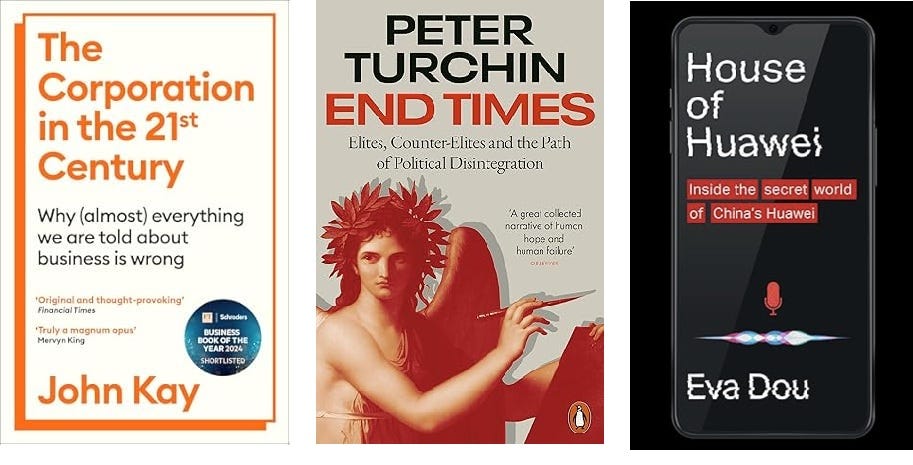
The Corporation in the Twenty-First Century: Why (almost) everything we are told about business is wrong – John Kay
End Times: Elites, Counter-Elites, and the Path of Political Disintegration, by Peter Turchin
House of Huawei: The Secret History of China’s Most Powerful Company – Eva Dou
Books: fiction
Down Cemetery Road – Mick Herron
The Princess Bride: S. Morgenstern’s Classic Tale of True Love and High Adventure – William Goldman
Anxious People – Fredrik Backman

DISCLAIMER: I never give trading ideas, and NOTHING I say is investment advice! I hold some BTC, ETH and a tiny amount of some smaller tokens, but they’re all long-term holdings – I don’t trade. Also, I often use AI for research instead of Google, but never for writing.